


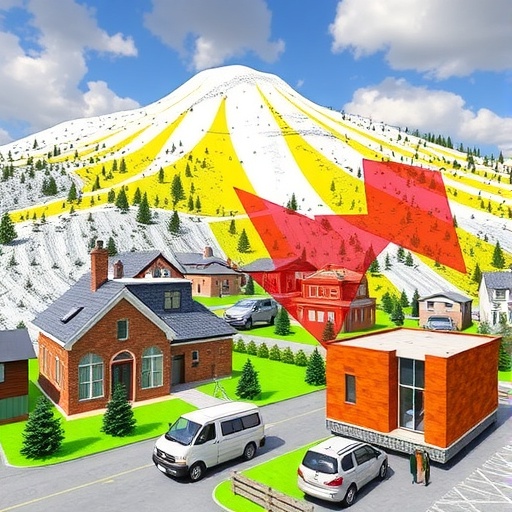
In the face of increasingly frequent and devastating geohazards, including landslides, rockfalls, and floods, mountain communities remain among the most vulnerable populations worldwide. The recent research breakthrough by Zhou, Wang, Peng, and colleagues presents an innovative framework aimed at radically transforming evacuation strategies tailored specifically for these fragmented and high-risk terrains. Their interdisciplinary approach combines cutting-edge simulation technologies with real-time data analysis to minimize risk and safeguard lives in the precarious environments nestled within mountainous regions.
Mountainous regions present unique challenges when designing evacuation protocols. Steep slopes, limited infrastructure, and dispersed populations complicate timely and efficient evacuations. Conventional risk mitigation strategies often fall short due to the complex interplay between natural hazards and human mobility in these areas. Recognizing these challenges, the research team developed a hybrid simulation framework that integrates agent-based modeling, geographic information systems (GIS), and dynamic risk assessment to optimize evacuation routes and timing according to evolving hazard scenarios.
At the heart of this study lies the hybrid modeling approach, which synthesizes both macroscopic and microscopic perspectives on evacuation dynamics. Agent-based models simulate individual behavior and decision-making under stress, capturing variability and localized responses that aggregate to community-wide evacuation patterns. Simultaneously, GIS data layers enrich the model with detailed topographic, infrastructural, and hazard exposure information, ensuring that the simulation is deeply contextualized within the physical reality of mountain landscapes.
One of the innovative aspects of the framework is its real-time decision-support capability. By continuously integrating sensor data, weather forecasts, and hazard monitoring input, the system generates dynamic risk maps that update evacuation advisories based on shifting conditions. This capacity to adapt on the fly challenges traditional static evacuation plans that may become obsolete as hazards evolve, thereby offering a more resilient and responsive strategy to protect at-risk populations.
Crucially, the model accounts for the heterogeneity of mountain communities. Diverse demographic characteristics—ranging from elderly individuals to children and people with mobility impairments—are explicitly incorporated into simulations. This ensures evacuation strategies prioritize vulnerable groups appropriately and do not assume uniform mobility or risk perception. Their framework deliberately models the social dimension of disasters, recognizing that behavioral patterns critically influence evacuation outcomes.
The research further identifies critical bottlenecks in existing evacuation infrastructure, such as narrow mountain roads or limited crossing points, where evacuation delays can cause catastrophic consequences. The simulation outputs help planners visualize congestion points and explore alternative routing, staggered evacuation timings, and resource allocation to optimize throughput. This level of granular, scenario-based planning offers an unprecedented tool for authorities tasked with disaster preparedness in mountainous zones.
Validation of the hybrid model was conducted through case studies in several mountain communities prone to landslides and flash floods. By comparing simulated evacuation times and outcomes with historical evacuation data, the researchers demonstrated improved accuracy and efficacy in emergency responses. The simulations not only predicted evacuation challenges but also proposed proactive adaptations to community layouts and infrastructure placements to further reduce evacuation times.
The potential societal impact of this research is profound. As climate change intensifies extreme weather events, mountainous regions are expected to face rising incidences of triggering events for geohazards. This framework equips local governments with a predictive and adaptive model to preempt disaster consequences rather than solely reacting post-event. Its integration into existing disaster management workflows can enhance the speed, safety, and equity of mountain community evacuations.
Furthermore, the hybrid simulation framework advances the scientific understanding of the interaction between geophysical hazards and human mobility. By bridging natural science and social science disciplines, it exemplifies the future of risk science where interdisciplinary synthesis drives innovation. The model’s modular design also facilitates integration with other hazard types, potentially expanding its applicability beyond mountain communities alone.
Technologically, this study exemplifies the convergence of simulation science, big data analytics, and geospatial technologies into a highly practical tool. The use of high-resolution terrain data and machine learning algorithms to predict hazard progression patterns underscores how artificial intelligence can be harnessed to solve real-world disaster problems. Moreover, this approach underscores the importance of decentralizing disaster information systems, allowing local actors to make timely, data-informed decisions reflecting their unique realities.
Community engagement emerged as an essential dimension during application phases. The researchers emphasize the inclusion of local knowledge and participatory methods to refine evacuation strategies. Empowering residents with understanding and input into evacuation planning cultivates trust and increases compliance during actual emergencies. This people-centered design principle enhances the framework’s real-world adoption potential and sustainability.
From a policy perspective, the framework could influence how resources are allocated for disaster risk reduction in mountainous terrain. Identifying key infrastructure weaknesses and vulnerable populations enables more targeted investment in evacuee transportation options, emergency shelters, and communication networks. Ultimately, this could transform mountain disaster resilience from a reactive, crisis-driven approach to a proactive, prevention-oriented paradigm.
The study’s implications extend to other geohazard-prone settings globally, including volcanic regions, earthquake-prone hillsides, and coastal cliffs. Adaptations of the hybrid framework could provide a universal platform for multi-hazard evacuation decision-making where terrain complexity and community diversity converge to complicate standard protocols. Its adaptability asserts the framework’s potential as a cornerstone technology underpinning future disaster risk resilience strategies.
In sum, the research by Zhou and colleagues represents a milestone in disaster risk reduction, promising to save lives by intelligently navigating the complex intersection of natural hazards and human behavior in mountain environments. It is a call to the scientific community, policymakers, and emergency planners to embrace an innovative, integrative methodology that is both technologically advanced and socially conscious.
As climate-driven disasters escalate and mountainous communities continue to grow, adopting such hybrid simulation frameworks could become not just beneficial but essential. The ability to dynamically simulate, predict, and adapt evacuation strategies stands to revolutionize disaster preparedness and response. This research not only advances academic frontiers but delivers practical, life-saving tools that can transform how we confront and survive geohazard threats.
In a world where disasters seem increasingly unpredictable, the fusion of simulation science, community engagement, and adaptive planning as proposed by this framework shines as a beacon of hope. It challenges the inertia of conventional evacuation models and offers a scalable, sophisticated solution to one of the most pressing problems facing vulnerable mountain populations today.
Cite Scienmag News
Denise Maddox. (September 30, 2025). Hybrid Simulation Enhances Mountain Community Evacuation Plans. Scienmag. https://scienmag.com/hybrid-simulation-enhances-mountain-community-evacuation-plans/
Denise Maddox. "Hybrid Simulation Enhances Mountain Community Evacuation Plans." Scienmag, 30 September 2025, https://scienmag.com/hybrid-simulation-enhances-mountain-community-evacuation-plans/. Accessed 4 September 2026.
Denise Maddox. "Hybrid Simulation Enhances Mountain Community Evacuation Plans." Scienmag. September 30, 2025. https://scienmag.com/hybrid-simulation-enhances-mountain-community-evacuation-plans/


