


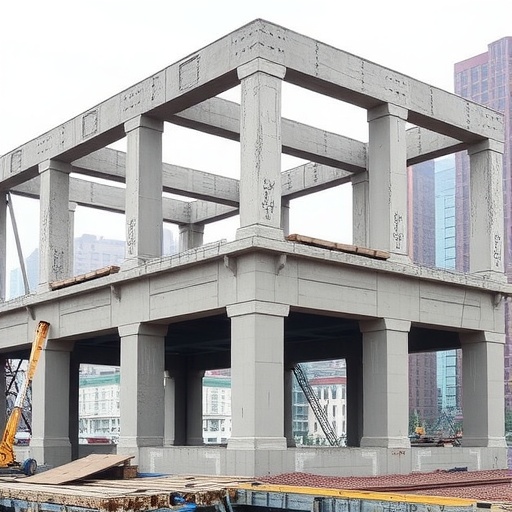
Earthquake-resistant buildings may soon gain a new layer of protection from an unusual alliance of materials operating across three different length scales. A study published in the Bulletin of Earthquake Engineering reports that concrete reinforced with carbon nanotubes, polyvinyl alcohol fibers and steel fibers can substantially improve key mechanical properties while reducing the probability of severe damage or collapse in a modeled six-story building. The material, known as multi-scale hybrid fiber-reinforced concrete, or HFRC, is designed to control cracking from the nanoscale to the scale of visible structural fractures. Its reported performance suggests that carefully engineered concrete could help buildings remain safer during rare, high-intensity earthquakes, although the results come from laboratory tests and numerical simulations rather than a full-scale building shaken to failure.
The research team, led by Jiao Huang of Chang’an University in China, combined three reinforcements that perform different jobs inside the cement matrix. Carbon nanotubes are extremely small cylindrical structures made of carbon atoms. Dispersed through cement paste, they can influence the material’s microscopic structure and help limit the initiation and growth of tiny cracks. Polyvinyl alcohol, or PVA, fibers are larger synthetic strands that bridge developing cracks and allow the surrounding cementitious material to deform without breaking suddenly. Steel fibers, larger and stiffer still, provide resistance after major cracks have formed and help carry tensile forces across damaged regions. The concept resembles a chain of defenses: nanotubes act early, polymer fibers stabilize distributed cracking, and steel fibers contribute strongly once damage becomes visible and substantial.
This architecture addresses a fundamental weakness of ordinary concrete. Concrete is highly effective under compression, meaning it can withstand forces that squeeze it, but it is comparatively brittle under tension, when forces pull it apart. Earthquakes subject frames to rapidly reversing combinations of compression, tension, bending and shear. As a result, cracks can form in beams, columns and joints, then widen as the structure sways repeatedly. Conventional reinforcing steel can provide ductility at the structural scale, but the concrete surrounding the bars may still deteriorate, spall or lose its load-bearing ability. Fibers distributed throughout the concrete can restrain cracks more uniformly than reinforcement concentrated in individual bars, potentially preserving stiffness and energy-dissipation capacity during cyclic loading.
In material testing, the proposed HFRC showed marked gains over conventional concrete. Its compressive strength increased by 31.3 percent, while splitting tensile strength rose by 100.3 percent and flexural strength improved by 34.8 percent. Splitting tensile tests indirectly measure the resistance of concrete to tension by applying compression along the length of a cylindrical specimen until it splits. Flexural strength measures how well a beam-like specimen resists bending. The particularly large improvement in splitting tensile strength is important for earthquake engineering because tensile cracking is one of the first mechanisms through which concrete elements begin to lose integrity. The reported results indicate that the combined fibers did more than simply add strength; they altered how cracks developed and how the material continued carrying load after cracking.
To translate those material properties into building-scale predictions, the researchers developed a modified compressive constitutive model. A constitutive model is a mathematical description of how a material responds to stress and strain. For concrete, the curve typically rises to a peak stress and then descends as crushing and internal damage accumulate. The descending, or post-peak, branch is especially important in seismic simulations because it governs how much deformation a damaged element can sustain before losing its capacity. The new model incorporates characteristic parameters associated with the different fiber scales, allowing the numerical representation to capture both the pre-peak response and the post-peak behavior of the hybrid composite. Without such a model, a simulation could treat the strengthened concrete as merely stronger while missing the way fibers change its ductility and failure progression.
The team then implemented the material model in OpenSees, an open-source platform widely used for nonlinear structural analysis. They created a numerical model of a six-story reinforced-concrete frame and subjected it to nonlinear time-history analysis using 30 ground-motion records. In this type of analysis, the equations governing the building’s motion are solved as the earthquake acceleration changes with time. The model tracks how beams, columns and other components respond beyond their elastic limits, including stiffness degradation, energy dissipation and residual deformation. The researchers also performed incremental dynamic analysis, or IDA, in which each ground motion is repeatedly scaled to increasing intensity. This produces a relationship between earthquake intensity and structural demand, helping researchers estimate the point at which a building moves from minor damage toward serious damage or collapse.
The results contained a potentially counterintuitive finding. Across three investigated intensity levels, the HFRC frame had mean roof displacements 5.8 to 8.9 percent larger than those of the conventional reinforced-concrete frame. Its mean maximum inter-story drift ratios were also 4.7 to 8.1 percent larger. Roof displacement is the horizontal movement of the building’s top relative to its base, while inter-story drift ratio measures the relative horizontal displacement between two adjacent floors divided by their story height. Drift is a central earthquake-performance indicator because excessive movement can damage columns, beams, walls, partitions and building contents. The larger average movements in the HFRC model do not necessarily indicate poorer performance. A more ductile structure may undergo greater controlled deformation while sustaining less irreversible damage, whereas a stiffer structure can move less but experience more concentrated and brittle failure.
That distinction became clear under a representative critical record at the rare-earthquake level, defined in the study by a peak ground acceleration of 0.4 times gravitational acceleration. Under this record, the maximum inter-story drift ratio fell from 3.70 percent in the conventional reinforced-concrete frame to 3.22 percent in the HFRC frame, a reduction of 13.0 percent. The result suggests that the hybrid material can redistribute damage and limit the most severe local deformation under a demanding earthquake, even if average responses across a collection of records sometimes show larger movement. In practical terms, the fibers may allow structural members to bend and crack while maintaining a more stable load path, preventing the abrupt deterioration that can occur when ordinary concrete crushes or fractures.
Fragility analysis provided another measure of the material’s potential. Seismic fragility curves express the probability that a structure will exceed a specified damage state as a function of earthquake intensity. The study considered several limit states, culminating in an ultimate state labeled LS5. At a spectral acceleration of 1.6 g measured at the building’s fundamental period and referenced to 5 percent damping, the conventional RC frame had an LS5 exceedance probability 16.4 percentage points higher than the HFRC frame. Spectral acceleration is an intensity measure related to the acceleration demand that an earthquake imposes on a structure with a particular natural vibration period. By comparing exceedance probabilities rather than a single displacement value, fragility analysis accounts for the uncertain nature of ground motions and the variability of structural response. The lower probabilities for the HFRC frame at severe damage and collapse states indicate a potentially wider safety margin under strong shaking.
The researchers also identified a stable relationship between roof drift ratio and inter-story drift ratio, with a ratio ranging from 1.4 to 1.5. This correlation could support simplified performance assessments in which roof movement is used to estimate the more localized story-to-story deformation that often controls damage. Such a shortcut would not replace detailed nonlinear analysis for important buildings, but it could make preliminary evaluations faster and more accessible, particularly when engineers must screen many structures after an earthquake or compare retrofit options during design. The finding is also significant because it links a readily measured global response to a local damage indicator, helping translate sophisticated simulation results into quantities that engineers and emergency planners can interpret.
The study has important limitations before the material can be considered a proven construction solution. The structural conclusions rely on a computational six-story frame and 30 selected ground-motion records, not on a full-scale HFRC building exposed to repeated real earthquakes. Performance could depend on fiber dispersion, mixing procedures, curing conditions, construction quality and the behavior of connections between beams and columns. Carbon nanotubes can be difficult to distribute uniformly, and the economic and environmental costs of combining three reinforcement types remain to be established. The authors report that all data and models supporting the findings are available from the corresponding author upon reasonable request, creating an opportunity for independent validation. For now, the results point toward a promising strategy rather than a finished building code: engineer the concrete at multiple scales, allow it to deform without catastrophic loss of capacity, and use probabilistic analysis to determine whether that microscopic intervention meaningfully reduces earthquake risk at the scale of entire buildings.
Cite Scienmag News
Violet Maxwell. (August 29, 2026). Hybrid Fiber-Reinforced Concrete Frames’ Earthquake Vulnerability Assessed Across Scales. Scienmag. https://scienmag.com/hybrid-fiber-reinforced-concrete-frames-earthquake-vulnerability-assessed-across-scales/
Violet Maxwell. "Hybrid Fiber-Reinforced Concrete Frames’ Earthquake Vulnerability Assessed Across Scales." Scienmag, 29 August 2026, https://scienmag.com/hybrid-fiber-reinforced-concrete-frames-earthquake-vulnerability-assessed-across-scales/. Accessed 3 September 2026.
Violet Maxwell. "Hybrid Fiber-Reinforced Concrete Frames’ Earthquake Vulnerability Assessed Across Scales." Scienmag. August 29, 2026. https://scienmag.com/hybrid-fiber-reinforced-concrete-frames-earthquake-vulnerability-assessed-across-scales/


