

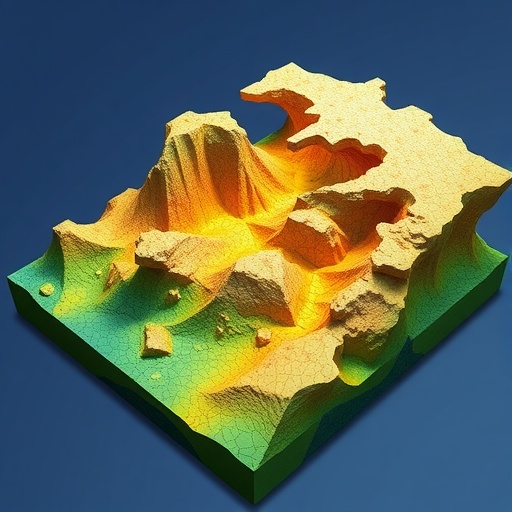
In recent years, the exploration and identification of mineral deposits have seen significant technological advancements, notably with the integration of artificial intelligence and deep learning techniques. A groundbreaking study, led by researchers Li, Zhao, and Yuan, introduces a novel approach that combines three-dimensional Graph Convolutional Networks (GCN) and Convolutional Neural Networks (CNN) to enhance the mineral prospectivity modeling specifically for porphyry and skarn-type mineralization. This innovative hybrid model promises to transform the mineral exploration landscape, providing new avenues for efficient resource management and sustainable mining practices.
The methodology’s core lies in its ability to leverage the unique strengths of both Graph Convolutional Networks and Convolutional Neural Networks. GCNs excel in processing graph-structured data, which is prevalent in geological information, while CNNs are adept at handling spatial data such as imagery and grid-based datasets. By integrating these two methodologies, the researchers have developed a hybrid model that can provide enhanced predictions regarding mineral potential in three-dimensional space, a considerable advancement over conventional two-dimensional models.
Porphyry and skarn-type mineralization are among the most significant sources of various metals, including copper, gold, and molybdenum. However, their geological complexities often pose challenges to traditional exploration methodologies. The integration of the GCN-CNN model into mineral prospectivity mapping allows for more sophisticated analyses, enabling geoscientists to identify areas with greater likelihood of mineral deposits. This is achieved through a more accurate understanding of spatial relationships and geological features that dictate mineralization.
In their research, the team employed a comprehensive dataset that encompassed geological, geochemical, and geophysical attributes collected from multiple existing mining sites. By processing this extensive dataset using their hybrid model, they were able to generate predictive maps that delineate zones of high mineral potential. This capability could lead to a reduction in exploration costs and time, allowing mining companies to focus their efforts on the most promising sites.
Moreover, the model’s applications extend beyond simple prospectivity mapping; it could also assist in delineating the shapes and boundaries of mineral deposits that are typically unobserved through traditional methods. The use of three-dimensional modeling offers a substantial advantage as it closely mirrors the subsurface complexities, presenting a more realistic approximation of mineral distributions.
The research findings underscore the potential of GCN-CNN frameworks in mining. By improving the accuracy of mineral resource modeling, this technology could not only lead to increased productivity in mineral exploration but also encourage more responsible mining practices. With enhanced predictive capabilities, companies may contribute to sustainable initiatives by minimizing unnecessary drilling and excavation in low-potential areas.
Furthermore, the study places significant emphasis on the role of continuous learning and adaptation in AI-driven models. The GCN-CNN hybrid model is structured to evolve over time, incorporating new geological data as it becomes available. This feature ensures that the model remains relevant in changing geological conditions and continues to offer valuable insights into mineral exploration.
In addition to practical mining applications, the implications of this research extend into academic fields and environmental considerations. By utilizing advanced algorithms to visualize mineral potential, researchers can play a crucial role in informing policy decisions regarding resource extraction and land use. Efficient prospecting that minimizes environmental degradation aligns with global sustainability goals, making these technological innovations not only beneficial for mining companies but also for society as a whole.
The significant strides in AI and machine learning hold the promise of transforming various industries, and mineral exploration is no exception. Moreover, as the global demand for minerals continues to rise, propelled by advancements in technology and renewable energy sources, there is an urgent need for more effective exploration methodologies. The GCN-CNN hybrid model stands out as a promising solution to this pressing need, bridging the gap between traditional mining practices and modern computational techniques.
Li, Zhao, and Yuan’s research offers a glimpse into the future of mineral exploration, characterized by enhanced predictive accuracy and efficiency. Their pioneering work in developing the 3D GCN-CNN hybrid model not only sets a new benchmark for geo-informatics but also encourages further exploration into the capabilities of machine learning in geological sciences.
As the mining industry seeks to adapt to rising environmental and social challenges, embracing innovative technologies like the GCN-CNN hybrid model may become essential. This research not only highlights the potential for improved discovery rates but also emphasizes the necessity of responsible and sustainable resource management practices in an era where environmental considerations are at the forefront.
In summary, this study embodies a significant leap forward in mineral prospectivity modeling and emphasizes the burgeoning intersection of artificial intelligence and geoscience. With the GCN-CNN hybrid model, the future of mineral exploration looks promising, offering exciting opportunities for both the mining sector and environmental stewardship.
Following this cutting-edge research, stakeholders in the industry are urged to stay abreast of ongoing advancements. By doing so, they can ensure they remain competitive in a landscape that is increasingly reliant on technological innovations for success and sustainability.
Subject of Research: Mineral Prospectivity Modeling for Porphyry and Skarn Mineralization
Article Title: 3D GCN–CNN Hybrid Model for 3D Mineral Prospectivity Modeling of Porphyry- and Skarn-Type Mineralization
Article References:
Li, X., Zhao, C., Yuan, F. et al. 3D GCN–CNN Hybrid Model for 3D Mineral Prospectivity Modeling of Porphyry- and Skarn-Type Mineralization.
Nat Resour Res (2025). https://doi.org/10.1007/s11053-025-10593-9
Image Credits: AI Generated
DOI: https://doi.org/10.1007/s11053-025-10593-9
Keywords: GCN, CNN, mineral prospectivity, porphyry, skarn, hybrid model, artificial intelligence, machine learning, sustainable mining, exploration techniques.


