


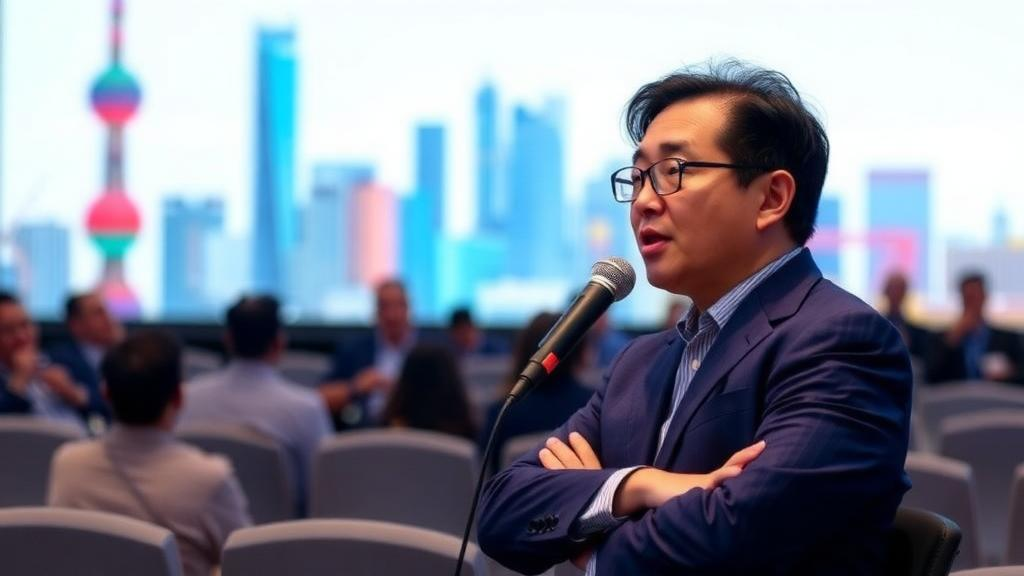
Artificial intelligence may be the most powerful optimisation engine humanity has ever built, but according to Professor Jay Siegel, Vice-President and Pro-Vice-Chancellor (Teaching and Learning) at the University of Hong Kong, the technology will only deliver lasting value if society keeps human beings at the centre of the economic transformation it is unleashing. Speaking on 10 September at the 2026 Inclusion Conference on the Bund in Shanghai, Siegel delivered an address that ranged from the philosophy of knowledge to the environmental history of industrial chemistry, arguing that the rapid rise of AI demands the same kind of long-term societal foresight that earlier technological revolutions were denied. His message was pointed: productivity alone is not accomplishment, and national wealth alone is not social welfare.
This year’s conference, held under the theme “Building the AI Economy Together”, brought together technology companies, industry leaders and start-ups from around the world to debate the future of artificial intelligence. Against the backdrop of one of Shanghai’s most iconic waterfront districts, the gathering served as a stage for competing visions of how AI should be governed, commercialised and integrated into daily life. Siegel’s contribution stood out for its insistence that the most important questions are not technical but civilisational, and that the answers must be worked out before the technology’s consequences become irreversible rather than after.
Siegel framed Hong Kong’s role in this transformation through both geography and history. “Hong Kong has long had command over the gateway between the East and the West, and has long been a centre for trade, culture, and various aspects of society,” he told the audience. “For 115 years, HKU has been the university for Asia. Moving forward within the ‘One Country, Two Systems’ framework, we need to recognise the importance of Hong Kong and Hong Kong’s inclusion in these greater endeavours. We are very happy to be here and to hold that responsibility.” The remarks positioned the university, and the city it serves, as a natural bridge for the cross-border dialogue that an AI-driven economy will require.
At the heart of the address was a conceptual argument that Siegel urged the audience to take seriously: the distinction between knowledge and wisdom. Artificial intelligence systems, he acknowledged, possess extraordinary capabilities in optimisation, pattern recognition and productivity enhancement. Yet, he argued, these capabilities should not be confused with the deeper human faculties that decide what is worth optimising in the first place. Human wisdom, in his framing, far transcends the sheer volume of data that can be stored in a mind, whether biological or silicon-based. A system that can process more information than any person is not therefore capable of the judgement, values and sense of purpose that give knowledge its meaning.
Siegel extended the same logic to a pair of related distinctions that he suggested should anchor policy debates in the AI era: the difference between productivity and accomplishment, and the difference between national wealth and social welfare. Economies can become vastly more productive without their citizens becoming more fulfilled, and nations can accumulate wealth without translating it into wellbeing for their populations. True human fulfilment, he argued, relies on recognising these critical differences. The implication for the AI economy is direct: metrics that celebrate output gains and capital accumulation are insufficient measures of success if they come at the cost of human dignity, agency and social cohesion.
To make the stakes concrete, Siegel drew on a source that might seem unexpected at a technology conference: the history of chemistry. He noted that humanity excels at calculating the immediate production costs of new technologies but consistently fails to foresee their “negative externalities”, the hidden costs imposed on society and the environment that only become apparent decades later. His first example was chlorine, a chemical that revolutionised sanitation and made dense urbanisation possible, transforming public health in the world’s growing cities, before its carcinogenic risks were fully understood. The very compound that helped build modern urban life carried dangers that early adopters could not have priced into their decisions.
His second example was petroleum, the fuel that powered the Industrial Revolution and enabled a century of unprecedented economic growth, but which ultimately led to modern climate change. Siegel emphasised that because the long-term risk-mitigation costs of fossil fuels were never factored into early economic models, addressing their environmental consequences today has become exceptionally difficult. The lesson is not that these technologies should have been rejected, but that the absence of foresight created costs so large and so deferred that no generation since has been able to escape them. The bill for unpriced externalities, in other words, always comes due, and it compounds.
Applying this historical lesson to the digital age, Siegel argued that society now faces a comparable inflection point with artificial intelligence and automation. If automation risks de-humanising the workforce and diminishing human fulfilment, he said, then society must proactively address these tough questions and incorporate the potential societal costs into today’s technology implementation models. The alternative is to repeat the pattern of the industrial era: embrace a transformative technology for its immediate benefits, discover its social costs only in retrospect, and then spend generations and enormous resources attempting to mitigate damage that wiser planning could have reduced or avoided. Building the cost of human wellbeing into deployment models from the start, rather than treating it as an afterthought, is the practical meaning of a human-centric AI economy.
Siegel concluded his address with a call to action aimed directly at the speakers and attendees gathered on the Bund. He urged them to engage in the difficult but necessary dialogues that will shape a brighter, self-empowered future, framing those conversations not as an obstacle to innovation but as its essential companion. For a conference dedicated to building the AI economy together, the message served as both a challenge and an invitation: the technology’s trajectory is still being decided, and the window for embedding human values into its economic architecture is open now. Whether the AI revolution learns from the cautionary tales of chlorine and petroleum, or repeats them at greater speed and scale, will depend on whether the industry, governments and universities choose to have those conversations before the externalities arrive.
Subject of Research: Human-centric approaches to the artificial intelligence economy and the long-term societal impacts of automation
Article Title: HKU vice-president professor Jay Siegel calls for human-centric AI economy at the 2026 Inclusion Conference on the Bund in Shanghai
Article References: HKU vice-president professor Jay Siegel calls for human-centric AI economy at the 2026 Inclusion Conference on the Bund in Shanghai. (n.d.). Original publication
Image Credits: AI Generated
DOI: Not provided
Keywords: artificial intelligence, AI economy, Jay Siegel, University of Hong Kong, Inclusion Conference, Shanghai, human-centric AI, automation, negative externalities, technology policy, workforce, climate change
Cite Scienmag News
Courtney Benton. (October 3, 2026). Human-Centric AI Economy Urged by HKU Leader at Shanghai Inclusion Conference. Scienmag. https://scienmag.com/human-centric-ai-economy-urged-by-hku-leader-at-shanghai-inclusion-conference/
Courtney Benton. "Human-Centric AI Economy Urged by HKU Leader at Shanghai Inclusion Conference." Scienmag, 3 October 2026, https://scienmag.com/human-centric-ai-economy-urged-by-hku-leader-at-shanghai-inclusion-conference/. Accessed 4 October 2026.
Courtney Benton. "Human-Centric AI Economy Urged by HKU Leader at Shanghai Inclusion Conference." Scienmag. October 3, 2026. https://scienmag.com/human-centric-ai-economy-urged-by-hku-leader-at-shanghai-inclusion-conference/


