

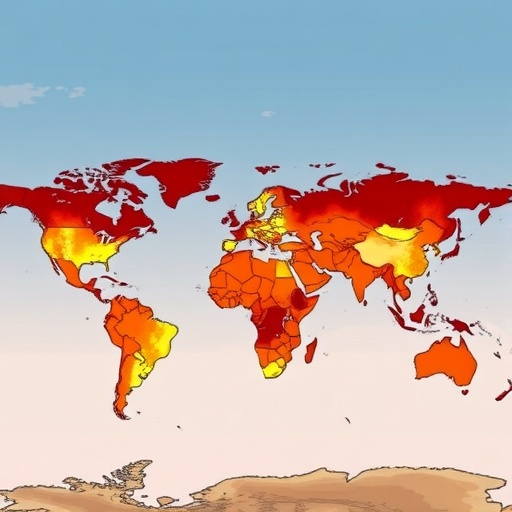
In recent decades, the global community has witnessed an unmistakable increase in average surface temperatures, a direct consequence of anthropogenic climate change. As greenhouse gas emissions continue unabated, the planet is facing not only higher overall temperatures but also unprecedented levels of heat stress. Heat stress refers to the physiological strain on humans caused by excessive heat load, which can lead to detrimental health outcomes, reduced labor productivity, and amplified energy demand. A groundbreaking study published in Nature Communications by Peng, Wang, Yang, and colleagues in 2026 offers a comprehensive analysis of how anthropogenic climate changes are driving rising global heat stress while illuminating the stark inequalities present in its spatial distribution.
At the core of this research lies the integration of complex climate models with epidemiological and physiological data, enabling a nuanced evaluation of future heat stress scenarios under current greenhouse gas emission trajectories. The authors employed multiple climate model outputs under different Representative Concentration Pathways (RCPs) to project thermal conditions across the globe throughout the 21st century. By framing heat stress in terms of Wet Bulb Globe Temperature (WBGT), an index combining temperature, humidity, wind speed, and solar radiation, the study taps into a biometeorological metric that closely aligns with human heat tolerance limits. Notably, WBGT thresholds correlate with heat strain responses, making the projections highly relevant for public health, occupational safety, and urban planning.
One of the most striking conclusions from the study is the rapid escalation in the frequency and intensity of heat stress events in tropical and subtropical regions, where a large fraction of the global population already resides under warm climatic conditions. These regions, including parts of South Asia, Southeast Asia, Africa, and Central America, are identified as heat stress “hotspots” where future climate scenarios predict near-daily occurrences of hazardous WBGT levels during peak summer months. The physiological impacts here are profound, as these conditions surpass the human body’s cooling capability, fast-tracking risks of heat exhaustion, heatstroke, and exacerbated cardiovascular and respiratory diseases.
However, the research also highlights substantial spatial inequalities in heat stress burden. Wealthier northern hemisphere countries, despite warming as well, often possess infrastructure, healthcare capacity, and adaptive resources such as air conditioning to mitigate heat impacts. In contrast, lower-income regions disproportionately suffer from the dual insults of increasing heat exposure and limited adaptive capacity. This disparity is likely to widen existing social and economic inequities, compounding vulnerabilities particularly among outdoor workers, elderly populations, and those with preexisting health conditions. Moreover, rural communities lacking access to reliable cooling sources are especially at risk, underscoring the intersectionality of climate change with socioeconomic status.
The methodology underpinning these findings involves downscaling global climate model outputs to fine spatial resolutions while integrating demographic and labor statistics. This granularity allows for identifying populations that face heightened occupational heat stress due to outdoor work in agriculture, construction, and informal sectors. The study estimates that heat exposure during working hours will diminish labor capacity by as much as 30–40% by the latter half of the century in certain tropical zones under high-emission scenarios. Such reductions in productivity not only threaten food security but can also impede economic growth trajectories in vulnerable regions.
From a physiological perspective, the paper delves into thermoregulation mechanisms that become compromised under extreme heat. Human body heat dissipation is heavily reliant on sweating and convective cooling; however, when humidity rises alongside temperature, evaporative cooling efficacy declines sharply. The resultant hyperthermia triggers a cascade of pathophysiological responses, including cardiovascular strain and inflammatory responses, which the researchers explain in detail. These processes paint a clearer picture of why heat stress translates into increased morbidity and mortality, particularly among susceptible individuals.
The implications for public health policy are profound. The research underscores the urgency of integrating heat stress projections into disaster risk reduction strategies and healthcare planning. Developing heat early warning systems, improving urban design to reduce heat island effects, and enhancing community awareness emerge as critical components to mitigate heat-related health burdens. Furthermore, the study emphasizes the need for international climate justice, advocating for global cooperation to assist vulnerable nations in building adaptive capacity and resilience.
Equally important is the call for urgent greenhouse gas emission reductions. The scenarios modeled illustrate a stark contrast between outcomes under high emission pathways versus aggressive mitigation efforts. Under a more optimistic trajectory aligned with the Paris Agreement targets, the increase in hazardous heat stress days is substantially curtailed, preserving labor productivity and protecting vulnerable communities. This evidence bolsters arguments for rapidly transforming energy systems, curbing carbon emissions, and adopting sustainable development models that prioritize health and equity.
The study also ventures into the potential of technological and behavioral adaptation strategies. Personal cooling devices, community cooling centers, shifts in working hours to cooler parts of the day, and improvements in building ventilation are explored as immediate measures that can alleviate heat stress impacts. However, the authors caution that such adaptations have limits and must be coupled with systemic climatic changes to be truly effective.
In an urban context, the paper explores how rapidly expanding cities in the global south face compounded challenges, as urban heat islands exacerbate ambient temperatures beyond regional climate projections. Increasing vegetation cover, reflective building materials, and sustainable urban planning are proposed as mitigation approaches to buffer heat exposure in burgeoning metropolitan areas.
From a scientific standpoint, this study represents a significant advancement by interlinking climate projections, physiological responses, socioeconomic data, and health outcomes into a cohesive framework. The use of WBGT as a human-centric metric bridges climate science with public health pragmatism, offering actionable insights for decision makers. The spatial inequality lens further deepens understanding of climate vulnerability patterns and aligns with frameworks for equity-focused adaptation.
The authors note that uncertainties remain, particularly with respect to local-scale climate feedbacks and emergent socio-political dynamics influencing adaptive capacities. Continuous improvements in climate model resolution, incorporation of real-time population data, and interdisciplinary collaboration will be vital for refining projections and designing interventions.
As society grapples with the multifaceted challenges of climate change, this research serves as a clarion call to prioritize heat stress as a critical and measurable impact. The convergence of climate science with human health emphasizes that climate mitigation and adaptation are not abstract goals but necessary steps to avoid escalating human suffering. The spatial inequalities revealed demand that responses be tailored to address the disproportionate risks borne by marginalized populations.
Ultimately, this study affirms that heat stress is more than a mere symptom of warming; it is an urgent challenge that tests social resilience, economic stability, and global equity. As climate change accelerates, the insights from Peng, Wang, Yang, et al. provide a vital knowledge foundation to guide humanity’s response in mitigating the looming heat crisis. Only through integrated scientific understanding and committed policy action can the world hope to safeguard health and livelihoods in a warming future.
Subject of Research:
Anthropogenic climate change and its influence on the rising prevalence and spatial inequality of global heat stress.
Article Title:
Anthropogenic climate change drives rising global heat stress and its spatial inequality.
Article References:
Peng, J., Wang, Q., Yang, Z. et al. Anthropogenic climate change drives rising global heat stress and its spatial inequality. Nat Commun (2026). https://doi.org/10.1038/s41467-026-69164-y
Image Credits:
AI Generated


