


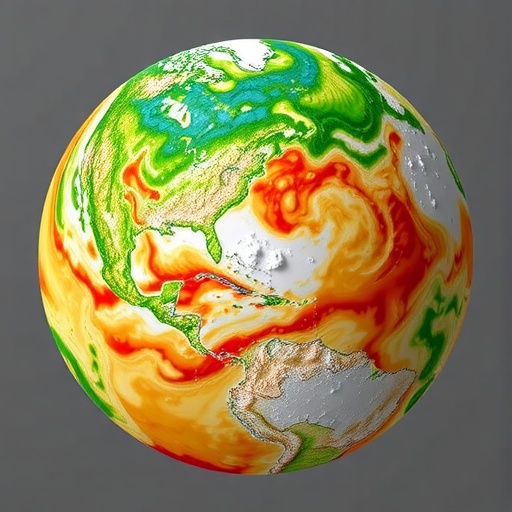
As global temperatures steadily rise, the patterns that determine where and when heatwaves strike are shifting in unexpected ways. A groundbreaking study published in Nature Communications by Feng et al. (2025) reveals a counterintuitive migration of heatwave hotspots toward the equator across multiple continents, fundamentally reshaping our understanding of climate dynamics under anthropogenic influence. This research sheds light not only on the underlying causes driving these changes but also on the profound implications for ecosystems, economies, and vulnerable human populations in tropical regions.
Traditionally, heatwaves have been predominantly associated with mid-latitude regions where seasonal temperature variations create conducive conditions for extreme heat episodes. Such events have been extensively studied in Europe, North America, and parts of Asia, allowing scientists to link their increased frequency and intensity to human-induced climate change. However, the new findings suggest that the evolving spatial distribution of heatwaves is far more complex, revealing a striking equatorward shift in peak heatwave occurrences, driven largely by anthropogenic forcing mechanisms altering atmospheric circulation patterns.
Feng and colleagues employed advanced climate modeling frameworks coupled with comprehensive historical temperature records to detect subtle shifts in heatwave frequencies and locations over the past five decades. Leveraging satellite observations, ground-based weather station data, and state-of-the-art simulations, the researchers meticulously traced the movement of heatwave centers. Their analysis demonstrated a consistent southward and northward migration from traditional mid-latitude hotspots toward regions closer to the equator in both hemispheres, a pattern previously unrecognized in climate science literature.
The drivers of this equatorward migration lie in the complex interplay between global warming-induced changes in sea surface temperatures, atmospheric jet stream dynamics, and localized land-atmosphere interactions. Anthropogenic greenhouse gas emissions have not only heightened average global temperatures but also modulated large-scale circulation systems such as the Hadley cell and subtropical jets. These shifts disrupt the atmospheric stability and moisture transport mechanisms, fostering new conditions favorable for extreme heatwaves developing nearer to the equator where tropical ecosystems reside.
What makes this revelation especially alarming is the vulnerability of equatorial regions to heat stress. Unlike temperate zones, many tropical areas have historically avoided prolonged and severe heatwaves due to more stable thermal conditions moderated by oceanic influences and consistent humidity patterns. A migration of extreme heat events toward these regions implies increased risks of heat-related illnesses, agricultural losses, and ecological disturbances, disproportionately impacting communities with limited adaptive capacities and infrastructure.
Furthermore, the equatorward migration phenomenon challenges existing climate risk assessments and disaster preparedness strategies. Policymakers and urban planners have often focused mitigation and adaptation efforts on regions with historically high vulnerability to heatwaves, mostly in mid-latitudes. This new spatial redistribution calls for a reassessment of resource allocation, early warning systems, and public health initiatives to encompass tropical nations which may now face unprecedented heat-related hazards.
The methodology employed by Feng et al. underscores the importance of integrating multidisciplinary approaches to understand climate extremes. By combining observational records, high-resolution climate simulations, and rigorous statistical techniques, the team was able to isolate anthropogenic influences from natural climate variability. Their work provides robust evidence that this migration pattern is not a transient anomaly but a persistent and escalating consequence of human activities since the industrial era.
Intriguingly, the researchers also highlight region-specific nuances in the migration trend. For instance, South America and Africa exhibit more pronounced equatorward shifts compared to Asia and Australia, likely influenced by regional oceanic currents and land surface characteristics. These granular insights emphasize that while the overarching trend is global, local climate systems and geographical factors mediate the precise outcomes and impacts.
The study further explores the implications of shifting heatwave locations for biodiversity. Tropical ecosystems, already under pressure from habitat loss and climate change, may face additional stress as species adapted to narrower thermal ranges confront new extremes. Coral reefs, rainforests, and agricultural zones in equatorial regions could experience elevated mortality rates, reduced productivity, and altered species interactions, amplifying the cascading effects of climate disruption on global food security and ecosystem resilience.
Moreover, the equatorward migration affects atmospheric chemistry and pollutant behavior in ways that remain insufficiently understood. Heatwaves exacerbate the formation of ground-level ozone, a harmful pollutant linked to respiratory ailments and crop damage. Shifting heatwave centers into densely populated tropical urban areas could potentiate air quality degradation, posing further public health challenges that demand urgent interdisciplinary research and policy attention.
From a technological standpoint, the findings underscore the necessity for upgraded climate monitoring infrastructure in tropical regions. Many equatorial countries lack comprehensive weather observation networks, limiting the precision of heatwave forecasting and risk management. Enhanced data collection, combined with local engagement and capacity building, is essential to prepare vulnerable populations and minimize the social and economic toll of these emerging heat extremes.
The implications for energy systems are also profound. Rising temperatures in equatorial regions increase demand for cooling and strain energy grids, potentially leading to blackouts and heightened greenhouse gas emissions if fossil fuel-based power dominates. Integrating renewable energy solutions and designing climate-resilient infrastructure tailored to this new heatwave distribution must become a global priority to align mitigation and adaptation goals.
Feng et al.’s research exemplifies the advancing frontier of climate science, where nuanced spatial and temporal analyses reveal unexpected patterns critical to human and environmental wellbeing. As heatwaves continue to intensify under global warming, insights into their migratory trajectories will help scientists, governments, and societies better anticipate and respond to future climate challenges.
In conclusion, the equatorward migration of heatwave locations driven by anthropogenic forcing represents a paradigm shift in our understanding of how climate extremes are allocated across the planet. This phenomenon not only complicates risk assessment frameworks but also heightens the urgency for global cooperation in climate mitigation, adaptation, and equitable resilience-building, particularly for populations in tropical regions newly exposed to dangerous heat stress.
This study serves as a clarion call for the international community to reconsider climate vulnerability through a lens that accounts for shifting hazard geographies. Only with proactive strategies informed by high-resolution, regionally specific science can we hope to safeguard both people and ecosystems from the evolving scourge of heatwaves in a warming world.
Cite Scienmag News
Violet Maxwell. (September 2, 2025). Human Activity Shifts Heatwaves Toward Equator. Scienmag. https://scienmag.com/human-activity-shifts-heatwaves-toward-equator/
Violet Maxwell. "Human Activity Shifts Heatwaves Toward Equator." Scienmag, 2 September 2025, https://scienmag.com/human-activity-shifts-heatwaves-toward-equator/. Accessed 3 September 2026.
Violet Maxwell. "Human Activity Shifts Heatwaves Toward Equator." Scienmag. September 2, 2025. https://scienmag.com/human-activity-shifts-heatwaves-toward-equator/


