


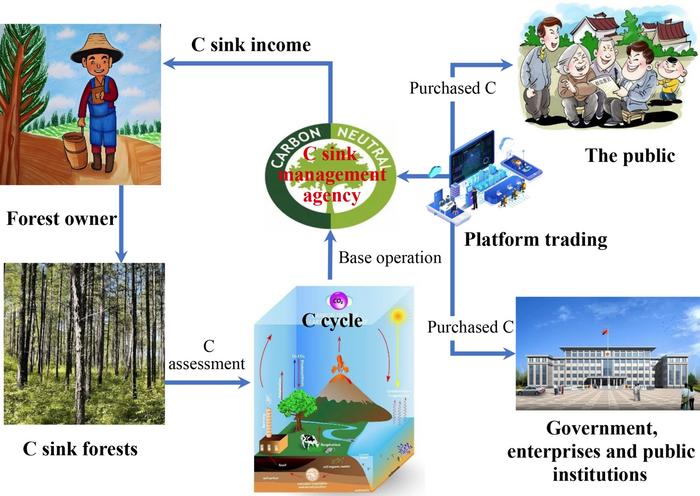
Since the first industrial revolution, the rapid development of the human economy and society has directly exacerbated the process of CO2 emission from human activities such as fossil fuel combustion, industrial processes, agriculture, and land use activities. With the continuous increase of global greenhouse gas concentration dominated by CO2, the greenhouse effect is becoming more and more obvious, and the trend of global warming is becoming more and more serious. To cope with the continuous warming of the global climate and mitigate climate change, China, as a responsible country in the world, actively advocates and practices global climate governance, such as the international community’s climate change governance system. After long-term efforts, China has reversed the rapid growth of CO2 emissions. However, at present, China’s CO2 emissions still rank first in the world, and the pressure for substantial emission reduction in the future is huge. Therefore, while vigorously reducing emissions, it is also necessary to use the photosynthesis of forests to sequester CO2, and ultimately offset CO2 emissions and sequestration, that is, carbon neutrality. Since the 1970s, China has launched some major ecological construction projects and carried out afforestation work, making China a country with the largest plantation area in the world. However, due to the lack of comprehensive analysis of the evolution law of carbon sequestration capacity of plantations, carbon sequestration benefits, carbon sequestration, and emission reduction paths and benefits, there is no consensus on the role and realization path of forest carbon sequestration in the process of achieving carbon neutrality targets, and a systematic theoretical system has not yet been formed. The carbon sequestration function of large-scale plantations in China faces some challenges, such as the current distribution status of plantations in China. What is the current contribution of plantations to China’s carbon sequestration? How to enhance the sustainable carbon sequestration capacity of plantations in the future? Solving these problems is crucial for China to cope with global climate change.

Credit: Lei DENG, Haitao HU, Jiwei LI, Xue LI, Chunbo HUANG, Zhijing YU, Hailong ZHANG, Qing QU, Xiaozhen WANG, Lingbo DONG, Zhouping SHANGGUAN
Since the first industrial revolution, the rapid development of the human economy and society has directly exacerbated the process of CO2 emission from human activities such as fossil fuel combustion, industrial processes, agriculture, and land use activities. With the continuous increase of global greenhouse gas concentration dominated by CO2, the greenhouse effect is becoming more and more obvious, and the trend of global warming is becoming more and more serious. To cope with the continuous warming of the global climate and mitigate climate change, China, as a responsible country in the world, actively advocates and practices global climate governance, such as the international community’s climate change governance system. After long-term efforts, China has reversed the rapid growth of CO2 emissions. However, at present, China’s CO2 emissions still rank first in the world, and the pressure for substantial emission reduction in the future is huge. Therefore, while vigorously reducing emissions, it is also necessary to use the photosynthesis of forests to sequester CO2, and ultimately offset CO2 emissions and sequestration, that is, carbon neutrality. Since the 1970s, China has launched some major ecological construction projects and carried out afforestation work, making China a country with the largest plantation area in the world. However, due to the lack of comprehensive analysis of the evolution law of carbon sequestration capacity of plantations, carbon sequestration benefits, carbon sequestration, and emission reduction paths and benefits, there is no consensus on the role and realization path of forest carbon sequestration in the process of achieving carbon neutrality targets, and a systematic theoretical system has not yet been formed. The carbon sequestration function of large-scale plantations in China faces some challenges, such as the current distribution status of plantations in China. What is the current contribution of plantations to China’s carbon sequestration? How to enhance the sustainable carbon sequestration capacity of plantations in the future? Solving these problems is crucial for China to cope with global climate change.
To solve the above problems of carbon sequestration capacity of plantations in China, Zhouping Shangguan, Deng Lei, and their team from Northwest A&F University, based on the summary and analysis of the existing plantation construction, pointed out that China’s plantation area accounted for 32.94% of the national forest area, accounting for 8.31 % of the land area, the national plantation preservation area has achieved steady growth for 40 consecutive years, but the growth rate slowed down this year. The current plantation is dominated by young forests, indicating that the carbon sequestration potential is large in the next few decades. From 1970 to 2000, China’s forest carbon stock increased by 40%. From 2001 to 2010, the forest carbon sequestration rate of the Natural Forest Protection, Grain for Green, Three-North Shelterbelt Forest, China Rapid-Growing and High-Yield Forest Construction, and Beijing-Tianjin Sandstorm Source Control projects accounted for 63.4%–71.2 % of the country, accounting for 25% of the total carbon sequestration of all vegetation restoration projects in the world.
Although in the past, planted forests have sequestered a large amount of CO2 in China, there are some challenges facing China’s planted forests as afforestation continues. It mainly includes: (1) The afforestation space is reduced, and the difficulty of expanding the total amount is increased. (2) The area of cultivated land afforestation is large and faces the risk of reversal; (3) The overall quality is not high and the productivity is low. (4) Wood dependence increased, and the contradiction between supply and demand is prominent; (5) Super-intensity logging is serious. In this regard, the researchers put forward effective countermeasures, mainly to (1) further promote the land greening action and multi-faceted expansion of ecological development space. It is necessary to fully tap the afforestation potential of existing forest land, improve the utilization rate of forest land, continue to promote the construction of key ecological projects, and promote the realization of land greening; (2) strengthen scientific management and improve the quality of plantation resources. To promote the construction of a forest management system, the implementation of forest quality improvement; (3) optimize plantation structure and enhance timber supply capacity. Through intensive management of plantations, existing forest reform and cultivation, tending and replanting and replanting, efforts should be made to reserve and cultivate rare and large-diameter forest resources, gradually reverse the long-term shortage of rare and large-diameter timber in China, and meet the needs of people for high-quality timber for a better life; (4) strengthen supervision, and effectively protect the afforestation results. It is necessary to accelerate the reform of forest harvesting management and improve the forest harvesting management system. At the same time, improve the information level of forest resource monitoring, realize the normalization of resource monitoring and management, and effectively protect the results of afforestation. These countermeasures are based on a full understanding of the dynamic evolution of plantation carbon sequestration, and propose future plantation carbon sequestration paths and benefit improvement solutions, which will promote plantations to better serve China’s carbon neutrality goals.
This study has been published in Frontiers of Agricultural Science and Engineering in 2024, Volume 11, Issue 3. DOI: 10.15302/J-FASE-2023534.
Journal
Frontiers of Agricultural Science and Engineering
Method of Research
Experimental study
Subject of Research
Not applicable
Article Title
Pursuing the goal of carbon neutrality in China: path for realization of carbon sequestration in planted forests
Article Publication Date
15-Sep-2024
Cite Scienmag News
Denise Maddox. (September 4, 2024). How to solve the challenges faced by the carbon sequestration function of Chinese plantations in the future? Scienmag. https://scienmag.com/how-to-solve-the-challenges-faced-by-the-carbon-sequestration-function-of-chinese-plantations-in-the-future/
Denise Maddox. "How to solve the challenges faced by the carbon sequestration function of Chinese plantations in the future?" Scienmag, 4 September 2024, https://scienmag.com/how-to-solve-the-challenges-faced-by-the-carbon-sequestration-function-of-chinese-plantations-in-the-future/. Accessed 3 September 2026.
Denise Maddox. "How to solve the challenges faced by the carbon sequestration function of Chinese plantations in the future?" Scienmag. September 4, 2024. https://scienmag.com/how-to-solve-the-challenges-faced-by-the-carbon-sequestration-function-of-chinese-plantations-in-the-future/

