


Quality is the core characteristic of cultivated land and is crucial for ensuring sustainable resource utilization and national food security. To meet the increasing demand for food driven by rapid population growth and the continual optimization of dietary structures, the intensity of cultivated land utilization has been steadily increasing. This trend has resulted in degradation issues such as deterioration of black soil, thinning of the cultivated land layer, reduction in organic matter content, soil salinization, acidification, and contamination by heavy metals, all of which threaten national food security. Currently, China has entered a critical period of agricultural modernization and ecological civilization construction. It is essential to deeply understand the connotations of cultivated land quality in the context of the new era, assess the current status of cultivated land quality, establish goals for enhancing cultivated land quality, and implement differentiated measures for improving cultivated land quality. These are urgent scientific questions that need to be addressed.

Credit: Wenguang CHEN , Xiangbin KONG , Yubo LIAO
Quality is the core characteristic of cultivated land and is crucial for ensuring sustainable resource utilization and national food security. To meet the increasing demand for food driven by rapid population growth and the continual optimization of dietary structures, the intensity of cultivated land utilization has been steadily increasing. This trend has resulted in degradation issues such as deterioration of black soil, thinning of the cultivated land layer, reduction in organic matter content, soil salinization, acidification, and contamination by heavy metals, all of which threaten national food security. Currently, China has entered a critical period of agricultural modernization and ecological civilization construction. It is essential to deeply understand the connotations of cultivated land quality in the context of the new era, assess the current status of cultivated land quality, establish goals for enhancing cultivated land quality, and implement differentiated measures for improving cultivated land quality. These are urgent scientific questions that need to be addressed.
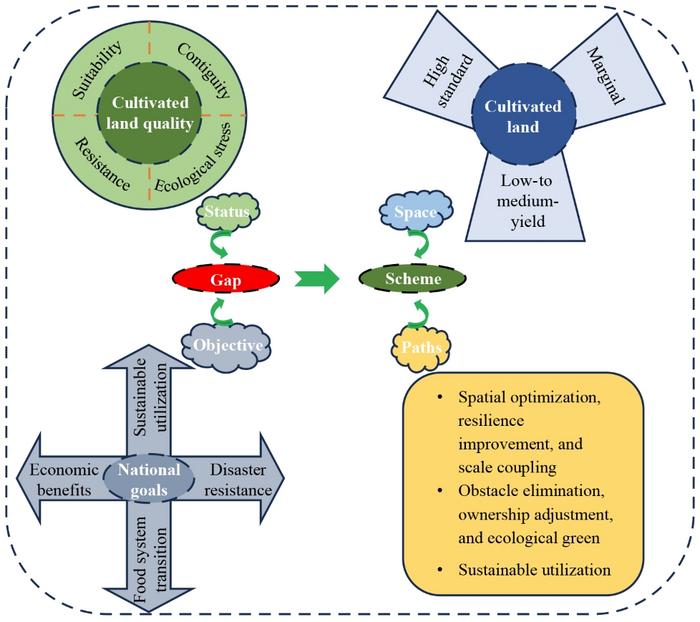
To address the scientific question above, Professor Kong Xiangbin’s team from China Agricultural University provided a systematic and scientific explanation based on theoretical research and field investigations on evaluation of cultivated land quality, sustainable use of cultivated land. The attributes of cultivated land quality can be considered in four dimensions: suitability, contiguity, resilience, and ecological stress. Among these, suitability is the natural productivity of cultivated land determined by climatic conditions, topography, soil physicochemical and biological traits; contiguity is the shape of cultivated land parcels and the degree of concentration and contiguity, and characterizes the ability of cultivated land to satisfy the degree of convenience of human cultivation and the mechanization of agriculture; resilience is mainly determined by the conditions of cultivated land infrastructure, which characterizes the ability of cultivated land to resist external disasters and other perturbations in the production of cultivated land; and ecological stress is the extent to which cultivated land is subjected to soil heavy metal pollution, groundwater overexploitation, and soil erosion, which characterizes the sustainability of environmentally-sustainable production of cultivated land.
The study found that the suitability of cultivated land in China showed a decreasing trend from east to west. Fifty percent of the cultivated land in China was highly suitable cultivated land, mainly occurring in the middle-lower Yangtze Plain, southern and eastern parts of the Huang-Huai-Hai Plain, eastern and northwestern parts of the Northeast China Plain, the Sichuan Basin and surrounding regions. The contiguity of cultivated land in China showed a decreasing trend from northeast to southwest, poor contiguity of cultivated land mainly occurred on the Yunnan-Guizhou Plateau, in southern China, on the Qinghai-Tibet Plateau, and on the south and northwest of the Loess Plateau. Highly resistance cultivated land is mainly distributed in the three major plains, while weakly resistance cultivated land is predominantly found in mountainous and hilly areas in China. The cultivated land with ecological stress of in China widely occurring in various agricultural areas, mostly the Huang-Huai-Hai Plain, the northern arid and semiarid region, the Northeast China Plain, the Loess Plateau and the Sichuan Basin and surrounding areas.
Based on the current situation of cultivated land quality and the strategic needs of national high-quality development, China’s future goals for improving cultivated land quality include four aspects: promoting the sustainable use of resources, improving the economic benefits of farming, coping with extreme meteorological disasters, and meeting the transition of the food system.
Against the backdrop of a volatile international environment and high domestic demand for food, China should guarantee a safe supply of staples, a stable supply of animal feed, and a moderate supply of high-nutrient food. In the future, China should create three major food production spaces: high-standard, low-to medium-yield, and marginal cultivated land. China urgently needs to construct three paths to implement the goal of improving cultivated land quality, namely the development of high-standard cultivated land with the core of spatial optimization, resilience enhancement and scale coupling, the transformation of low- to medium-yield cultivated land with the core of obstacle elimination, tenure adjustment, ecological sustainable, and the conservation development of marginal cultivated land with a focus on sustainable use.
This study summarized the connotations of cultivated land quality under the new era context, analyzed the current status of cultivated land quality, proposed goals for cultivated land quality construction, and constructs a differentiated path for cultivated land quality construction that can achieve synergies among improving cultivated land quality, ensuring national food security, and protecting the ecological environment. This study has been published on the Journal of Frontiers of Agricultural Science and Engineering in 2024, 11(2) DOI: 10.15302/J-FASE-2023523.
Journal
Frontiers of Agricultural Science and Engineering
Method of Research
Experimental study
Subject of Research
Not applicable
Article Title
Exploring differentiated improvement strategies of cultivated land quality in China
Article Publication Date
15-Jun-2024
Cite Scienmag News
Denise Maddox. (July 10, 2024). How to differentially improve the cultivated land quality in China? Scienmag. https://scienmag.com/how-to-differentially-improve-the-cultivated-land-quality-in-china/
Denise Maddox. "How to differentially improve the cultivated land quality in China?" Scienmag, 10 July 2024, https://scienmag.com/how-to-differentially-improve-the-cultivated-land-quality-in-china/. Accessed 4 September 2026.
Denise Maddox. "How to differentially improve the cultivated land quality in China?" Scienmag. July 10, 2024. https://scienmag.com/how-to-differentially-improve-the-cultivated-land-quality-in-china/

