

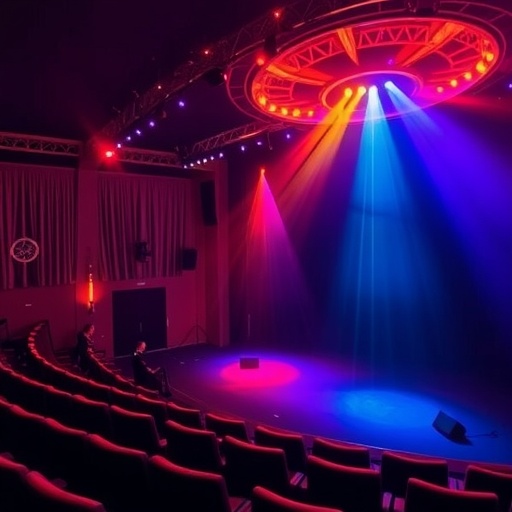
In the realm of live music, the experience extends beyond mere sound; it encompasses a complex interplay of sensory inputs that shape our emotional and cognitive responses. While auditory elements have traditionally dominated the assessment of concert hall quality, emerging research underscores the profound influence of visual factors—particularly color—on how sound is perceived. A ground-breaking study conducted by researchers at the Technical University of Berlin has revealed that the color design of concert halls significantly affects listeners’ auditory impressions, reshaping our understanding of acoustical perception.
Published in The Journal of the Acoustical Society of America, this interdisciplinary investigation transcends conventional acoustics, integrating psychological and sensory analysis through advanced virtual reality techniques. The research team, led by acoustic specialist Stefan Weinzierl, sought to dissect the multifaceted nature of room acoustics perception, highlighting that listeners’ experiences are shaped not only by physical sound properties but also by the visual ambiance. According to Weinzierl, auditory perception of concert halls involves multiple dimensions, including reverberance, loudness, and timbre, the latter often described as the “color” of sound itself.
To probe the hypothesized connection between visual stimuli and sound perception, the researchers designed an innovative experiment simulating concert halls differentiated solely by their color characteristics. Utilizing state-of-the-art virtual reality platforms, they created twelve distinct environments by manipulating hue, brightness, and saturation across red, green, and blue spectrums. This virtual approach circumvented the impracticalities of physically altering architectural spaces while preserving ecological validity via binaural headphone technology, which dynamically adjusted auditory feedback in response to head movements of participants.
The experimental protocol involved exposing participants to four musical performances—two violin and two clarinet pieces—featuring a range of tempos and musical periods. Subjects were then tasked with rating the auditory experience across several parameters: liking, perceived strength, reverberance, and particularly timbre. Intriguingly, the data revealed a strong correlation between the color environment of the concert hall and the perceived timbre of the music, indicating that the “sound color” listeners heard was modulated by the visual color environment surrounding them.
Delving deeper, the researchers observed that more visually saturated colors tended to alter auditory timbre impressions markedly. Cool, saturated hues, especially those in the green and blue ranges, were associated with a “colder” or more metallic auditory timbre, while the red-toned environments evoked warmer timbres. This phenomenon suggests an intricate cognitive cross-modal interaction whereby visual input dynamically shapes auditory interpretation. Moreover, participants expressed a higher degree of enjoyment for performances in darker halls, highlighting how visual ambiance can enhance emotional reception of music.
An important aspect of this study is its contribution to the ongoing discourse on multisensory integration. Traditional acoustic design has emphasized shaping the physical sound characteristics within a space to optimize clarity, loudness, and reverberation profiles. However, Weinzierl and colleagues argue for a paradigm shift, advocating that architectural and interior design elements—including color schemes—should be considered potent contributors to auditory experience. Their findings suggest that what we see can modulate what we hear, extending the notion of acoustics to include sensory context.
Interestingly, unlike timbre, perceived loudness remained impervious to color manipulations, aligning with previous psychological studies that isolated loudness perception as predominantly an auditory phenomenon unaffected by visual environment. This distinction reinforces the idea that different acoustic dimensions are variably susceptible to cross-modal influences, refining theoretical models of sensory processing.
The implications of this research reverberate beyond music listening into architectural practice and auditory science. Concert hall architects and acousticians are encouraged to embrace a holistic design approach that integrates visual aesthetics with physical acoustics. Materials, color choices, lighting, and textural elements can be orchestrated to craft auditory environments that not only perform technically but also evoke intended emotional and perceptual responses from audiences.
From a technical standpoint, this study leverages binaural rendering, an advanced technique that simulates three-dimensional sound environments through headphones, enhancing the realism of the virtual concert halls. This enabled controlled manipulation of both acoustic and visual parameters without compromising authenticity, a methodological advance likely to inspire future research in multisensory auditory perception.
Furthermore, the variance in participants’ responses linked to their prior musical experience reveals the role of listener expertise in sensory integration. Musicians and experienced listeners exhibited more pronounced effects of color on timbre perception and preference, indicating an interaction between cognitive schema and sensory input processing. This nuance underscores the importance of accounting for audience variability in designing performance spaces.
In sum, this study provides compelling evidence that the aesthetic environment of a concert hall wields a tangible influence on listeners’ sound perception, transcending mere auditory mechanics. It catalyzes a reimagining of concert hall design as a multisensory art form, where visual and acoustic domains coalesce to enrich musical experience profoundly. Future investigations might explore other sensory modalities, such as tactile or olfactory cues, further unveiling the complex symphony of human perception in artistic contexts.
Subject of Research: The perceptual influence of concert hall color design on room acoustics and sound timbre.
Article Title: The influence of the color design of auditoriums on room acoustic impression.
News Publication Date: February 24, 2026.
Web References: https://doi.org/10.1121/10.0042275
Image Credits: Drouzas et al.
Keywords
Musical acoustics, acoustics, physics, music, fine arts, sound


