


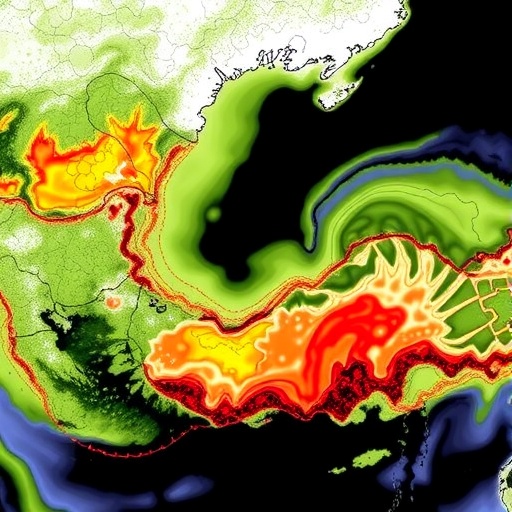
The Bosporus Strait may be doing far more than shuttling water between the Black Sea and the Sea of Marmara. A high-resolution computer simulation suggests that pulses of salty Mediterranean-origin water entering the Black Sea can generate long-lived, lens-shaped structures hidden beneath the surface—features that may help explain some of the basin’s most elusive forms of mesoscale variability. The findings point to a previously underappreciated role for the narrow strait in shaping circulation across the entire Black Sea.
The study, published in Ocean Dynamics, uses a regional version of the NEMO ocean-modelling framework to reproduce water movement in the Black and Marmora seas. The model resolves the two basins on a regular horizontal grid with a spacing of approximately 1.2 kilometres, a scale fine enough to represent many rotating eddies, narrow current bands and frontal features that are blurred in coarser global models. Its purpose was not simply to map currents, but to investigate how the Bosporus exchange influences the wider Black Sea’s three-dimensional circulation.
The Bosporus is a particularly challenging passage for oceanographers because it connects two seas with sharply different physical properties. The Black Sea receives substantial freshwater from rivers and precipitation, making its upper waters comparatively fresh, while the Mediterranean system supplies denser, saltier water through the Sea of Marmara. This contrast produces a strongly stratified water column, with lighter water above and heavier water below. The strait typically supports a two-layer exchange: a surface flow directed toward the Sea of Marmara and a deeper, denser flow moving northward into the Black Sea. The opposing currents can interact with wind, pressure differences, tides, mixing and changes in sea level, producing a highly variable system.
In physical oceanography, the boundary between water layers of different density is often marked by a pycnocline, a zone in which density changes rapidly with depth. The pycnocline can act as a barrier that limits vertical mixing, but it can also become a pathway along which intruding water travels horizontally. When a parcel of dense, salty water enters the Black Sea and becomes trapped beneath the lighter surface layer, it may spread laterally without immediately sinking to the seafloor or mixing away. Such structures are known as intrapycnocline lenses. Their temperature and salinity differ from the surrounding water, allowing them to retain a distinct identity as they move through the basin.
The researchers compared the model’s behaviour with observations from acoustic Doppler current profilers, or ADCPs, collected in different parts of the Bosporus between autumn 2008 and winter 2009. ADCP instruments infer water velocity by measuring the Doppler shift of sound scattered by particles carried in the current. This makes them particularly useful for measuring the speed and direction of layered flows in a narrow strait. According to the study, the simulated transport intensities in the upper and lower layers were consistent with the observations. The model also reproduced observed episodes in which either the upper or lower current became blocked, providing a test of whether its simplified treatment of the strait could capture important real-world dynamics.
That validation matters because the Bosporus itself is too narrow and complex to be represented in every detail within a basin-scale model. Instead of resolving every small-scale feature of the channel, the researchers used a relatively simple representation of the strait while maintaining high resolution across the connected basins. A model of this kind solves equations governing fluid motion, heat, salt and mass conservation. It must also account for the effects of density, which depends on temperature and salinity, as well as the influence of wind stress, surface heat exchange, river input, bottom friction and mixing. The result is a digital ocean in which the researchers can trace how an event at the strait propagates into the Black Sea.
The simulations revealed that periods of intense inflow of saline water could produce stable, lens-like bodies beneath the pycnocline. The authors compare these structures with Meddies, warm and salty subsurface eddies formed when Mediterranean water enters the Atlantic through the Strait of Gibraltar. Meddies can persist for months or years because their rotating circulation isolates them from the surrounding ocean. The Black Sea lenses identified in the simulation appear to share some of the same physical logic: a water mass with distinctive density is injected into a stratified environment, becomes organized into a rotating or quasi-contained structure, and remains identifiable as it travels.
The comparison does not mean that the Black Sea lenses are identical to Atlantic Meddies. The two environments differ in size, stratification, basin geometry and exchange pathways. But the analogy highlights a common mechanism in rotating, stratified fluids. When a dense water anomaly enters a lighter environment, the Earth’s rotation and pressure gradients can bend and organize the flow. Instead of dispersing immediately, the anomaly may roll into a coherent subsurface feature. Because the lens is located within the water column rather than at the surface, satellites may fail to detect it directly. Its presence could instead be inferred from temperature and salinity profiles, current measurements or the changes it causes in surrounding circulation.
This hidden variability could be important for the Black Sea’s physical and ecological state. Mesoscale features—typically spanning several kilometres to hundreds of kilometres and lasting from weeks to months—transport heat, salt, nutrients, oxygen and suspended material. They can alter the distribution of plankton, influence marine habitats and affect the spread of pollutants or biological species. In a basin as strongly stratified as the Black Sea, subsurface transport is especially significant because oxygen exchange between the surface and deeper waters is limited. The study does not claim that the simulated lenses alone control the basin’s oxygen conditions, but it suggests that they should be considered when interpreting how water and dissolved properties move below the surface.
The research also changes the way the Bosporus might be viewed in regional circulation studies. The strait is often treated as a narrow gateway whose main importance lies in exchanging water between two larger basins. The new modelling results indicate that its influence may extend well beyond the immediate vicinity of Istanbul. The timing and intensity of saline inflows can seed structures that remain detectable over long periods, potentially contributing to patterns of variability far from the strait. In this interpretation, the Bosporus is not merely a conduit; it is an active generator of subsurface dynamics.
The result is particularly relevant because direct observations of the Black Sea interior remain sparse compared with measurements in many open-ocean regions. Surface observations, satellite altimetry and drifting instruments reveal much about upper-layer circulation, but they provide a less complete picture of water masses moving beneath the pycnocline. Numerical models can fill some of that gap by producing continuous estimates of currents and hydrographic properties throughout the water column. At the same time, simulations can create features that are sensitive to the model’s resolution, mixing schemes and boundary conditions. The authors therefore frame the lenses as a potentially essential component of mesoscale variability that has been difficult to identify from observations alone, rather than as a phenomenon already fully confirmed by an extensive observational record.
The study’s high-resolution configuration successfully reproduced major observed characteristics of Black Sea stratification and current variability, as well as the structure and changing strength of flow within the Bosporus. Its agreement with ADCP measurements provides confidence that the model captures the key transport processes during the comparison period. Yet the findings also underline the need for targeted observations. Repeated temperature, salinity and velocity profiles along likely lens pathways could test whether these features occur as frequently, persist as long and travel as far as the simulation suggests. Autonomous profilers, moorings and strategically deployed gliders could be especially useful because the lenses may pass unnoticed at the surface.
The model offers a framework for improving forecasts of the Black Sea’s hydrophysical conditions. Operational systems that predict currents and water properties are used to understand hazards, support maritime activity and monitor environmental change. If subsurface lenses can redirect heat and salt or modify the structure of surrounding currents, omitting them could reduce the accuracy of those forecasts. Representing them reliably will require careful treatment of the Bosporus exchange, realistic atmospheric forcing and sufficient resolution to preserve sharp density contrasts without artificially smearing them through excessive numerical diffusion.
The authors, Gennady K. Korotaev and Artem I. Mizyuk of the Marine Hydrophysical Institute of the Russian Academy of Sciences, describe the work as evidence that a relatively simple representation of the strait can still generate important basin-scale effects when it is embedded within a sufficiently detailed regional model. Their conclusions do not turn the Bosporus into an oceanic superhighway, but they do reveal how a passage only a few kilometres wide can influence structures hundreds of kilometres away through the physics of stratified, rotating water.
The broader message is that much of the Black Sea’s motion may be taking place out of sight. Beneath the familiar surface currents, isolated parcels of saline water could be travelling as persistent subsurface lenses, quietly reshaping the transport of heat and dissolved material. By linking measurements in the Bosporus with a kilometre-scale simulation of the surrounding seas, the study provides a new way to search for those hidden actors. Future observations will determine how common they are, but the model results suggest that understanding the Black Sea may require looking not only across its surface, but deep inside its layered waters.
Cite Scienmag News
Violet Maxwell. (August 29, 2026). How the Bosporus Strait Shapes Mesoscale Variability in the Black Sea. Scienmag. https://scienmag.com/how-the-bosporus-strait-shapes-mesoscale-variability-in-the-black-sea/
Violet Maxwell. "How the Bosporus Strait Shapes Mesoscale Variability in the Black Sea." Scienmag, 29 August 2026, https://scienmag.com/how-the-bosporus-strait-shapes-mesoscale-variability-in-the-black-sea/. Accessed 3 September 2026.
Violet Maxwell. "How the Bosporus Strait Shapes Mesoscale Variability in the Black Sea." Scienmag. August 29, 2026. https://scienmag.com/how-the-bosporus-strait-shapes-mesoscale-variability-in-the-black-sea/


