

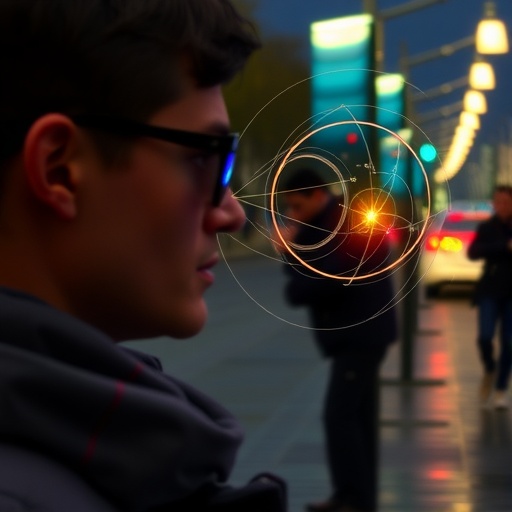
In recent years, the field of sensory substitution has witnessed remarkable developments, particularly in understanding how blind individuals adapt to their environment without vision. A groundbreaking study recently published in the prestigious journal eNeuro by Haydee Garcia Lazaro and Santani Teng from the Smith–Kettlewell Eye Research Institute offers profound insights into the neural and behavioral mechanisms underlying human echolocation. This technique, wherein some visually impaired individuals use self-generated mouth clicks and listen to the returning echoes, enables them to construct spatial awareness and perceive objects in their surroundings, essentially substituting auditory input for lost visual information.
Traditionally, echolocation has been associated with certain animals like bats and dolphins; however, certain blind humans have also honed this capacity with surprising precision. Garcia Lazaro and Teng’s research probed the fundamental question of how repeated acoustic signals contribute to perceiving spatial details, a process known as evidence accumulation. Their findings elucidate how repeated auditory clicks enhance the brain’s representation of object location, unveiling an intricate interplay between sensory input and neural processing.
The study commenced with a behavioral experiment involving four blind individuals who were adept at echolocation and twenty-one sighted individuals tested in complete darkness. Participants were tasked with locating objects based solely on sound echoes generated from their mouth clicks in an acoustically controlled environment. Remarkably, the blind echolocators demonstrated superior spatial accuracy compared to sighted participants relying on the same auditory cues, revealing trained echolocation as an exceptionally effective sensory substitution mechanism.
Crucially, performance improved with the number of self-produced clicks. As the blind echolocators emitted more clicks, their localization of objects became more precise. This phenomenon hints at an underlying cognitive process whereby the brain accumulates auditory evidence over a temporal sequence, integrating consecutive echo returns to enhance spatial resolution. Such temporal integration mirrors mechanisms observed in other sensory domains, where repeated sampling enhances perception accuracy by reducing uncertainty.
Complementing behavioral data, neural recording techniques unveiled dynamic brain activity patterns correlating with the accumulation of echo information. Neural signatures became more pronounced as clicking sequences progressed, indicating that the brain does not merely process individual echoes separately but synthesizes multiple echoes to optimize the spatial map. Specifically, regions implicated in auditory processing and spatial cognition exhibited augmented activation, suggesting cross-modal plasticity and adaptation in the absence of visual cues.
These findings advance a mechanistic understanding of how the human brain constructs spatial representations under sensory deprivation. The research underlines that the echolocating brain employs not only auditory analysis but also integrative computations that accumulate evidence across multiple sensory events to form robust perceptual judgments. This accumulation enhances reliability, a vital factor when working with inherently ambiguous echo signals.
Moreover, this study ignites promising avenues for rehabilitation and technological applications. Determining what distinguishes proficient echolocators at the neural and behavioral levels could inform innovative training protocols designed to teach echolocation skills both to blind individuals newly learning the technique and potentially to sighted individuals seeking augmented spatial awareness. This holds transformative potential for mobility aids and sensory augmentation devices.
The researchers emphasize the remarkable plasticity of the adult human brain, capable of reorganizing sensory processing pathways to maximize available information. Given that echolocation skill improves with practice and repeated sensory sampling, this process exemplifies not only cognitive flexibility but also adaptive changes potentially encompassing auditory cortex and multisensory integration regions.
Future research directions include dissecting specific brain regions responsible for evidence accumulation during echolocation and understanding how attentional mechanisms mediate this integration. Investigations could utilize advanced neuroimaging technologies such as functional MRI or magnetoencephalography to temporally and spatially characterize these processes with greater precision. Identification of individual variability factors will offer further clarity on why some blind individuals excel at echolocation while others do not.
Significantly, this work aligns with broader neuroscientific principles regarding how evidence is integrated across time to support decision-making and perception. While most research focuses on vision and audition isolated, this study elucidates how the brain uses echo-based auditory signals in conjunction with memory and prediction to infer spatial layouts. Such integrative sensory strategies illustrate the brain’s remarkable capacity to compensate for sensory loss by recalibrating sensory hierarchies and exploiting alternative modalities.
By illuminating the neural underpinnings of click-based echolocation, Garcia Lazaro and Teng’s study not only documents an extraordinary human ability but also enriches neuroscientific theories of sensory processing, plasticity, and cross-modal reorganization. This research stands to inspire new generations of sensory substitution devices and interventions aiming to enhance quality of life for those with visual impairments.
In summary, the study reveals that through repeated self-generated mouth clicks, expert blind echolocators improve spatial localization accuracy by accumulating echo information in their brains. This accumulation is associated with measurable boosts in neural activity within auditory and spatial processing areas, underscoring a sophisticated neural computation underpinning this remarkable sensory adaptation. The implications of these findings resonate widely, offering hope and direction for future assistive strategies grounded in neuroscientific evidence.
Subject of Research: People
Article Title: Neural and Behavioral Correlates of Evidence Accumulation in Human Click-Based Echolocation
News Publication Date: 6-Apr-2026
Web References: 10.1523/ENEURO.0342-25.2026
Keywords
Blindness, Vision disorders, Applied acoustics, Remote sensing, Sonar


