

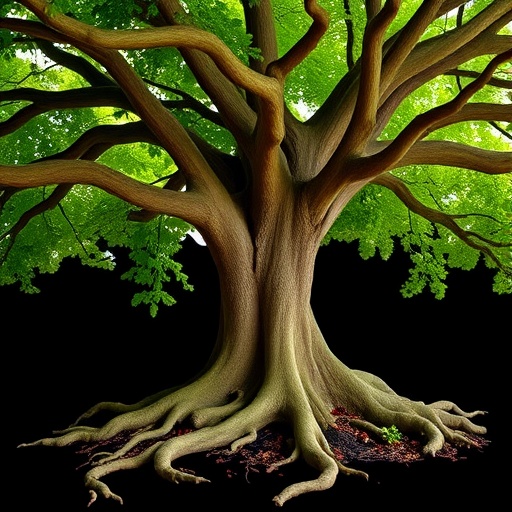
In the face of escalating environmental challenges, the resilience of oak trees to drought, nutrient limitations, and pathogenic threats has emerged as a critical area of inquiry within plant-microbe interaction research. A groundbreaking study published in the journal Cell Host & Microbe reveals that the microbiomes associated with semi-mature oak trees exhibit remarkable stability despite exposure to adverse conditions. This research sheds new light on how long-lived trees, specifically sessile oaks aged 35 years, maintain their health and ecological function through complex, often subtle microbial partnerships under environmental stress.
Unlike the rapid life cycles of many herbaceous plants that dominate plant microbiome studies, the longevity of trees poses unique questions about microbial dynamics over decades. Trees must contend with fluctuating climates and persistent threats, yet little is known about how their associated microbial communities buffer these stresses. This study bridges that gap by focusing on mature oaks growing naturally within a woodland ecosystem in Norfolk, UK, providing an unprecedented experimental framework to manipulate environmental variables and observe microbiome responses in situ.
Researchers established an experimental setup that included rain exclusion shelters to simulate prolonged drought conditions, along with ringbarking techniques mimicking nutrient and water transport disruption by severing phloem and xylem connections. Additionally, a subset of trees was inoculated with pathogenic agents linked to acute oak decline (AOD), a severe disease impacting oak populations. These multifaceted stress conditions were applied across 144 trees, enabling comprehensive analysis of microbial community resilience across different plant tissues.
The team employed high-throughput DNA sequencing to characterize bacterial and fungal communities inhabiting the leaves, stems, and roots, sampled at four intervals over two years. This longitudinal approach allowed precise monitoring of microbial community structure and function under sustained environmental perturbation. Intriguingly, despite significant physiological changes in host trees—such as reduced soil moisture and impaired nutrient transport—the core microbial consortia remained largely intact, highlighting an intrinsic stability of tree-associated microbiomes.
Subtle shifts were detected primarily in the root microbiome following drought simulation via rain exclusion. Notably, taxa within the phylum Actinobacteriota became more abundant, consistent with their known roles in enhancing drought tolerance. Concurrent increases in bacterial and fungal genera associated with plant growth-promotion suggest an adaptive recruitment of beneficial microbes under stress. This microbial plasticity within the rhizosphere likely contributes to maintaining tree health and mitigating the repercussions of environmental stressors.
The minimal alteration in microbial communities in response to nutrient limitation and pathogen inoculation was unexpected but may be explained by the trees’ developmental stage. AOD characteristically impacts older trees exceeding 50 years, whereas the study population consisted of semi-mature 35-year-old individuals. The findings imply a possible threshold effect in disease progression and microbiome disruption, which warrants further longitudinal studies spanning broader age ranges to elucidate disease-microbiome dynamics over tree lifespans.
This research challenges the conventional assumption that severe environmental stress invariably leads to dramatic microbiome shifts in plants. Instead, it supports a model where trees harness their microbiome as a relatively stable, dynamic interface that facilitates ecosystem resilience and stability. These insights have far-reaching implications for forest management and conservation strategies aimed at enhancing tree tolerance to climate change through microbiome management.
Understanding the molecular mechanisms underlying these plant-microbe interactions presents the next frontier. Unraveling how certain microbes confer drought tolerance or pathogen resistance at the biochemical level could enable the development of bioinoculants tailored to bolster tree health under changing climatic circumstances. Such innovations might prove transformative for forestry practices worldwide, promoting sustainability and carbon sequestration potential in forest ecosystems.
Beyond practical applications, this study contributes to a fundamental comprehension of ecological adaptation processes. Trees, as keystone species, influence biogeochemical cycles, carbon cycling, and ecosystem functioning. Insights into their microbiomes enrich our grasp of how terrestrial ecosystems respond to anthropogenic stress at a microbial scale, with cascading consequences at macro-ecological scales.
The findings underscore the importance of extending microbiome research beyond model organisms and short-lived plants to encompass long-lived species integral to global ecology. The study’s approach, combining experimental manipulation with high-resolution sequencing in a natural setting, serves as a powerful template for future investigations aiming to decode plant resilience mechanisms in the Anthropocene.
Looking forward, researchers emphasize the necessity of expanding this work across different geographic locations and tree species, to delineate universal versus site-specific microbiome responses. Integrating multi-omics technologies and longer timeframes will be paramount to fully discern the complex interplay between hosts, microbes, and environment influencing forest health.
In summary, the resilience of oak tree microbiomes to combined biotic and abiotic stresses illuminates a vital aspect of forest biology. As climate change accelerates, harnessing these natural microbial alliances could unlock new pathways for protecting global forests and ensuring the persistence of these majestic and ecologically indispensable organisms for centuries to come.
Subject of Research: Not applicable
Article Title: Microbial communities in semi-mature oak trees are resilient to drought, nutrient limitation and pathogen challenge
News Publication Date: 11-Feb-2026
Web References:
http://www.cell.com/cell-host-microbe
References:
Hussain et al., “Microbial communities in semi-mature oak trees are resilient to drought, nutrient limitation and pathogen challenge,” Cell Host & Microbe, DOI: 10.1016/j.chom.2026.01.009
Image Credits:
James McDonald
Keywords:
Tree roots, Trees, Droughts, Ecological adaptation, Nutrients, Pathogens, Climate change adaptation


