


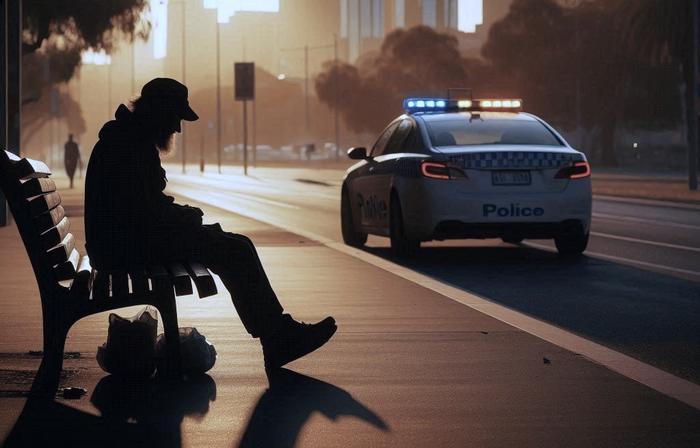
People who are homeless often endure constant and intrusive police interactions, leaving them feeling intimidated, harassed and stigmatised, a new study finds.

Credit: UTS
People who are homeless often endure constant and intrusive police interactions, leaving them feeling intimidated, harassed and stigmatised, a new study finds.
More people of all ages and backgrounds are finding themselves homeless, often due to job loss or illness, as well as a lack of affordable housing. Between 2016 and 2021 homelessness increased by 5.2% in Australia.
Professor of Law Thalia Anthony from the University of Technology Sydney (UTS) said the research aimed to give a voice to people experiencing homelessness and reveal how policing affects their lives.
“We often get the perspective of support agencies, courts and lawyers, but the system very rarely hears the voices of those experiencing homelessness,” said Professor Anthony, who was lead author of these published findings.
“We expected people to say they wanted better policing, more support. Instead, we found that what they really want is freedom from police intrusion in their lives. They want to be left alone. Of course, they also want access to housing.”
The study involving homeless people, Hyper‑policing the Homeless: Lived Experience and the Perils of Benevolent and Malevolent Policing, was recently published in the journal Critical Criminology.
Professor Anthony and legal services across the country interviewed more than 160 homeless individuals from all Australian capital cities and two regional centres about their interactions with police and the criminal justice system.
Descriptions of interactions included constant surveillance, identification checks, questioning, fines, move-on orders, charges, and arrests. A constant police presence left many feeling continuously targeted and punished for being homeless and needing to live on the street.
“Just leave us alone. We’re just trying to find somewhere warm to sleep,” said one participant. Police welfare checks, even questions such as “how are you going?” were seen as unnecessarily encroaching.
First Nations people were particularly affected. They experience homelessness at rates six times higher than the general Australian population, and report greater levels of police violence.
Accounts of physical abuse, such as a First Nations woman having her fingers broken in a police cell, as well as fears around dying in custody, illustrate the impact of policing on this community.
Pervasive policing was also a significant source of anxiety and stress for those experiencing homelessness, and added to feelings of social exclusion and marginalisation.
One homeless individual experiencing a mental health episode described how police intervention exacerbated their distress: “I just feel like it would’ve been a lot better if they just left me alone.”
Interviewees felt they were “low hanging fruit” for police, frequently targeted for minor offenses. Constant police scrutiny can lead to fines and criminal records, which in turn makes it harder to secure housing, creating a vicious cycle of homelessness and criminalisation.
The study draws attention to the stark disparity between government spending on prisons and social housing. In 2021-22, Australia spent $6 billion on prisons, far surpassing expenditures on social housing.
By reallocating resources, the study suggests, Australia can address the root causes of homelessness rather than criminalising those who are already vulnerable.
As one participant said, “The answer is not some normal level of policing or better policing – but freedom from policing.”
The research underscores the pressing need for improved social security nets, community support services and public housing infrastructure.
Journal
Critical Criminology
Method of Research
Survey
Subject of Research
People
Article Title
Hyper-policing the Homeless: Lived Experience and the Perils of Benevolent and Malevolent Policing
Article Publication Date
2-Aug-2024
COI Statement
N/A
Cite Scienmag News
Courtney Benton. (August 16, 2024). How policing impacts the homeless. Scienmag. https://scienmag.com/how-policing-impacts-the-homeless/
Courtney Benton. "How policing impacts the homeless." Scienmag, 16 August 2024, https://scienmag.com/how-policing-impacts-the-homeless/. Accessed 4 September 2026.
Courtney Benton. "How policing impacts the homeless." Scienmag. August 16, 2024. https://scienmag.com/how-policing-impacts-the-homeless/

