


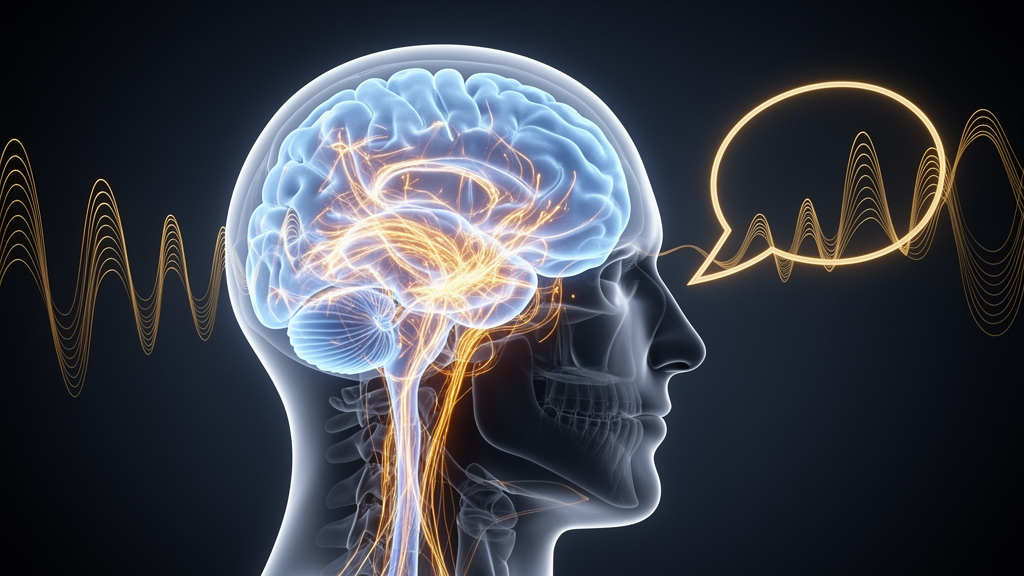
For millions of people who lose language after a stroke, the road back to communication is often measured with tests that bear little resemblance to everyday life. Naming a picture or repeating a sentence in a quiet clinic tells clinicians something important, but it rarely reveals how a person will manage a conversation at the dinner table, follow a story told by a grandchild, or hold their own in a busy social exchange. A new integrative review published in Frontiers in Human Neuroscience argues that this gap between what we test and what we want to treat has become the central obstacle to precision rehabilitation in post-stroke aphasia, and it lays out a detailed roadmap for closing it.
The review, led by Jiayi Xia of Shanghai Second Rehabilitation Hospital together with colleagues from Renji-affiliated rehabilitation centers and Huashan Hospital at Fudan University, synthesizes evidence on naturalistic language assessment, portable neuroimaging, and brain-network biomarkers. Its central claim is provocative: the same connected speech, narrative production, and conversational behaviors that clinicians observe informally can be converted into graded, multivariate neuropsychological profiles, and those profiles can be linked to measurable brain-network signatures that predict recovery and guide individualized therapy.
Conventional aphasia batteries such as the Western Aphasia Battery-Revised and the Boston Diagnostic Aphasia Examination remain indispensable for diagnosis, syndrome classification, and severity grading. They provide a shared clinical language and allow outcomes to be compared across studies. But the authors point to a well-documented limitation in neuropsychological assessment: ecological validity. Tests often show only moderate associations with everyday functioning, and stronger links emerge only when the test and the outcome measure assess closely corresponding domains. If the clinical target is real-world communication, assessment must include tasks that approximate the cognitive-linguistic demands of real-world communication.
The review is careful to avoid a false dichotomy. Naturalistic tasks are not valuable because they contain processes absent from conventional testing; even a sentence-comprehension item recruits lexical, semantic, syntactic, memory, and executive processes simultaneously. The distinction is one of task constraint and observability. In an extended communicative episode, multiple linguistic and cognitive processes vary and interact, allowing clinicians to measure several sources of difficulty at once under conditions that resemble daily life. Spoken discourse has been described as a clinically meaningful naturalistic outcome precisely because it captures performance at the level of extended communication rather than isolated test items.
What makes this framework scientifically interesting is the evidence that naturalistic behaviors map onto neural mechanisms rather than serving as purely descriptive outcomes. Studies have linked discourse-level performance to lesion location, white matter integrity, structural connectivity, and functional activation. Impaired discourse informativeness has been associated with frontal white matter damage, suggesting that discourse production depends not only on classical perisylvian language regions but also on frontal systems involved in selection, organization, and control. Lesion-based studies of conversational speech production have shown that natural speech deficits arise from distributed lesion patterns rather than a single cortical region. Narrative speech studies have revealed that action and object representations during naturalistic production are supported by distinct neural systems, and that lexical diversity, lexical sophistication, informativeness, and coherence each relate to specific neuroanatomical structures.
The review organizes naturalistic language samples into interacting phenotype dimensions: lexical-semantic access, phonological encoding, grammatical organization, discourse-semantic processing, executive-predictive control, and speech-motor output. These dimensions are intentionally overlapping rather than modular. Recent work shows distributed sensitivity to syntax and semantics throughout the language network, and lesion-symptom mapping has demonstrated a double dissociation between agrammatism, associated more strongly with frontal damage, and paragrammatism, associated more strongly with posterior temporal damage. A single syntactic phenotype, the authors argue, should be decomposed into measurable error types whenever data allow. Predictive processing, indexed by word surprisal and contextual expectation, is treated as a cross-cutting feature that influences lexical access, structure building, and comprehension.
On the neural side, the review emphasizes that recovery is best understood as a distributed network process. Preserved or re-engaged left-hemisphere language regions remain essential, especially when residual tissue is available within core language networks. A systematic review of neuroplasticity in post-stroke aphasia found modest evidence for a return of function in left-hemisphere language regions over time, while evidence for large-scale reorganization into entirely new systems remains less compelling. Right-hemisphere recruitment is treated as conditional rather than uniformly beneficial: it may support recovery when left-hemisphere damage is extensive, but may reflect inefficient compensation when the left hemisphere retains substantial capacity. Domain-general medial prefrontal systems contribute to language recovery, and resting-state network modularity has been associated with improved narrative production during rehabilitation.
Portable technologies are central to making ecological assessment practical. EEG-based neural tracking of natural speech provides millisecond-level temporal information about how the brain follows continuous linguistic input and has been proposed as an ecologically valid biomarker for detecting aphasia at the individual level during story listening. fNIRS, by contrast, measures cortical hemodynamic responses with greater feasibility for repeated assessment during overt language tasks, bedside evaluation, and rehabilitation settings. The two modalities are complementary: EEG answers when linguistic information is processed, while fNIRS answers where task-related cortical responses occur. Neither should be treated as a stand-alone aphasia biomarker, and the review details the artifact sensitivity, lesion-aware localization challenges, and standardization gaps that must be addressed before clinical use.
The authors propose an operational ecological biomarker framework implemented through seven steps: define a real-world communication target, select a task that samples that target, extract a reproducible multilevel feature set, construct a graded multivariate patient profile, test whether neural measures add convergent, dissociable, or incremental information beyond behavioral severity and lesion burden, translate only validated combinations into prognosis or treatment hypotheses, and repeat measures longitudinally to test change and transfer. The framework is explicitly designed to complement, not replace, standardized aphasia assessment.
The clinical implications are substantial. For prognosis, early functional activation has been shown to predict language outcome after stroke, and structural connectivity modeling has been used to predict post-stroke language function from routinely acquired clinical MRI data. Resting-state functional connectivity may predict responsiveness to language therapy in chronic post-stroke aphasia. For neuromodulation, fNIRS-guided selective rTMS has shown that functional activation patterns can guide stimulation targets, and fNIRS-guided high-frequency rTMS over activated speech-related areas combined with speech therapy has been associated with improved language function and altered network connectivity. The review acknowledges that many existing studies demonstrate associations without testing whether ecological biomarkers improve prognosis, treatment selection, or outcome monitoring beyond conventional clinical variables. Prospective validation, cross-language adaptation of discourse metrics, and standardized reporting of elicitation methods, transcription procedures, and coding rules are identified as priorities. If those hurdles are cleared, the vision is a scalable pathway in which brief naturalistic language sampling combined with portable EEG or fNIRS helps clinicians answer practical questions: what type of language difficulty is most limiting this patient’s communication, which neural systems appear preserved or compensatory, which therapy target is most appropriate, and whether the patient is improving in ways that transfer to daily life.
Subject of Research: Naturalistic language assessment and brain-network biomarkers for precision neurorehabilitation in post-stroke aphasia
Article Title: Naturalistic language assessment and brain-network biomarkers in post-stroke aphasia for precision neurorehabilitation
Article References: Xia, J., Pei, S., Zhou, S., & Bai, Y. (2026). Naturalistic language assessment and brain-network biomarkers in post-stroke aphasia for precision neurorehabilitation. Frontiers in Human Neuroscience, 20, Article 1966552. https://doi.org/10.3389/fnhum.2026.1966552
Image Credits: AI Generated
DOI: 10.3389/fnhum.2026.1966552
Keywords: post-stroke aphasia, naturalistic language assessment, brain-network biomarkers, connected speech, fNIRS, EEG, precision neurorehabilitation, ecological validity, discourse analysis, neuroimaging, Naturalistic, language
Cite Scienmag News
Cassandra Pierce. (October 15, 2026). How Natural Speech and Brain Networks Could Transform Aphasia Rehabilitation. Scienmag. https://scienmag.com/how-natural-speech-and-brain-networks-could-transform-aphasia-rehabilitation/
Cassandra Pierce. "How Natural Speech and Brain Networks Could Transform Aphasia Rehabilitation." Scienmag, 15 October 2026, https://scienmag.com/how-natural-speech-and-brain-networks-could-transform-aphasia-rehabilitation/. Accessed 15 October 2026.
Cassandra Pierce. "How Natural Speech and Brain Networks Could Transform Aphasia Rehabilitation." Scienmag. October 15, 2026. https://scienmag.com/how-natural-speech-and-brain-networks-could-transform-aphasia-rehabilitation/


