


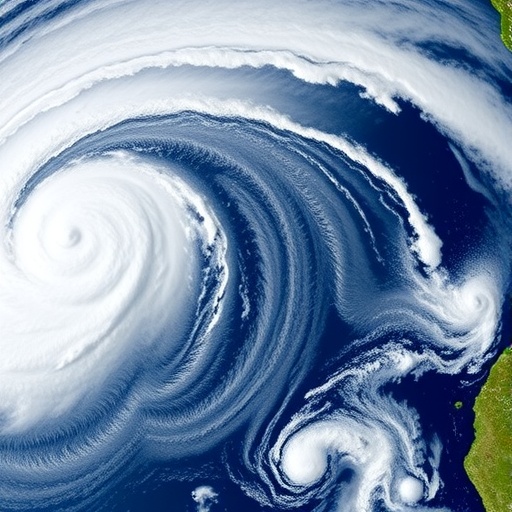
For decades, meteorologists have watched a vast pulse of thunderstorms circle the tropics, growing over the Indian Ocean, crossing Indonesia and the Pacific, and eventually weakening near the Americas. This planetary-scale weather system, known as the Madden–Julian Oscillation (MJO), can influence rainfall, monsoons, tropical cyclones and even winter weather thousands of kilometers away. Yet its slow eastward march—typically unfolding over 30 to 60 days—has resisted simple explanation. A review by atmospheric scientists Ángel F. Adames of the University of Wisconsin and Eric D. Maloney of Colorado State University argues that one of the most powerful ways to understand the MJO is to treat it not primarily as a temperature wave, but as a moving disturbance in tropical moisture.
The MJO was identified in observations of atmospheric pressure and winds over the tropical Pacific in the early 1970s by Roland Madden and Paul Julian. Unlike ordinary weather systems, which may last hours or days, the MJO spans nearly half the globe and persists for weeks. Its active phase is marked by extensive cloud formation, heavy rain and rising air, while a suppressed phase brings clearer skies, sinking air and reduced precipitation. These phases travel eastward together, but not as a single rigid object. The circulation, clouds, water vapor and rainfall interact across multiple layers of the atmosphere, creating a coupled system whose behavior links weather and climate.
The moisture-mode framework reviewed by Adames and Maloney begins with a deceptively simple observation: tropical deep convection depends strongly on the amount and distribution of water vapor in the free troposphere. Warm, humid air near the surface is not enough to guarantee towering thunderstorms. If the middle and upper atmosphere are too dry, rising clouds lose water through evaporation and entrainment before they can develop into deep convective towers. When the free troposphere becomes sufficiently moist, however, convection can intensify rapidly. Rainfall then releases additional water vapor and heat into the surrounding atmosphere, helping organize neighboring clouds. Moisture is therefore not merely a passive ingredient in tropical weather; it can act as the variable that controls the birth, growth and movement of convection.
This idea becomes especially important in the tropics because horizontal temperature differences are relatively weak. The tropics receive intense sunlight throughout the year, and gravity waves can rapidly redistribute the heat released by thunderstorms. In simplified models, this permits the weak temperature gradient, or WTG, approximation: large-scale temperature anomalies are quickly reduced, while moisture anomalies can persist for much longer. The latent heat released when water vapor condenses into cloud droplets and ice still drives atmospheric motion, but gravity waves spread its dynamical influence far from the original storm cluster. Under these conditions, the atmosphere can support “moisture modes”—waves whose evolution is governed mainly by the gain, loss and transport of water vapor rather than by temperature alone.
The MJO displays several signatures expected of such a moisture mode. Before the heaviest rainfall arrives, the tropical atmosphere often undergoes a gradual moistening that extends vertically through the free troposphere. Once convection peaks, atmospheric circulation changes begin transporting moisture both horizontally and vertically. Horizontal advection moves moist or dry air into and out of the developing disturbance, while vertical advection redistributes moisture through the depth of the atmosphere. These processes help explain why the rainiest part of the MJO is not always located at the center of the strongest moisture anomaly. The disturbance is a moving balance between moisture accumulation, convective consumption, large-scale circulation and replenishment from its surroundings.
The physics can also be expressed through moist static energy, a measure combining atmospheric enthalpy, latent energy associated with water vapor and gravitational potential energy. In tropical moisture disturbances, the column-integrated moist static energy budget tracks how surface evaporation, radiation, horizontal transport, vertical motion and precipitation alter the energy available to convection. The review highlights evidence that horizontal moisture advection is crucial to the MJO’s eastward propagation. Moist air is carried into regions ahead of the convective envelope, preconditioning them for new thunderstorms, while subsidence and drying develop behind it. This creates a self-propagating sequence: convection helps rearrange moisture, and the rearranged moisture prepares the next region for convection.
Clouds may help keep the cycle alive through radiation. High, cold cloud tops associated with deep thunderstorms emit less infrared radiation to space than the warmer surface would emit under clear skies. The resulting reduction in outgoing longwave radiation can warm the atmosphere relative to its surroundings, while changes in sunlight absorbed or reflected by clouds affect the energy entering the system. These cloud-radiative effects can increase atmospheric moist static energy and support further convection, particularly within the large-scale cloud shield of the MJO. The authors conclude that cloud-radiative heating is at least partly responsible for maintaining the oscillation, although it is not the sole mechanism. Surface fluxes, ocean feedbacks, circulation and the organization of cloud populations also contribute.
The moisture-mode perspective offers an explanation for why the MJO changes with the seasons and why it often struggles to cross the Maritime Continent, the region of islands and shallow seas separating the Indian and Pacific oceans. Land surfaces heat and cool more rapidly than the ocean, producing strong daily cycles of convection. Mountains, coastlines, shallow surrounding waters and complex regional circulations disrupt the large-scale moisture pathways that operate efficiently over open ocean. During some seasons, the disturbance crosses the region; during others, it weakens, stalls or detours around it. A moisture-based framework connects these outcomes to changes in background humidity, wind patterns, surface energy fluxes and the vertical structure of convection rather than treating the Maritime Continent as a mysterious geographical barrier.
The same framework is being used to investigate how the MJO might respond to rising carbon dioxide concentrations. A warmer atmosphere can hold more water vapor, but that does not mean every tropical disturbance will simply become stronger or faster. Climate change alters sea-surface temperatures, atmospheric circulation, cloud-radiative feedbacks, vertical humidity profiles and the exchange of energy between ocean and atmosphere. Each of these changes can affect how quickly moisture accumulates ahead of convection and how efficiently it is removed behind the disturbance. Model studies reviewed by the authors suggest that changes in moist processes can modify the MJO’s propagation and amplitude, but the direction and magnitude of those changes remain sensitive to model physics and the simulated mean climate.
The implications extend far beyond the equatorial oceans. As the MJO travels eastward, its circulation can excite Rossby waves that propagate into the extratropics, altering jet streams, storm tracks and blocking patterns. Its phases have been linked to shifts in rainfall across East Asia, atmospheric rivers and snowpack in the western United States, winter blocking in the Northern Hemisphere, North Atlantic circulation and the likelihood of severe weather such as tornadoes and hail. Because the MJO evolves over weeks, recognizing its phase can provide information beyond the limit of conventional weather forecasts, potentially improving subseasonal predictions. Yet operational models often struggle to represent it because they misjudge tropical humidity, cloud processes, ocean feedbacks or the interaction between convection and large-scale circulation.
Adames and Maloney argue that moisture modes may also describe a broader family of tropical disturbances. The tropics contain convectively coupled Kelvin waves, equatorial Rossby waves, easterly waves and monsoon-related systems with different sizes, speeds and structures. Some are dominated by divergent motion, while others are more rotational and can interact with potential vorticity and vertical wind shear. Their differences do not necessarily rule out a common moisture-centered description. Instead, the relative importance of moisture advection, rotation, radiation, surface fluxes and gravity-wave adjustment may determine which kind of disturbance emerges. This could provide a unifying way to interpret the remarkable diversity of tropical weather systems.
The review does not claim that moisture-mode theory has solved the MJO. Competing theories emphasize radiative-convective instability, cloud populations, ocean-atmosphere coupling, equatorial wave dynamics and nonlinear circulation. Observations and models continue to disagree over which processes are essential and which merely amplify an oscillation generated elsewhere. Some simulations produce MJO-like variability without all the mechanisms expected from a simple moisture mode, while others fail because their background atmosphere is too dry or their convection responds unrealistically to humidity. The value of the theory is therefore not that it replaces every other explanation, but that it identifies measurable processes that can be tested in observations and improved in models.
The emerging picture turns the MJO into something more dynamic than a procession of thunderstorms. It is a traveling atmospheric engine powered by the movement of water vapor, the release of latent heat and feedbacks involving clouds, radiation, circulation and the ocean. Moisture gathers, convection erupts, gravity waves redistribute heating, and winds transport humidity toward the next stage of the cycle. By focusing on that sequence, scientists can connect the MJO’s internal physics to its seasonal behavior, its sensitivity to climate change and its far-reaching influence on weather. The atmosphere’s most consequential tropical wave may ultimately be governed by a substance that seems ordinary at ground level—but becomes a planetary-scale force when it moves through the sky.
Cite Scienmag News
Sloane Callahan. (August 26, 2026). How Moisture Mode Theory Advances Understanding of Madden-Julian Oscillation and Tropical Disturbances. Scienmag. https://scienmag.com/how-moisture-mode-theory-advances-understanding-of-madden-julian-oscillation-and-tropical-disturbances/
Sloane Callahan. "How Moisture Mode Theory Advances Understanding of Madden-Julian Oscillation and Tropical Disturbances." Scienmag, 26 August 2026, https://scienmag.com/how-moisture-mode-theory-advances-understanding-of-madden-julian-oscillation-and-tropical-disturbances/. Accessed 5 September 2026.
Sloane Callahan. "How Moisture Mode Theory Advances Understanding of Madden-Julian Oscillation and Tropical Disturbances." Scienmag. August 26, 2026. https://scienmag.com/how-moisture-mode-theory-advances-understanding-of-madden-julian-oscillation-and-tropical-disturbances/


