


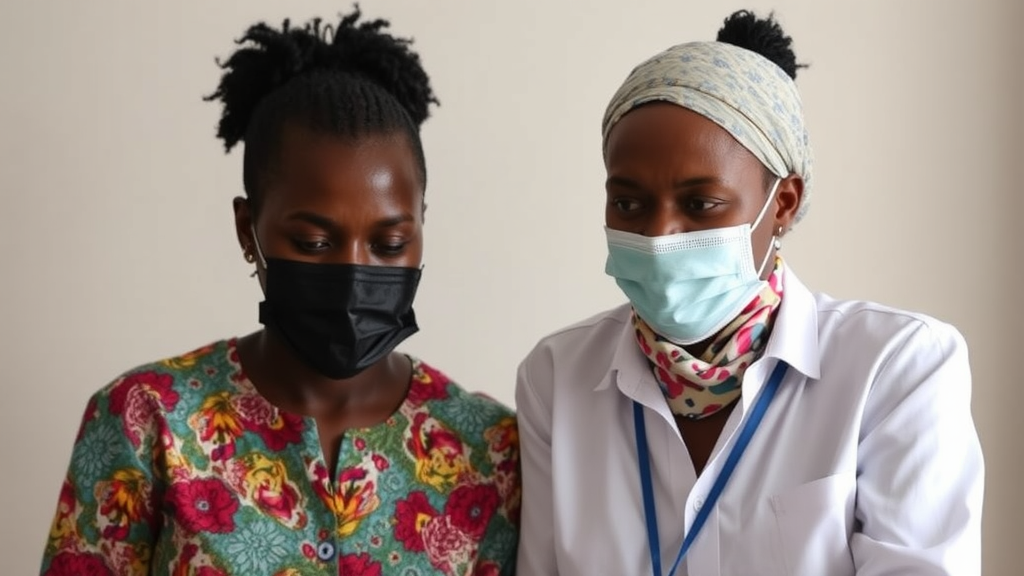
In the sprawling megacity of Lagos, home to roughly 20 million of Nigeria’s 200 million people, mental health services have long struggled against a familiar set of obstacles: too few specialists, overstretched primary care clinics, patchy drug supplies and a treatment gap so severe that up to 85 percent of Nigerians with mental disorders receive no care at all. A new study published in Health Research Policy and Systems describes how a research team led by Abiodun O. Adewuya of the Lagos State University College of Medicine set out to close part of that gap in an unexpected way — not by inventing new technology, but by systematically adapting and pilot-testing a global World Health Organization guideline on digital interventions so that it could actually work inside Lagos primary care clinics. The result is one of the most detailed real-world roadmaps yet for translating an international health systems guideline into local practice in a low- and middle-income country.
The guideline in question is the WHO Guideline: recommendations on digital interventions for health system strengthening, known as WHO-GRDI. Released in 2019, it distils the global evidence on nine categories of digital health intervention, from birth and death notification and drug stock management to telemedicine, targeted client communication, patient tracking, health worker decision support and digital training. The problem, the researchers argue, is that guidelines like this are written for the world in general, not for any particular health system in particular. In countries where electricity is unreliable, networks drop and health workers are already stretched thin, an unadapted guideline can sit on a shelf. Guideline adaptation — a systematic, participatory process that preserves the integrity of the original recommendations while customising them for local laws, resources and culture — is widely seen as a faster and cheaper alternative to developing new guidelines from scratch, yet detailed accounts of how to do it for mental health systems have been scarce.
The team structured the entire project around the Knowledge to Action cycle, a widely used implementation science framework that moves from identifying a problem, through adapting knowledge to local context, to implementing, monitoring and sustaining change. Lagos was a deliberately pragmatic choice. The state already runs the Mental Health in Primary Care programme, or MeHPriC, which operationalises the WHO’s mhGAP strategy in 57 designated flagship primary health centres, each staffed with doctors, nurses, midwives, community health extension workers, pharmacy technicians and counsellors. MeHPriC had already demonstrated clinical and cost-effectiveness in treating depression, anxiety, substance use disorders and epilepsy, but its processes were largely manual, with only scattered use of SMS messages, WhatsApp and emergency phone lines.
The project unfolded in four phases: planning, adaptation, implementation and evaluation. In the planning phase, the researchers established a Local Steering Committee of project members and independent local experts in digital intervention, guideline development, programme implementation and qualitative research, alongside a separate Stakeholders’ Forum drawing in psychiatrists, psychologists, primary care workers, technology providers, policymakers and nongovernmental organisations. Early dissemination through existing unions of nurses, midwives, community health workers and general practitioners helped secure cooperation from the outset. Ethics approval came from both the Lagos State University Teaching Hospital and the WHO itself.
The adaptation phase began with a hard-nosed assessment of whether Lagos was even ready. The team reviewed Nigeria’s mental health law, national mental health policy, task-shifting policy and National Health ICT Strategic Framework, and mapped existing digital health projects through the WHO’s Digital Health Atlas and a Nigerian digital health dashboard. The connectivity picture was surprisingly strong: by August 2021 Nigeria had more than 188 million active mobile lines, over 140 million people accessing the internet by phone, 48 percent broadband penetration and a call setup success rate of 98.9 percent. Notably, of 12 reviewed digital health projects in Nigeria, none focused on mental health — confirming the unmet need. Five independent raters then appraised the WHO-GRDI itself using the AGREE-II instrument, the international standard for guideline quality, scoring it 79.3 percent overall, with particularly strong marks for editorial independence and clarity. An 11-member Contextualization and Adaptation Panel of mental health specialists, primary care experts, policymakers, technology providers and linguists then worked through multiple rounds of structured feedback and formal consensus to produce a locally tailored draft, which was externally reviewed by professional bodies and 60 consulted stakeholders.
The adapted guideline emerged with eight rather than nine recommendations. Birth and death notification were merged into a single recommendation, since Lagos facilities record live deliveries, stillbirths and deaths with the same staff and systems. The word telemedicine was dropped entirely as ambiguous to local workers, and health worker decision support was relabelled clinical decision support. During planning workshops, stakeholders used the Theoretical Domains Framework to surface barriers and facilitators, then ranked the recommendations using a modified Delphi technique. Five were judged feasible for a pilot within the project’s timeline: drug stock notification, client-to-health-provider communication, health worker supervision and communication, targeted client communication and clinical decision support. The rest were set aside for want of infrastructure or priority.
The pilot itself ran for three months in five randomly selected flagship primary health centres, one from each administrative district. In each clinic, 11 health workers already involved in MeHPriC received mobile phones or tablets preloaded with project materials, and 55 health workers plus five supervising mental health specialists were trained over two weeks. Evaluation used validated implementation science instruments: the Acceptability of Intervention Measure, Intervention Appropriateness Measure and Feasibility of Intervention Measure, each scored on five-point Likert scales, supplemented by a perceived effectiveness rating and the 12-item Organizational Readiness for Implementing Change scale completed by health workers and managers. Altogether, 150 clients, 50 health workers, a five-member mental health team and five health managers participated in the assessment.
The headline results were encouraging. Recommendations on drug stock notification, health worker supervision and communication, and targeted client communication scored high across the board — perceived effectiveness between 80.0 and 92.0 percent, acceptability between 80.5 and 91.0 percent, appropriateness between 84.0 and 90.0 percent and feasibility between 81.0 and 90.0 percent. Organizational readiness was uniformly high, with a mean ORIC score of 55.62 out of 60, and no significant difference between frontline workers and managers. But two recommendations fell short. Client-to-health-provider communication scored between 65.6 and 73.4 percent, and clinical decision support between 78.0 and 79.0 percent on acceptability and effectiveness. The qualitative data explain why. Workers felt that emergencies such as suicidal crises demand face-to-face contact, worried about guilt and clinical liability if a remote patient deteriorated, and resented unpaid work extending beyond their capacity. On decision support, many found the electronic mhGAP guide too prescriptive and felt that checking a device in front of a patient undermined the patient’s self-esteem and the therapeutic relationship. Practical complaints about electricity, network connectivity, device safety and the need for more training rounded out the concerns.
The authors draw three main lessons for anyone attempting similar work in a low- or middle-income country. First, robust stakeholder engagement before, during and after adaptation is essential, and existing professional networks are the most efficient conduit for it. Second, policymakers should ensure a digital strategy, supporting infrastructure, legislation, governance frameworks and training plans are in place before attempting implementation of guideline recommendations. Third, integrating new recommendations into an already functioning programme — as the team did with MeHPriC’s existing mobile phone backup — makes the manual-to-digital transition far smoother. The team has prepared evidence briefs for Lagos policymakers and plans continued policy dialogues. The study does carry limitations: Lagos is Nigeria’s most developed state, the pilot was short at three months, and not all WHO-GRDI recommendations were implemented. Still, the authors argue the work offers valuable information for adapting and implementing the WHO-GRDI and other health systems guidelines, and they call for further research embracing the views and experiences of end-users to understand the balance between the generalizability and local adaptability of health systems guidelines. An ongoing feasibility trial of the electronic mhGAP app in Nepal and Nigeria is expected to inform the next round of implementation decisions.
Subject of Research: Adaptation and pilot implementation of the WHO guideline on digital interventions for strengthening mental health systems in Lagos State, Nigeria
Article Title: Adaptation and pilot implementation of the WHO guideline on digital intervention to strengthen mental health systems in Lagos state, Nigeria
Article References: Adewuya, A. O., Abdulmalik, J., Abimbola, S., Oladipo, O. E., Dahiru, A., Shettima, F., Fasawe, A., Fahim, C., Marten, R., Yangchen, S., & Straus, S. (2026). Adaptation and pilot implementation of the WHO guideline on digital intervention to strengthen mental health systems in Lagos state, Nigeria. Health Research Policy and Systems, 24(S1), Article 74. https://doi.org/10.1186/s12961-026-01463-8
Image Credits: AI Generated
DOI: 10.1186/s12961-026-01463-8
Keywords: WHO-GRDI, digital health, mental health systems, Nigeria, Lagos, guideline adaptation, implementation science, primary health care, mHealth, mhGAP, low- and middle-income countries, health policy
Cite Scienmag News
Glenn Wilkins. (September 13, 2026). How Lagos Is Turning WHO Digital Health Advice Into Working Mental Health Care. Scienmag. https://scienmag.com/how-lagos-is-turning-who-digital-health-advice-into-working-mental-health-care/
Glenn Wilkins. "How Lagos Is Turning WHO Digital Health Advice Into Working Mental Health Care." Scienmag, 13 September 2026, https://scienmag.com/how-lagos-is-turning-who-digital-health-advice-into-working-mental-health-care/. Accessed 4 October 2026.
Glenn Wilkins. "How Lagos Is Turning WHO Digital Health Advice Into Working Mental Health Care." Scienmag. September 13, 2026. https://scienmag.com/how-lagos-is-turning-who-digital-health-advice-into-working-mental-health-care/


