


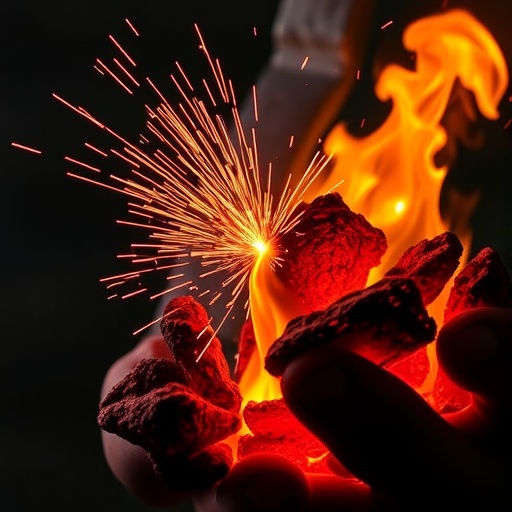
Deep beneath the world’s coal mines, fires that were sealed away months or even years earlier wait in the dark. Engineers erect airtight barriers, flood the void with inert gas, and move on—only to discover, when the seals are finally opened, that the coal is still hot, still reacting, and sometimes still ready to burn. A new study published on August 26, 2026, in Natural Resources Research explains why this happens and why the choice of cooling method can quietly decide whether a declared-dead fire stays dead. Haiyan Wang, Xiaolu Liu, and colleagues at the University of Science and Technology Beijing examined coal recovered from different regions of sealed fire areas and traced how microscopic damage, gas chemistry, and reaction kinetics interact in the thermally disturbed transition-edge zone, the narrow band where a burned-out core grades into cooler rock. Their conclusion is counterintuitive and commercially important: some of the coal that has been most aggressively cooled is also the coal most likely to ignite again the moment fresh air returns.
The phenomenon at the center of the research is coal spontaneous combustion, or CSC. Coal is never chemically inert: its fractured, porous surface reacts with oxygen from the air even at ordinary ambient temperatures through a slow process called chemisorption, which releases heat. When airflow carries that heat away, nothing dramatic happens; when coal lies in an undisturbed pile or a sealed goaf, heat accumulates, reaction rates climb steeply with temperature, and the deposit can reach its ignition point without any flame or spark. The standard mining response is to seal the affected area behind barriers and drive the oxygen concentration down with inert gases such as nitrogen or carbon dioxide, or with liquid nitrogen, which chills the rock and displaces air simultaneously. Yet seals leak. Pressure differences between the sealed zone and surrounding workings draw fresh air in through fractures, and this leakage air intrusion, as the authors describe it, can induce secondary coal temperature rises in material presumed safely quenched. The consequences are severe: reignition endangers crews, destroys equipment, and can force mines to abandon otherwise accessible reserves.
At the heart of the new work is a structural distinction that turns out to be decisive. When the researchers compared coal from the periphery of a sealed fire area with coal from its thermally disturbed transition zone, they found the transition-zone material physically transformed. Its fracture network was far more developed, its total pore volume was higher, and its specific surface area—the measure of reactive surface available per unit mass—was larger. Each heating episode expands the coal’s organic matrix and its mineral inclusions at different rates, and each cooling episode contracts them again; the mismatch pries open cracks, connects isolated voids, and progressively dismantles the rock’s internal architecture. The consequences are mechanical and chemical at once. Fractures act as highways that let oxygen penetrate deep into the coal seam, while an enlarged internal surface multiplies the number of sites where oxygen can adsorb and react. That distinction matters because oxygen supply, not fuel, usually limits how fast a smoldering coal mass can reheat. The transition edge, in short, is not simply cooled coal; it is coal that has survived a thermal ordeal and emerged with a microscopic architecture primed for re-oxidation.
To test how different extinguishing strategies act on this damaged material, the team worked with coal that had undergone relatively little thermal disturbance—the RC series—and coal from the thermally disturbed transition zone—the 160 series—applying a sequence of cooling treatments: immersion in liquid nitrogen (LN2), treatment with gaseous nitrogen (N2), and a third cooling regimen (SC). Each represents a real option available to firefighting teams underground. The researchers then interrogated the treated samples with complementary techniques. Gas adsorption measurements, following the IUPAC standard for evaluating surface area and pore-size distribution, quantified how the micropore network had evolved. Temperature-programmed oxidation experiments tracked the release of carbon monoxide, the signature indicator gas of coal self-heating, and connected it to the abundance of carbonyl functional groups on the coal surface. High-temperature oxidation tests then measured ignition temperatures and activation energies across two distinct reaction stages. Together, these measurements link what happens at the nanometer scale of pores and molecular groups to the macroscale behavior that ultimately decides whether a reopened fire zone flares or stays cold.
The pore-scale results produced one of the study’s most striking findings. Compared with the liquid-nitrogen-treated reference coal, the corresponding transition-zone sample, 160-LN2, exhibited lower micropore content and a smaller specific surface area. Previous work had shown that liquid nitrogen freeze–thaw cycles rework coal’s pore and fracture structure; the new results reveal how strongly that reworking depends on the coal’s thermal history. The mechanism is a brutal form of thermal bookkeeping. Liquid nitrogen boils at approximately minus 196 degrees Celsius, and when it contacts coal that is already fractured and heat-weakened, the enormous temperature gradient generates intense thermal stress. The thermally disturbed coal, its structure already loosened by fire, responded to this cryogenic shock by converting its smallest pores—micropores—into larger fractures. That conversion matters because micropores and their vast cumulative surface are where oxygen chemisorbs and where self-heating gains its foothold. Destroying micropores, however, does not make coal safe: the fractures created in their place open rapid channels for oxygen transport. Cryogenic cooling, in short, reshapes the hazard rather than erasing it, and it reshapes it differently depending on how much thermal damage the coal has already absorbed.
The gas chemistry told a parallel story. Thermally disturbed coal cooled with gaseous nitrogen or with the SC regimen—the 160-N2 and 160-SC samples—released sustained, elevated levels of carbon monoxide throughout testing. Carbon monoxide matters because it is the gas mine operators watch: rising CO concentrations are the classic early warning that oxidation is accelerating somewhere out of sight. The team found that CO release was positively correlated with the carbonyl content of the coal at the characteristic temperatures where indicator gases appear. Carbonyl groups—carbon-oxygen double bonds—are the chemical fingerprints of oxidation, created as oxygen attacks the coal’s carbon framework and persisting on its surface. Their correlation with CO emissions means the gas is not a random byproduct but the direct degradation product of specific oxygenated structures. Because carbon monoxide is already monitored continuously underground, the correlation offers a way to translate routine gas readings into estimates of how much chemical reactivity remains stored in a sealed zone’s coal.
The high-temperature oxidation tests delivered the study’s most consequential ranking. Among all the treated samples, RC-LN2—the relatively undisturbed coal cooled with liquid nitrogen—showed the lowest ignition temperature and the lowest activation energy in both the oxygen absorption and weight-gain stage and the subsequent decomposition–combustion stage, marking it as the sample most susceptible to spontaneous combustion. Activation energy is the energetic threshold a chemical reaction must clear; the lower it is, the more readily oxidation proceeds at any given temperature. The two stages describe a coal’s full journey from passive oxygen uptake to active burning, and RC-LN2 crossed both thresholds more easily than any other sample. The result is consistent with the pore measurements: the reference coal retained the dense micropore network and large reactive surface that its transition-zone counterpart had lost to thermal stress, leaving it structurally intact but chemically exposed. Liquid nitrogen cooling, the findings suggest, can therefore leave behind the most vulnerable material precisely where the coal seemed least damaged—a warning that the calmest-looking corners of a sealed fire zone may conceal the greatest danger.
For mine operators, the practical message is that cooling is not interchangeable, and neither is coal. A strategy that performs well in one region of a sealed fire area can be poorly matched to another, because the transition edge and the periphery differ in fracture density, pore architecture, surface area, and chemical reactivity. The authors argue that their results provide a scientific basis for selecting appropriate cooling strategies in sealed fire zones, improving fire-prevention and suppression efficiency while reducing the risk of reignition after reopening. In practice, that means pairing each cooling method with the thermal history of the coal it will touch and reading the warning signs correctly: persistent carbon monoxide emissions from thermally disturbed material, and carbonyl chemistry that reveals how much oxidation potential remains locked in the rock. The work was supported by the National Natural Science Foundation of China under grant 52074156 and by the China Postdoctoral Science Foundation under grant 2024M760213, with corresponding author Xiaolu Liu leading the collaboration at the University of Science and Technology Beijing.
Beyond any single mine, the study reframes what “extinguished” truly means. Coal fires are a persistent global problem, consuming reserves, releasing greenhouse gases and toxic emissions, and destabilizing the workings around them. What this research adds is a microscopic vocabulary for the most treacherous part of a burned-out zone: the transition edge, where fractures, micropores, carbonyl groups, and cryogenic stress converge. A sealed fire, the findings imply, should be treated not as a system that has been switched off but as one with memory, its coal carrying the structural and chemical scars of everything that has happened to it. The study’s framework—linking pore architecture, surface chemistry, and reaction kinetics—could shape monitoring and cooling protocols long after the flames are gone. Reopening a sealed zone safely means knowing which scars make the coal hungry for oxygen, and choosing the cooling treatment that leaves the least reactive material behind. The alternative is to discover, sometimes years later and hundreds of meters underground, that the fire was never really out.
Cite Scienmag News
Violet Maxwell. (August 29, 2026). How Heat and Oxygen Coupling Sparks Coal Reignition in Sealed Fire Zones. Scienmag. https://scienmag.com/how-heat-and-oxygen-coupling-sparks-coal-reignition-in-sealed-fire-zones/
Violet Maxwell. "How Heat and Oxygen Coupling Sparks Coal Reignition in Sealed Fire Zones." Scienmag, 29 August 2026, https://scienmag.com/how-heat-and-oxygen-coupling-sparks-coal-reignition-in-sealed-fire-zones/. Accessed 3 September 2026.
Violet Maxwell. "How Heat and Oxygen Coupling Sparks Coal Reignition in Sealed Fire Zones." Scienmag. August 29, 2026. https://scienmag.com/how-heat-and-oxygen-coupling-sparks-coal-reignition-in-sealed-fire-zones/


