


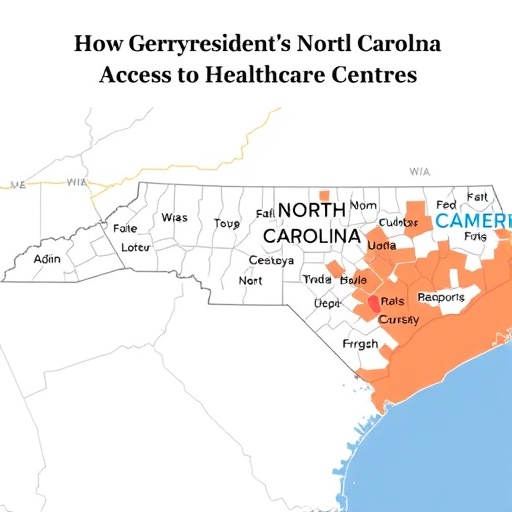
A groundbreaking study conducted by researchers at the University of Massachusetts Amherst reveals a previously underexplored consequence of partisan gerrymandering: its detrimental impact on access to healthcare services. This study, focusing on North Carolina, utilizes rigorous data analysis to demonstrate how the deliberate redrawing of electoral districts for political gain compromises community access to federally qualified health centers (FQHCs), entities critical in delivering primary and preventive healthcare to underserved populations.
Redistricting, a constitutionally mandated process, is designed to ensure equal representation by adjusting electoral boundaries in response to population changes. However, gerrymandering—the manipulation of these boundaries to favor a particular party—can undermine fair political representation. While the U.S. Supreme Court has imposed limitations on judicial challenges to partisan gerrymandering, deeming it a non-justiciable political question in many instances, the implications of this practice extend far beyond the ballot box, as this new research compellingly shows.
The study, led by Auden Cote-L’Heureux, a recent UMass Amherst graduate now pursuing advanced studies in Germany, in collaboration with senior author David Chin, assistant professor of health policy and management at UMass Amherst’s School of Public Health and Health Sciences, integrates electoral, demographic, and healthcare infrastructure data. By doing so, it establishes a quantitative linkage between the degree of gerrymandering and the scarcity of accessible healthcare facilities within communities.
Analyzing the layout of ZIP codes in relation to legislative districts, the research team used innovative metrics to assess “partisan dislocation”—a measure of how voters are artificially separated from like-minded constituents due to political boundary manipulation. ZIP codes fragmented across multiple districts were identified as heavily gerrymandered, whereas those principally contained within a single district exhibited more coherent representation.
The results are both stark and troubling. Communities contained within fragmented ZIP codes experienced significantly reduced access to FQHCs, with these areas showing fewer healthcare centers overall and a decreased likelihood of gaining new facilities over nearly two decades. Additionally, residents in such areas traveled approximately 30% farther to reach their nearest health center compared to those in less manipulated districts. This increased travel burden further exacerbates challenges to obtaining essential healthcare services.
From a structural perspective, these findings illustrate how weakened political representation, engendered by gerrymandering, translates directly into tangible health disparities. The study documents up to a 29% reduction in FQHC availability correlated with heightened gerrymandering severity in state senate districts. This link underscores the interconnectedness of political geography and public health outcomes, situating gerrymandering as a critical social determinant influencing equitable healthcare access.
The implications of this research resonate with wider calls to depoliticize health access. Cote-L’Heureux emphasizes that healthcare should be insulated from the vicissitudes of political partisanship, asserting that access to essential health services must not hinge on electoral strategies. This position is bolstered by an editorial accompanying the study in the American Journal of Public Health, underscoring the urgency of addressing health equity within the broader framework of political representation.
Moreover, the study seeks to pioneer a novel legal avenue to contest gerrymandering’s harms by reframing the debate around measurable public health consequences. Given the Supreme Court’s 2019 ruling that partisan gerrymandering cases largely fall outside federal judicial review, this research introduces quantifiable health impacts as a potentially compelling argument in future litigation.
David Chin reflects on the research as laying empirical groundwork for advocacy and reform, highlighting the critical intersection of political science, public policy, and healthcare delivery. The innovative methodology leverages publicly available data and cross-disciplinary techniques to illuminate the political determinants of health in ways previously unexplored.
To foster public engagement and transparency, the research team has developed an interactive map depicting the degree of gerrymandering across North Carolina’s state House districts at the ZIP code level. The map visually articulates partisan dislocation, with blue shades indicating Democratic-leaning manipulations and red hues denoting Republican-favored gerrymandering. This tool serves as an accessible platform for stakeholders, researchers, and citizens to comprehend the spatial dynamics linking political boundaries and healthcare disparities.
In conclusion, this study not only reveals a critical dimension of how structural political mechanisms can erode health equity but also charts a course for innovative responses at the intersection of law, policy, and community health. By quantifying the consequences of gerrymandering on health infrastructure, the researchers provide a formidable evidentiary basis for deploying health equity arguments in the ongoing fight against partisan electoral manipulation.
The work is a clarion call to policymakers, public health advocates, and the judiciary to consider the broader societal costs of gerrymandering beyond electoral outcomes, spotlighting healthcare access as a vital frontier in ensuring fair and just political representation.
News Publication Date:
13-Nov-2025
References:
American Journal of Public Health, November 13, 2025
Cite Scienmag News
Phoebe Ingram. (November 13, 2025). How Gerrymandering in North Carolina Impacted Residents’ Access to Healthcare Centers. Scienmag. https://scienmag.com/how-gerrymandering-in-north-carolina-impacted-residents-access-to-healthcare-centers/
Phoebe Ingram. "How Gerrymandering in North Carolina Impacted Residents’ Access to Healthcare Centers." Scienmag, 13 November 2025, https://scienmag.com/how-gerrymandering-in-north-carolina-impacted-residents-access-to-healthcare-centers/. Accessed 4 September 2026.
Phoebe Ingram. "How Gerrymandering in North Carolina Impacted Residents’ Access to Healthcare Centers." Scienmag. November 13, 2025. https://scienmag.com/how-gerrymandering-in-north-carolina-impacted-residents-access-to-healthcare-centers/


