


In a groundbreaking study that promises to reshape our understanding of sensory processing, researchers at the RIKEN Center for Brain Science (CBS) in Japan have unveiled the intricate neural underpinnings that allow animals to discern the pleasing or unpleasant qualities of odors. Led by neuroscientist Hokto Kazama, the team’s work reveals that the brain does not interpret the attractiveness or aversiveness of smells through a simple binary opposition; rather, it employs distinct and separate neuronal circuits to encode these hedonic values, challenging longstanding assumptions in olfactory neuroscience.
Olfaction, among the most ancient of the senses, evolved from simple chemical detection mechanisms in primitive aquatic vertebrates to a complex sensory system capable of processing a vast array of airborne molecules. Unlike straightforward sensory systems, the olfactory system confronts the immense challenge posed by the virtually infinite diversity of odor molecules as well as their combinatorial nature. This complexity precludes a one-to-one receptor system for recognizing odors. Instead, the brain relies on the concerted activity of thousands of overlapping neurons spread throughout different brain regions to decode smell, which makes unraveling how odor valence is perceived a formidable scientific endeavor.
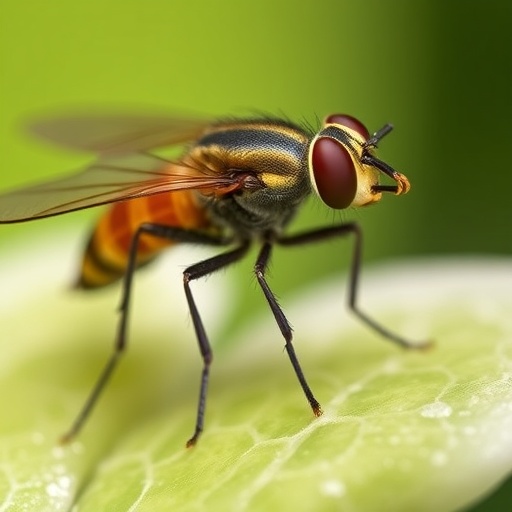
To circumvent the complexity inherent in mammalian olfaction, Kazama and colleagues turned to the fruit fly, Drosophila melanogaster, an ideal model organism with a fully mapped nervous system that nonetheless retains key olfactory circuit features shared across animal species. They meticulously identified every olfactory neuron and their synaptic connections, capitalizing on the fly’s relatively compact brain. Nevertheless, the scale of the system—with thousands of neurons interacting through hundreds of thousands of synapses—demanded innovative technological approaches and computational modeling to decipher its functional organization.
Their experimental breakthrough came from integrating advanced imaging techniques such as two-photon microscopy with optogenetic cell labeling methods. This allowed them to monitor neuronal activity with cellular precision across entire brain regions in real time while selectively activating or silencing specific neuronal populations with light. Complementing these empirical tools, the team constructed a network model rooted in the fly brain’s connectome – a comprehensive map of neural connections – enabling simulations that recapitulate neuronal firing patterns and predict how odor information is processed.
Central to their findings is the lateral horn, a specialized brain area in fruit flies analogous in function to structures involved in innate olfactory processing in higher animals. The researchers demonstrated that the lateral horn harbors distinct populations of neurons dedicated to encoding the hedonic value of odors. Neurons signaling an unpleasant or aversive odor are driven predominantly by feedforward excitation, propagating sensory input through direct excitatory pathways. In contrast, neurons responsive to pleasant odors receive an additional layer of local inhibitory modulation, revealing a more complex circuit architecture underlying positive odor valence.
What emerged from this work was a striking distinction in the connectivity motifs of circuits encoding pleasant versus unpleasant odors, indicating that these dimensions of olfactory experience are not simply reciprocal opposites but are processed by separate, specialized pathways. This discovery upends traditional models that framed positive and negative odor valence as opposing ends of a single neural continuum and suggests that the brain’s logic in encoding sensory value is more nuanced and compartmentalized than previously appreciated.
Taking advantage of the optogenetic approach, Kazama’s team could experimentally validate their computational model’s predictions. For instance, by selectively silencing the local inhibitory neurons associated with positive odor circuits, flies exhibited diminished attraction to odors they normally found pleasant, affirming the causal role of these neurons in encoding odor appeal. Such precise manipulation of neural components underscores the power of linking detailed circuit mapping with functional assays to untangle complex sensory computations.
Beyond elucidating fruit fly olfactory processing, the implications of this research ripple through neuroscientific and technological domains alike. Given the evolutionary conservation of olfactory circuits across animals, insights from these compact neural networks offer vital clues to how human brains differentiate subtle hedonic distinctions in smells. This knowledge enhances our comprehension of sensory perception and its neural substrates, advancing fields as diverse as flavor science, behavior, and psychiatry.
Moreover, Kazama envisions that replicating the circuit principles uncovered in the fly brain could inform the development of sophisticated algorithms and brain-inspired artificial intelligence systems. The modular, parallel processing mechanisms that separate positive and negative odor representation could inspire novel computational frameworks capable of more efficient and context-sensitive sensory evaluation in machines, bringing biological realism to AI perception.
The ultimate aspiration of this work is embodied in the creation of a digital twin of a brain—a comprehensive, connectome-based network model that emulates neuronal activity under various scenarios. Such models hold transformative potential for predictive neuroscience, enabling researchers to simulate brain function and dysfunction without invasive experimentation. This approach could accelerate drug discovery, disease modeling, and unraveling of neural codes underpinning complex behaviors.
The study, published in the prestigious journal Cell, exemplifies the power of multidisciplinary collaboration, blending cutting-edge imaging, genetic manipulation, computational modeling, and classical neurobiology. It represents a significant leap toward decoding the algorithms of brain function at the cellular and circuit level, contributing not only to fundamental science but also to applied technologies in sensory science and neuroengineering.
In sum, the research spearheaded by Hokto Kazama and the RIKEN CBS team not only deciphers how lateral horn neurons encode the hedonic value of odors but also challenges pre-existing paradigms about sensory coding. By revealing that “pleasant” and “unpleasant” odors are processed through distinct neural pathways, they provide a new foundation for understanding the neural basis of perception. This discovery sets the stage for future explorations into how sensory values influence behavior and decision-making, ultimately bridging the gap between molecular signals and subjective experience.
News Publication Date: [Not provided in the source]
Web References: http://dx.doi.org/10.1016/j.cell.2025.08.032
References: Published in Cell, DOI: 10.1016/j.cell.2025.08.032
Cite Scienmag News
Cassandra Pierce. (October 9, 2025). How Fruit Flies Reveal the Secrets of Savoring Flavor. Scienmag. https://scienmag.com/how-fruit-flies-reveal-the-secrets-of-savoring-flavor/
Cassandra Pierce. "How Fruit Flies Reveal the Secrets of Savoring Flavor." Scienmag, 9 October 2025, https://scienmag.com/how-fruit-flies-reveal-the-secrets-of-savoring-flavor/. Accessed 4 September 2026.
Cassandra Pierce. "How Fruit Flies Reveal the Secrets of Savoring Flavor." Scienmag. October 9, 2025. https://scienmag.com/how-fruit-flies-reveal-the-secrets-of-savoring-flavor/


