


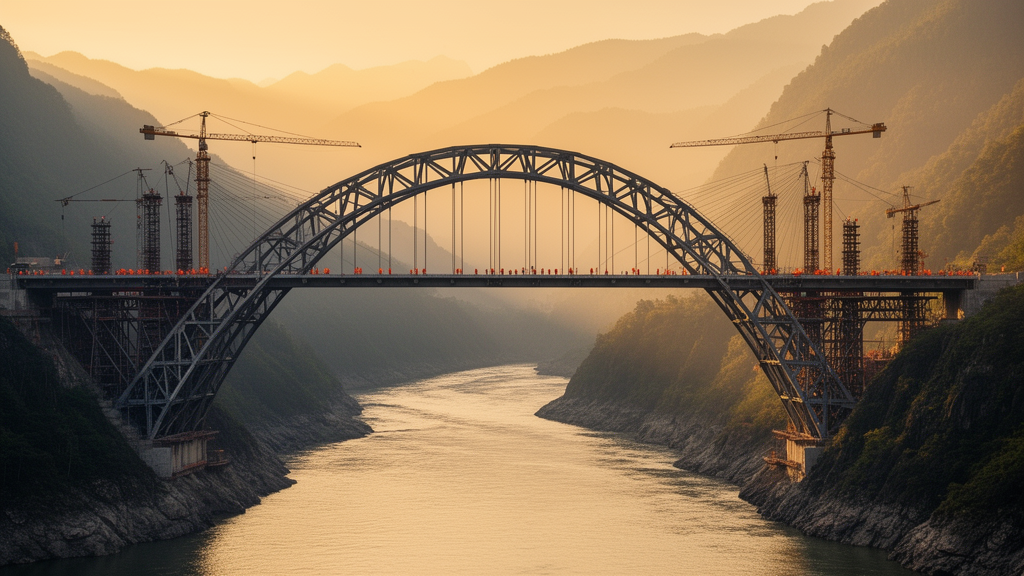
A 600-meter concrete arch now stretches across the Longtan Reservoir in China’s Guangxi Zhuang Autonomous Region, and it has rewritten the record books. The Tian’e Longtan Bridge, a deck-type steel-reinforced concrete arch bridge, is currently the world’s longest-span arch bridge, surpassing the previous record for steel-reinforced concrete arches by 155 meters. Writing in the journal Advances in Bridge Engineering, engineers Jielian Zheng and Chun Zheng describe the key innovations that made the crossing possible, from slimming down the arch ribs to rethinking the reinforcement formulas found in decades-old design codes. Their account offers a rare technical window into how a structure of this scale was designed, built and monitored.
The bridge is a key control project on the Nandan-Xialao Expressway, spanning the Longtan Reservoir roughly six kilometers from the dam. The reservoir channel has a U-shaped cross section flanked by steep mountains, with a water surface about 600 meters wide and 160 meters deep. The approved construction budget was 1.2784 billion CNY, and the final account came in lower, at 1.2324 billion CNY. The full structure is 2,488.55 meters long and 24.5 meters wide. Its twin arch ribs, spaced 16.5 meters apart, form catenary curves with a clear span of 600 meters, a rise of 125 meters, a rise-span ratio of 1/4.8 and an arch axis coefficient of 1.9. Each rib uses a uniform-width, variable-depth concrete box section, 6.5 meters wide, deepening from 8 meters at the crown to 12 meters at the springing. Thirty transverse concrete-box connections at 40-meter intervals tie the ribs together, and both ribs and connections use C60 concrete.
Choosing the construction method was itself a decisive safety question. The authors note that the arch rib of a long-span concrete arch weighs five to ten times more per unit length than the girder of a cable-stayed or suspension bridge of the same span, and its erection demands large temporary facilities. Of 26 concrete arch bridges with spans exceeding 200 meters built outside China, 20 used in situ casting with hanging baskets; the record holder among them, Spain’s Almonte Bridge completed in 2016, reaches 384 meters. In China, only nine of 41 concrete arch bridges longer than 200 meters used the hanging-basket method, the longest being the 335-meter Shuiluo River Bridge, whose arch rib hung suspended for 600 days, exposed to temperature swings and wind. By contrast, the 416-meter Nanpan River bridge on the Kunming-Nanning Railway used the stiff skeleton method: total rib erection took 450 days, of which only 120 were needed to assemble the cable-supported steel tube truss, one fifth of the Shuiluo River Bridge’s suspended time. All four concrete arch bridges over 400 meters completed worldwide by the time Tian’e Longtan was built are in China and used the stiff skeleton method, which the team adopted.
That method centers on a stiff skeleton of concrete-filled steel tubular chords. Each arch rib’s skeleton is an arch truss with four chords of Q420qD steel tubes, 900 millimeters in diameter with wall thicknesses of 30 to 35 millimeters, braced by welded angle steel on node plates. The tubes were filled with C80 self-compacting slightly expansive concrete. The skeleton was fabricated in a factory at the Tian’e Longtan Hydropower Station about six kilometers downstream, divided into 48 segments, shipped to the site and erected by cable-stayed cantilevered assembly, with a maximum single-segment lifting weight of 169 tonnes. Installing the steel tube skeleton took 100 days; pouring the encasing concrete, layer by layer and segment by segment, took 160 days. The bridge started construction in June 2020 and opened to traffic on February 1, 2024, recording zero accidents over the four-year build.
The first major innovation was cutting the volume of encasing concrete, the single heaviest component of the structure. For long-span steel-reinforced concrete arches, dead load accounts for 92 to 96 percent of the combined dead and live load, and the arch ribs make up roughly 60 percent of the total superstructure weight, with the encasing concrete itself contributing 80 to 90 percent of rib weight. Because the encasing concrete’s cross-section is governed mainly by the need to envelop the stiff skeleton rather than by load-bearing demands, reducing it directly reduces rib stresses. Earlier arches with spans over 400 meters used constant-height, three-cell box ribs; Tian’e Longtan instead adopted a variable-height, constant-width double-box rib that omits the top and bottom plates of the middle cell. Although a chord tube diameter-to-thickness ratio of 1/25 fell outside existing specification requirements, steel plate coiling tests showed welding quality was unaffected. With a minimum 15-centimeter protective layer outside the chord tubes, the encasing concrete volume fell from the originally designed 36,000 cubic meters to 28,100 cubic meters, a 22 percent reduction. Compared with the previous record holder, the 445-meter Beipan River Bridge on the Shanghai-Kunming Railway, the span grew 35 percent while the concrete volume grew only 6 percent, bringing the rib stress level of the 600-meter bridge down to that of a 400-meter span.
The second innovation challenged the moment amplification factors used to calculate the ultimate load-bearing capacity of arch rib cross-sections. The designers computed factors following five different codes, and the results diverged wildly: for the springing section under maximum axial force, the five codes yielded 2.24, 6.84, 5.87, 8.59 and 3.70, all far above values proposed by academic researchers and by model tests. Even the smallest code value, 3.7, would have required four layers of bundled 32-millimeter bars per arch plate, a longitudinal reinforcement ratio nearly 20 times that of two existing long-span arches, the 420-meter Wanzhou Yangtze River Bridge and the 312-meter Pumiao Bridge, both crack-free after nearly 30 years of service. Instead, the team applied the moment magnification formula from Professor Li Guohao’s classic work on bridge stability, obtaining 1.51. That criterion required only two layers of single-row 16-millimeter bars per plate, just 1/16 of the steel area of the original scheme, cutting total longitudinal reinforcement by 3,500 tonnes. A nonlinear overall stability calculation, assuming no longitudinal reinforcement at all, gave a bearing capacity safety factor of 2.37, only 10 percent below the 2.63 of the four-layer scheme. Measured displacements and chord tube stresses during construction matched the linear elastic finite element predictions within 10 percent, which the authors say strongly verifies that current code-specified magnification factors are significantly overestimated.
The third innovation concerned the stiffness of the CFST skeleton, which carried 70,000 tonnes of encasing concrete poured in 36 increments. For eight completed SRC arch bridges, the mass ratio of steel tube truss to encasing concrete ranges from 1/13.2 to 1/15; Tian’e Longtan’s 8,150-tonne skeleton against 28,100 cubic meters of concrete gives 1/8.6, markedly stiffer. The question was whether that stiffness was excessive. The answer lay in the pouring sequence: before the bottom plate concrete hardens, the skeleton alone carries everything, but afterward the hardened concrete shares the load. The mid-span deflection and steel tube stress caused by the bottom plate’s own weight were, respectively, 12 times and 6 times those caused by the web and top plates. When the bottom plate layer was complete, measured mid-span deflection reached 1,081 millimeters, 84 percent of the dead-load deflection of 1,281 millimeters, and upper chord stress reached 299 megapascals, 88 percent of the maximum time-dependent transient stress of 340 megapascals and close to the 360-megapascal allowable for the steel. Both stresses and deformations had therefore approached design limits, showing the skeleton achieved minimum material consumption while satisfying requirements.
Controlling time-dependent transient stresses during the staged pour was the project’s central construction risk. The encasing concrete was placed in three layers, bottom plate, web plate and top plate, with volumes of 8,800, 11,000 and 8,300 cubic meters. During continuous pouring of the bottom plate, transient stresses in the concrete inside the chord tubes rose sharply, with peak tensile stress reaching 32 megapascals and peak compressive stress 25 megapascals, enough to potentially damage the skeleton without load adjustment. Because the stress variation at the springing follows a single-wave curve peaking near the L/4 position, pouring simultaneously on both sides of that point can bring the springing bending moment close to zero. The team therefore developed a scheme of eight pouring platforms per layer with four casting simultaneously while the other four were prepared, achieving a minimum pouring cycle of four days, more than 50 percent shorter than a four-platform scheme with similar stress control. Eight concrete pumps delivered concrete to four platforms at once. Each of the 36 pours moved roughly 800 cubic meters in 7 to 10 hours over 184 days; in the end, no tensile stress was measured in the upper chord tube concrete, transient tensile stresses stayed below 1 megapascal and compressive stresses below 16 megapascals.
Material science and design detailing rounded out the effort. To raise the compressive stress reserve in the encasing concrete, the deck uses a continuous rigid-frame structure over a 72-meter segment from springing to mid-span with no added loads, while cost-effective prestressed T-beams span the remaining 480 meters, reducing spandrel column heights by 3.5 meters. The minimum compressive stress in the encasing concrete, at the top plate of the springing section, is 3.49 megapascals under permanent loads and 0.88 megapascals under the standard load combination. A volume-change-regulating admixture invented by Academician Liu Jiaping’s team at Southeast University, together with strict temperature control, surface film curing and continuous water spraying, addressed the crack risk inherent in large volumes of heavily constrained, high-grade concrete. The result: all 28,100 cubic meters of encasing concrete remain crack-free. The bridge withstood a magnitude 4.4 near-field earthquake fifteen days after opening without damage, carried 1.78 million vehicles by the end of 2025, and won an IABSE award in 2024. Compared with a cable-stayed bridge of the same span, the design saves 110 million CNY in construction costs and 470 million CNY in maintenance over a 100-year service period, with seven times the structural stiffness.
Subject of Research: Key construction innovations for the 600-meter Tian'e Longtan steel-reinforced concrete arch bridge
Article Title: Key innovations in the construction of Tian’e Longtan Bridge
Article References: Zheng, J., & Zheng, C. (2026). Key innovations in the construction of Tian’e Longtan Bridge. Advances in Bridge Engineering, 7(1), Article 34. https://doi.org/10.1186/s43251-026-00222-7
Image Credits: AI Generated
DOI: 10.1186/s43251-026-00222-7
Keywords: Tian'e Longtan Bridge, arch bridge, steel-reinforced concrete, concrete-filled steel tubes, stiff skeleton method, encasing concrete, moment amplification factor, bridge construction, Guangxi, structural engineering, innovations, construction
Cite Scienmag News
Denise Maddox. (October 29, 2026). How engineers built the world’s longest-span arch bridge. Scienmag. https://scienmag.com/how-engineers-built-the-worlds-longest-span-arch-bridge/
Denise Maddox. "How engineers built the world’s longest-span arch bridge." Scienmag, 29 October 2026, https://scienmag.com/how-engineers-built-the-worlds-longest-span-arch-bridge/. Accessed 1 November 2026.
Denise Maddox. "How engineers built the world’s longest-span arch bridge." Scienmag. October 29, 2026. https://scienmag.com/how-engineers-built-the-worlds-longest-span-arch-bridge/









