


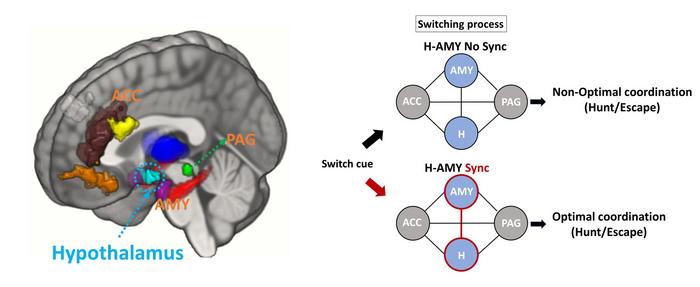
The hypothalamus is a small region of the human brain typically associated with regulating body temperature, hunger, thirst, fatigue, and sleep. But it also has another important role: helping the brain and body switch between different and opposing survival behaviors such as hunting prey and escaping predators. That’s the conclusion of a new study publishing June 27th in the open-access journal PLOS Biology by Jaejoong Kim and Dean Mobbs of California Institute of Technology, US, and colleagues.

Credit: Jaejoong Kim, California Institute of Technology (CC-BY 4.0,
The hypothalamus is a small region of the human brain typically associated with regulating body temperature, hunger, thirst, fatigue, and sleep. But it also has another important role: helping the brain and body switch between different and opposing survival behaviors such as hunting prey and escaping predators. That’s the conclusion of a new study publishing June 27th in the open-access journal PLOS Biology by Jaejoong Kim and Dean Mobbs of California Institute of Technology, US, and colleagues.
Previous studies in animals have suggested that the hypothalamus is critical in switching between behaviors, but it has been unclear if this is the case in humans. Studying the brain region in humans is challenging because of the tiny size of the hypothalamus; several of its subregions are below the resolution of typical functional magnetic resonance imaging (fMRI) scans.
In the new study, the researchers developed artificial-intelligence-based approaches to optimize and analyze fMRI scans of the brains of 21 healthy individuals, taken over four-hour periods while people were engaged in a hunting and escaping survival game within the fMRI scanner. Participants had to control an avatar, switching between hunting prey and escaping a predator.
The researchers built a computational model to explain the differences in movement patterns that characterized hunting behavior compared to escaping behavior. Then, they analyzed how changes in movements were linked with subtle changes in hypothalamus activity. Using this approach, the team discovered that patterns of neural activity in the hypothalamus, as well as nearby regions of the brain that are directly connected to the hypothalamus, are associated with behavior switching — at least for survival behaviors. Moreover, the strength of this hypothalamus signaling could predict how well someone would perform in their next survival task. While the association was seen for switching between hunting and escaping behaviors, it was not observed for switching between other behaviors.
The authors conclude that the hypothalamus plays a key role in how the human brain switches between and coordinates survival behaviors — a function that is important and evolutionarily advantageous.
The authors add, “New research demonstrates the vital role of the human hypothalamus in switching between survival behaviors such as hunting and escaping, employing advanced imaging and computational modeling methods. This research also reveals how the hypothalamus interacts with other brain regions to coordinate these survival strategies.”
#####
In your coverage, please use this URL to provide access to the freely available paper in PLOS Biology:
Citation: Kim J, Tashjian SM, Mobbs D (2024) The human hypothalamus coordinates switching between different survival actions. PLoS Biol 22(6): e3002624.
Author Countries: United States
Funding: This study was funded by the Templeton Foundation grant (TWCF0366; https://www.templeton.org/; to DM, ST, JK). The funders had no role in study design, data collection and analysis, decision to publish, or preparation of the manuscript.
Journal
PLoS Biology
Method of Research
Computational simulation/modeling
Subject of Research
Not applicable
COI Statement
Competing interests: The authors have declared that no competing interests exist.
Cite Scienmag News
Cassandra Pierce. (June 27, 2024). How does the human brain switch between survival tasks? Scienmag. https://scienmag.com/how-does-the-human-brain-switch-between-survival-tasks/
Cassandra Pierce. "How does the human brain switch between survival tasks?" Scienmag, 27 June 2024, https://scienmag.com/how-does-the-human-brain-switch-between-survival-tasks/. Accessed 3 September 2026.
Cassandra Pierce. "How does the human brain switch between survival tasks?" Scienmag. June 27, 2024. https://scienmag.com/how-does-the-human-brain-switch-between-survival-tasks/

