


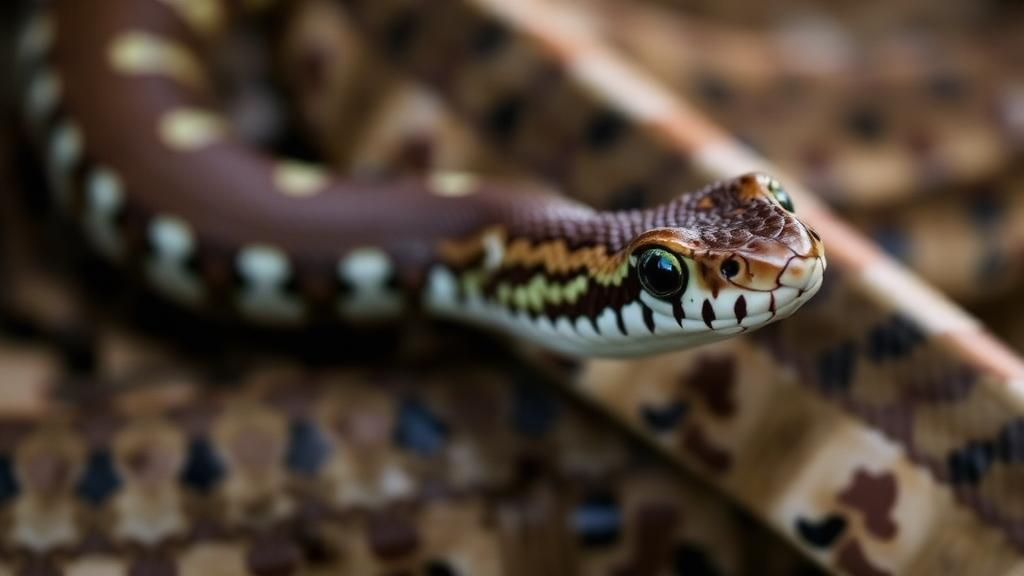
One of the most consequential questions in invasive species management is deceptively simple to state and maddeningly difficult to answer: how do you demonstrate that a destructive invader is absent from an island? A new study published in the journal NeoBiota tackles this problem head-on for the brown treesnake (Boiga irregularis), the cryptic nocturnal predator that has devastated Guam’s native bird fauna since its accidental arrival in the 1940s. Researchers led by Melia G. Nafus of the U.S. Geological Survey, working with colleagues including Marijoy C. Viernes, W. Trey Dunn, Jennifer A. Fike, Sara J. Oyler-McCance, and Joseph Cruz, systematically evaluated the biosurveillance protocols used in rapid response and detection exercises on Guam and the neighboring island of Saipan. Their findings, published on 6 January 2026, provide a quantitative framework for reducing the error that creeps into the inference of absence from a failure to detect.
The brown treesnake occupies a uniquely troubling position in invasion biology. On Guam, where the species is distributed throughout the island, it has caused ecological damage so severe that an entire biosecurity apparatus exists solely to prevent its spread to other islands in the Mariana archipelago and beyond. Saipan, the nearest major neighbor, participates in biosecurity programs designed to intercept the snake before it can establish a foothold. But every interception protocol, every rapid response exercise, and every detection survey ultimately rests on a single statistical assumption: that if trained searchers do not find a snake, the snake is probably not there. The strength of that assumption depends entirely on how well the search methods work, and until now, the factors that govern detection probability for this species had never been rigorously dissected.
The research team structured their investigation around five interlocking questions. First, they asked whether brown treesnake detection probability was density dependent, meaning whether the likelihood of finding a snake during a visual survey changed as a function of how many snakes were actually present. Second, they tested whether terrestrial environmental DNA sampling, a technique that detects genetic material shed by organisms into soil and surface substrates, could identify snake presence in occupied areas. Third, they calculated the likelihood that brown treesnakes would have been detected in Saipan given the sampling effort deployed during a real biosurveillance exercise, and explored whether lizards could serve as a proxy species on snake-free islands for estimating the factors that affect detection. Fourth, they examined how transect design influenced the pace at which observers moved through search areas, and how that pace in turn affected lizard counts. Fifth, they quantified the importance of observer training in surveying for cryptic reptiles and in completing broad versus targeted bioinventories.
The answer to the first question carries the most weight for biosecurity planning. The researchers found that brown treesnake detection probability was indeed density dependent when using visual surveys, and that it declined with abundance on Guam. This finding has a counterintuitive but critical implication: in areas where snake densities are low, which is precisely the scenario that biosecurity programs care about most, greater survey effort is required to have high confidence that a failure to detect the species actually supports the conclusion that it is absent. In other words, the harder it is to find the last few individuals of an invading population, the more work it takes to prove they are not there at all. This creates a fundamental tension for rapid response programs, which must often make decisions about resource allocation under uncertainty.
The environmental DNA component of the study represents a promising technological complement to traditional visual searching. The researchers developed a terrestrial eDNA sampling protocol and demonstrated that it was effective at detecting brown treesnakes in occupied locations on Guam. Environmental DNA methods work by collecting soil, water, or other substrate samples and screening them for genetic fragments that organisms leave behind through skin cells, feces, or other biological material. For a cryptic species that spends much of its time concealed in vegetation, refugia, or canopy structures, the ability to detect its genetic signature without visually encountering the animal itself could transform early detection efforts. However, the authors are careful to note that further validation of the eDNA protocols would still be required before the technique could be applied to early detection scenarios, where the stakes of a false negative are highest.
Perhaps the most operationally significant finding concerns the use of lizards as a proxy species. On Guam, where brown treesnakes are present at known densities, the researchers found that among trained observers, the ability to detect lizards was positively predictive of the number of snakes they detected at the standard snake densities found on the island. This relationship opens the door to a practical workaround for one of the most stubborn challenges in biosurveillance design: you cannot calibrate search protocols for a species that is not present. On snake-free islands like Saipan, there are no brown treesnakes to find, so there is no way to directly measure how well observers are searching. But if lizard detection ability serves as a reasonable proxy for snake detection ability, then training and evaluation exercises can be conducted on snake-free islands using lizards as the target, providing a defensible basis for estimating how well those same observers would perform when searching for snakes.
The study also yielded concrete recommendations for standardizing search effort in the field. The researchers found that creating easy pace-setting relationships between time and distance, specifically a target of 10 meters per minute, combined with flagging that clearly marked location along a transect, greatly reduced variability in search pace across survey nights. This may sound like a minor logistical detail, but search pace is one of the most important determinants of detection probability in visual surveys. If observers move too quickly, they miss animals; if they move too slowly, they cover less ground per unit of effort. By standardizing pace with simple field markers and clear distance-time relationships, the variability that has historically plagued detection exercises can be substantially reduced, making the resulting data far more useful for statistical inference.
Observer training emerged as another decisive factor. The researchers found that observers who were continuously trained to maintain brown treesnake search profiles detected twice as many cryptic reptiles, on average, compared to individuals who had never received training. Notably, this training advantage did not extend to non-reptile targets such as birds and small mammals, suggesting that the specific visual search patterns required for detecting cryptic reptiles are a learned skill that decays without reinforcement. The study also found that conducting broad bioinventories with many target species reduced detection of the primary target species, and that this dilution effect became increasingly pronounced as the number of years since the observer had completed training for the target species increased. In practical terms, an observer who was trained to find brown treesnakes five years ago but has since been conducting multi-species bioinventories is substantially less effective at finding snakes than one who has maintained continuous, focused training.
The cumulative message of the study is that designing biosurveillance exercises to evaluate search protocols can help improve or refine survey methods to reduce noise in the data. When the factors that affect detection, including observer skill, search pace, transect design, and the dilution of attention across multiple target species, are explicitly accounted for, the estimated confidence that a failure to detect an invasive species infers true absence improves dramatically. This is not merely an academic refinement. For islands like Saipan, where the brown treesnake has not established but remains at constant risk of introduction, the difference between a well-calibrated and a poorly calibrated surveillance program could determine whether a nascent invasion is intercepted early or discovered only after ecological damage has become irreversible.
As invasive species continue to expand their ranges in a globalized world, the framework developed by Nafus and colleagues offers a template that extends well beyond a single snake species on a single island. The principles of density-dependent detection, proxy species calibration, pace standardization, and continuous observer training are applicable to any cryptic invader whose early detection depends on visual searching. The brown treesnake may be the case study, but the lessons are universal: proving absence is one of the hardest things in ecology, and it demands the same rigor that scientists apply to proving presence.
Subject of Research: Biosurveillance design and detection probability for the cryptic invasive brown treesnake on Guam and Saipan
Article Title: Designing biosurveillance using target analysis for a cryptic invasive species, the brown treesnake (Boiga irregularis)
Article References: Nafus, M. G., Viernes, M. C., Dunn, W. T., Fike, J. A., Oyler-McCance, S. J., & Cruz, J. (2026). Designing biosurveillance using target analysis for a cryptic invasive species, the brown treesnake (Boiga irregularis). NeoBiota, 105, 1-23. https://doi.org/10.3897/neobiota.105.155408
Image Credits: AI Generated
DOI: 10.3897/neobiota.105.155408
Keywords: brown treesnake, Boiga irregularis, biosurveillance, invasive species, Guam, Saipan, environmental DNA, detection probability, observer training, rapid response, NeoBiota, island biosecurity
Cite Scienmag News
Patricia Pace. (October 19, 2026). How Do You Prove a Snake Is Not There? New Study Redesigns Biosurveillance for Guam’s Invasive Brown Treesnake. Scienmag. https://scienmag.com/how-do-you-prove-a-snake-is-not-there-new-study-redesigns-biosurveillance-for-guams-invasive-brown-treesnake/
Patricia Pace. "How Do You Prove a Snake Is Not There? New Study Redesigns Biosurveillance for Guam’s Invasive Brown Treesnake." Scienmag, 19 October 2026, https://scienmag.com/how-do-you-prove-a-snake-is-not-there-new-study-redesigns-biosurveillance-for-guams-invasive-brown-treesnake/. Accessed 19 October 2026.
Patricia Pace. "How Do You Prove a Snake Is Not There? New Study Redesigns Biosurveillance for Guam’s Invasive Brown Treesnake." Scienmag. October 19, 2026. https://scienmag.com/how-do-you-prove-a-snake-is-not-there-new-study-redesigns-biosurveillance-for-guams-invasive-brown-treesnake/


