


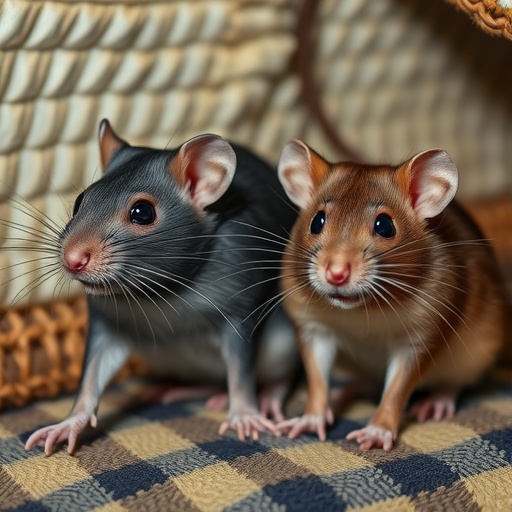
In groundbreaking research published in the esteemed journal JNeurosci, a team of neuroscientists led by John Christianson at Boston College delved into the intricate neural mechanisms that govern social decision-making in male rats. Focusing on the communication between two critical brain regions—the insular cortex and the prefrontal cortex—the study unveils how this neural pathway orchestrates complex social behaviors in response to distress cues from conspecifics. By dissecting these neural circuits, the researchers provide valuable insights into the biological substrates of empathy and social cognition, with far-reaching implications for understanding psychiatric conditions involving social dysfunction.
The insular cortex, a deep-seated brain structure conserved across mammalian species including rodents and humans, acts as an integrative hub where information about external environmental context and internal physiological states converge. Christianson and colleagues emphasize that this region’s unique capacity to bind self-related information with sensory inputs makes it pivotal in shaping behavioral responses to social stimuli. Acting as a conduit, the insular cortex relays this synthesized information to the prefrontal cortex—the executive brain area responsible for higher-order decision-making processes. The researchers posited that this connection is vital for adaptive social behavior, particularly in recognizing and reacting to the emotional states of others.
Experimentally, the study employed a nuanced behavioral paradigm wherein male rats encountered either stressed juvenile pups or adult peers exhibiting signs of distress. Remarkably, the rats displayed a clear differential social preference: they were drawn toward the stressed pups while avoiding the distressed adults. This pattern indicates that rats discriminate social cues based on the age and possibly the vulnerability of their conspecifics, prompting context-dependent decision-making. The dichotomous interaction suggests that the presence of an afflicted juvenile triggers a more immediate, perhaps biologically ingrained, caregiving response compared to the more ambiguous distress signals emanating from adult rats.
To dissect the neural substrates underlying these behaviors, the research team used targeted manipulations to disrupt activity within the insular and prefrontal cortices, as well as the neural communication between these regions. The perturbations led to profound alterations in social choice behavior, highlighting the indispensable role of the insula-prefrontal cortex pathway in regulating these social decisions. The interference not only impaired the preference for pups but also modulated avoidance behavior toward adults, underscoring the pathway’s critical involvement in balancing approach-avoidance responses in social contexts.
One of the salient questions arising from this work is the nature of the specific information conveyed along the insula-prefrontal cortex axis. Christianson notes that while pathway disruption clearly affects behavior, the precise content of transmitted neural signals remains elusive. Are these signals encoding the emotional valence of stress, age-related social categories, threat assessment, or an integration of these factors? Addressing this query requires detailed electrophysiological recordings and neural decoding analyses to parse the dynamic patterns of activity during social encounters, an endeavor the team is actively pursuing.
The implications of these findings extend beyond basic neuroscience, offering a potential translational framework for psychiatric disorders characterized by social anxieties and trauma-related dysfunction. Since human social behavior also depends on nuanced interpretations of others’ emotional states—processes often disrupted in conditions such as autism spectrum disorder, social anxiety disorder, and post-traumatic stress disorder—the rodent model provides a mechanistic gateway to novel therapeutic targets. By understanding how the insula-prefrontal pathway modulates social affective behavior, clinicians and researchers may develop interventions that restore or mimic these neural patterns to alleviate social deficits.
Furthermore, this research contributes to a broader understanding of empathy in brain function, expanding the scope from human-centric models to conserved evolutionary circuits observable in rodents. The capacity of rats to differentiate between social cues based on perceived vulnerability ties into fundamental neurobiological principles linking affective processing with decision-making. As such, these discoveries may refine existing theories on the neural basis of empathy and social cognition by anchoring them in identifiable circuit dynamics and measurable behaviors.
The study also highlights the functional relevance of the prelimbic area within the medial prefrontal cortex. This region, situated at the crossroads of emotion regulation, memory, and executive function, integrates multisensory information received from the insula, supporting rapid yet contextually appropriate social decisions. The preciseness of such integration promises a fertile ground for future exploration into how internal states bias decision circuits to produce adaptive social responses, a missing piece in understanding real-world social interactions.
From a technical standpoint, the methodology employed reflects a sophisticated fusion of behavioral neuroscience with neural circuit manipulation. By combining lesion techniques, pathway-specific inhibition, and behavioral assays, the researchers established a causal link between structural connectivity and social function. This experimental rigor sets a new standard for probing complex neurobehavioral phenomena, advancing the field toward elucidating how discrete brain pathways shape multifaceted social emotions and interactions.
Despite these advances, the study leaves open pressing questions about the temporal dynamics and plasticity of the insula-prefrontal pathway during social encounters. Does its activity fluctuate depending on the familiarity of conspecifics, the intensity of distress signals, or other contextual variables such as environmental threats? Also, how does experience shape this circuit’s responsiveness over time—can social learning modulate the neural encoding of distress to refine social behaviors? These avenues await further investigation, promising richer insights into the fluidity and adaptability of social brain networks.
In summary, Christianson and his team have charted a neural pathway that underpins vital aspects of social affective behavior in rats, revealing the insular cortex’s pivotal role in conveying internal and external contextual cues to the decision-making prefrontal cortex. The differential approach-avoidance responses to juveniles versus adults emphasize the sophistication and specificity of rat social cognition. This work not only enriches our understanding of fundamental brain-behavior relationships but also lays the groundwork for innovative treatments targeting social dysfunction in neuropsychiatric disorders.
This pioneering investigation into the insula-prefrontal cortex interplay opens up new scientific vistas by linking neuroanatomy, physiology, and behavior in an integrative framework. It calls for a reevaluation of how social signals are processed and acted upon in the brain and inspires future cross-species comparative studies. By mapping how the brain’s intricate circuitry negotiates the emotional states of others, the study enhances our grasp of the biological roots of empathy and the neural basis for social resilience.
The research exemplifies the power of modern neuroscience to unravel the complexity of social behavior through mechanistic and circuit-based approaches. As the team’s next endeavors unfold, with plans to decode neural signatures and contextual processing in real-time, the scientific community eagerly anticipates further revelations about the neural substrates that modulate social affect and decision-making. Such knowledge holds transformative potential for both basic science and clinical application, ultimately enriching our understanding of the social brain.
News Publication Date: 4-May-2026
Web References: http://dx.doi.org/10.1523/JNEUROSCI.1747-25.2026
Cite Scienmag News
Cassandra Pierce. (May 4, 2026). How Do Rats Decide to Approach or Avoid Distressed Peers? Scienmag. https://scienmag.com/how-do-rats-decide-to-approach-or-avoid-distressed-peers/
Cassandra Pierce. "How Do Rats Decide to Approach or Avoid Distressed Peers?" Scienmag, 4 May 2026, https://scienmag.com/how-do-rats-decide-to-approach-or-avoid-distressed-peers/. Accessed 4 September 2026.
Cassandra Pierce. "How Do Rats Decide to Approach or Avoid Distressed Peers?" Scienmag. May 4, 2026. https://scienmag.com/how-do-rats-decide-to-approach-or-avoid-distressed-peers/


