


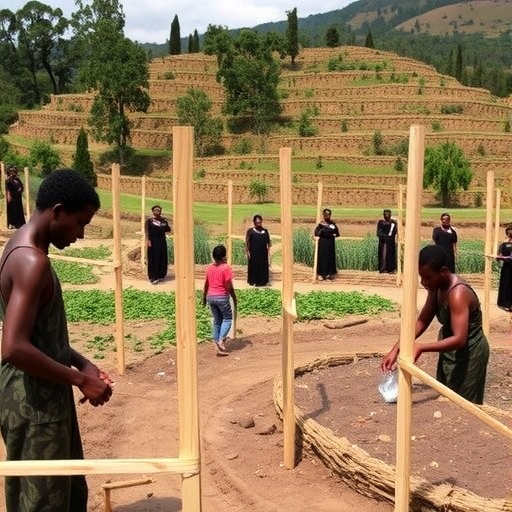
A vast network of pre-Hispanic earthworks in Colombia’s La Mojana region is challenging the long-standing idea that ancient societies transformed wetlands through short-lived, environmentally damaging campaigns. New research suggests that these field systems were sustained by collective labour, detailed knowledge of seasonal water movement and repeated maintenance—an agricultural strategy that may offer striking lessons for farming in a future defined by floods, droughts and climate instability.
The study, published in Communications Sustainability by Jordi Vieri, Fernando Montejo Gaitán, Marc Carrero-Pazos and colleagues, examines the archaeological landscape of La Mojana, a flood-prone lowland in northern Colombia. The region lies within the lower Magdalena River basin, where rivers, marshes and seasonal wetlands continually reshape the ground. Instead of treating the landscape as an obstacle to cultivation, pre-Hispanic communities engineered it. They constructed raised fields, canals and related earthworks that reorganised the movement of water across the plain.
These systems were not simply isolated mounds of soil. They formed interconnected landscape networks in which elevated planting areas were positioned alongside channels and low-lying zones. During periods of intense rainfall or river flooding, excess water could move through the canals, reducing prolonged saturation around crops. During drier intervals, the same water bodies could help retain moisture. The engineering therefore worked through regulation rather than complete control: farmers did not eliminate the wetland’s natural hydrology but modified its timing, direction and local effects.
That distinction is central to the researchers’ interpretation. Conventional accounts of ancient agricultural intensification often focus on how much labour a society could mobilise or how dramatically it could alter its environment. The La Mojana evidence points toward a more dynamic process. The productivity and durability of the field systems depended on keeping earthworks functional over time. Channels could become blocked by sediment, embankments could erode and planting surfaces could require renewal. Their survival would have required regular, coordinated work rather than a single episode of construction.
The research connects this maintenance burden with collective forms of labour and social organisation. Building raised fields and canals across a floodplain would have demanded the movement of large volumes of soil, but the more important challenge may have been synchronising tasks across the wider system. Cleaning channels, repairing field edges and adapting structures to changing water levels would have involved cooperation among households or communities. The landscape thus became both an agricultural technology and a physical record of social relationships.
The technical significance of the findings lies in the way the field systems integrated hydrology, soil management and crop production. In waterlogged environments, plant roots can suffer from oxygen deficiency, while stagnant water can increase the risk of disease and nutrient loss. Raised cultivation surfaces improve drainage around the root zone, while canals can transport or temporarily store water. Organic matter and sediments deposited by seasonal flooding may also have replenished soils, although the benefits would have depended on the speed, depth and duration of inundation. The result was a system capable of exploiting environmental variability instead of being destroyed by it.
The authors’ approach places the archaeological structures within their broader landscape rather than evaluating individual fields in isolation. Patterns of canals, elevated surfaces and low-lying areas reveal how people responded to the floodplain as a connected system. Such analysis is especially important because many earthworks have been damaged by modern agriculture, drainage, pasture expansion and other forms of land-use change. Studying their remaining spatial organisation can help distinguish deliberate engineering from natural ridges and channels, while also showing how extensive human intervention once was.
The findings are resonating far beyond the archaeology of Colombia because modern agriculture is confronting a similar problem from the opposite direction. Industrial farming has often attempted to simplify landscapes, separate water from fields and depend on fixed infrastructure. Climate change is making those assumptions increasingly fragile. More intense rainfall can overwhelm drainage networks, while longer dry seasons expose crops to water shortages. La Mojana’s pre-Hispanic systems demonstrate an alternative principle: resilience may come from designing agriculture to absorb fluctuations, distribute risk and work with natural water cycles.
The study does not imply that ancient field systems can simply be copied into modern farms. Their operation depended on particular soils, crops, climates and social institutions, and reconstructing them would require extensive ecological and archaeological testing. Nor does collective labour automatically mean that the societies who built the fields were equal or conflict-free. What the research reveals is more specific and more powerful: long-term environmental infrastructure requires long-term institutions capable of organising maintenance. In La Mojana, sustainability was not embedded in earthworks alone; it was produced through continuing cooperation between people, soils and water.
That conclusion turns an apparently vanished agricultural landscape into a message about the future. The raised fields and canals of La Mojana show that technological sophistication does not always mean suppressing nature with larger barriers, deeper drainage or greater energy use. Sometimes it means reading a difficult environment accurately and building systems that remain flexible within it. By linking ancient engineering to the social labour that kept it alive, the study presents sustainability not as a static design but as an ongoing collective practice—one that may become increasingly vital as the world’s farms face a more unpredictable climate.
Cite Scienmag News
Denise Maddox. (August 14, 2026). How Collective Labor Sustained Pre-Hispanic Fields in La Mojana. Scienmag. https://scienmag.com/how-collective-labor-sustained-pre-hispanic-fields-in-la-mojana/
Denise Maddox. "How Collective Labor Sustained Pre-Hispanic Fields in La Mojana." Scienmag, 14 August 2026, https://scienmag.com/how-collective-labor-sustained-pre-hispanic-fields-in-la-mojana/. Accessed 4 September 2026.
Denise Maddox. "How Collective Labor Sustained Pre-Hispanic Fields in La Mojana." Scienmag. August 14, 2026. https://scienmag.com/how-collective-labor-sustained-pre-hispanic-fields-in-la-mojana/


