

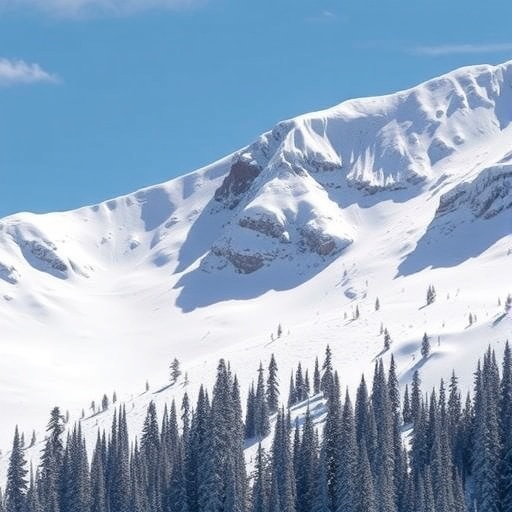
In recent years, the Pacific Northwest has witnessed unprecedented shifts in winter weather patterns, marked by increasing temperatures that profoundly alter snowfall dynamics across the region. What was once a consistent parade of snowflakes now includes frequent bouts of rain during winter months, events that are drastically reshaping the structure and stability of snowpacks. A growing body of research from the University of Washington is shedding light on how these rain-on-snow events lead to the formation of melt-freeze crusts within snow layers—a phenomenon with significant implications for avalanche risk and broader ecological impacts in cooler inland areas.
The fundamental mechanism behind crust formation is deceptively simple yet consequential: when rain falls onto existing snowpack during near-freezing conditions, the liquid precipitation infiltrates the snow’s porous structure and subsequently freezes, creating an impermeable icy crust. This crust acts as a critical boundary that bifurcates the snowpack, often leading to unstable stratification where overlying snow accumulations can easily slip, initiating avalanches. Traditionally, these crust formations have been primarily associated with maritime regions of the Pacific Northwest, but recent warming trends are extending this hazard to colder, more inland mountainous areas unaccustomed to such dynamics.
Avalanche professionals in Western Washington, who have long contended with rain-on-snow episodes, possess the expertise and experience needed to forecast and mitigate risks arising from icy crusts. However, counterparts in the drier, colder east—spanning Eastern Washington, Idaho, and Montana—are encountering an evolving threat landscape as warmer winters trigger conditions favorable for crust formation in these regions. The University of Washington’s new investigation employs comprehensive climate data and sophisticated snowpack modeling to project these changes and underline the urgency of adapting avalanche forecasting to new regional norms.
The research hinges on extensive climate records gathered from 53 monitoring sites scattered across the Pacific Northwest over the last quarter-century. Using this data, scientists developed and validated a numerical model capable of pinpointing days when melt-freeze crusts likely formed, achieving roughly 74% accuracy when compared with ground truth measurements from Snoqualmie Pass. This validation gives credence to subsequent simulations that imposed 2°C and 4°C warming scenarios to mimic projected future climates, enabling the team to visualize how crust formation patterns would shift under intensified warming.
Insights from the climatic simulations reveal a striking regional dichotomy demarcated by the Cascade Mountains. In the maritime-influenced west, rising temperatures tend to produce more slushy snow conditions rather than the solid ice crusts, potentially reducing avalanche risks related to crust boundaries. Conversely, the inland and higher elevation zones—historically characterized by colder and drier winters—display an increase in rain-on-snow events, leading to more frequent crust formation and thus elevated avalanche hazards. These findings highlight the nuanced and spatially variable nature of snowpack response to climate warming in mountainous environments.
Beyond avalanche safety, these structural changes in snowpack bear ecological consequences. Firm ice crusts can obstruct foraging behaviors of subnivean mammals, like reindeer or other grazers that rely on digging through snow to access lichen and other vegetation. Conversely, the same icy layers can harden the surface, providing runways that might aid in predator evasion. These subtle shifts in snowpack characteristics could ripple through local food webs and influence wildlife survival strategies, emphasizing the multifaceted impact of climate-driven cryospheric changes.
The implications extend further into the realm of community safety and infrastructure. Events where avalanches are triggered by unstable crust layers may shut down critical transportation corridors in seconds, delivering severe disruptions and exposing backcountry travelers to heightened risks. As high-elevation rain events become more common in regions where forecasters lack experience with such phenomena, the forecasting community faces a steep learning curve, underscoring the need for broadened knowledge sharing and updates to predictive models to incorporate new climatic realities.
Clinton Alden, lead author and civil and environmental engineering graduate student at UW, underscores the immediate need for readiness. “The warming trend signals a future in which regions traditionally spared from ice crust-related avalanches must now grapple with their complexities,” he explains. This call to action is echoed by avalanche forecaster John Stimberis, who highlights that states like Colorado and Wyoming are already reporting rain at elevations previously deemed too cold, fueling uncertainty about when avalanches may commence or stabilize.
This research sits at a critical intersection of climate science, hydrology, and hazard mitigation, filling a longstanding gap in our understanding of snowpack internal layering as climate warms. While snowfall amount and water content have been extensively studied, the nuanced layering within snowpacks—and how this structure influences stability and wildlife—remains an underexplored frontier. The University of Washington’s contributions pave the way for enhanced avalanche models that integrate these microstructural details into broader predictive frameworks.
As warming persists, these findings carry urgent messages for policymakers, environmental managers, and recreational users alike. The snowpack’s evolving complexity demands refined forecasting tools that move beyond bulk snow measurements to include microphysical changes wrought by freeze-thaw cycles and precipitation phase shifts. Coordinated efforts to extend training and data sharing among regional forecast teams could help bridge expertise gaps and bolster resilience to the new avalanche realities articulated by this study.
Looking ahead, further investigations are required to pinpoint the ecological ramifications at species and ecosystem scales and to refine human safety protocols in changing snow landscapes. Interdisciplinary collaboration among climatologists, wildlife biologists, and avalanche forecasters will be essential to crafting adaptive strategies that mitigate avalanche risk without compromising environmental integrity.
For communities and ecosystems nestled within mountain ranges of the Pacific Northwest and beyond, understanding and preparing for the consequences of melt-freeze crust proliferation is no longer optional—it is a requisite for survival in a climate-altered world. The research from the University of Washington offers a critical lens into this transformation, underscoring that rising temperatures will indelibly shift the mountain snowscape’s stability, ecology, and human interactions in ways that demand immediate scientific and societal engagement.
Subject of Research: Climate warming impacts on snowpack structure and avalanche risk in the Pacific Northwest
Article Title: Higher Temperatures Lead to More Melt-Freeze Crusts in Snowpacks in Cooler Regions of the Pacific Northwest
News Publication Date: 25-Feb-2026
Web References: http://dx.doi.org/10.5149/ARC-GR.2451
References: Alden, C., Lundquist, J. D., Stimberis, J., & Sullender, B. K. (2026). Higher Temperatures Lead to More Melt-Freeze Crusts in Snowpacks in Cooler Regions of the Pacific Northwest. ARC Geophysical Research.
Image Credits: Clinton Alden
Keywords: snowpack structure, melt-freeze crust, rain-on-snow events, avalanche risk, Pacific Northwest, climate change, snow stability, avalanche forecasting, snow hydrology, climate warming impacts


