


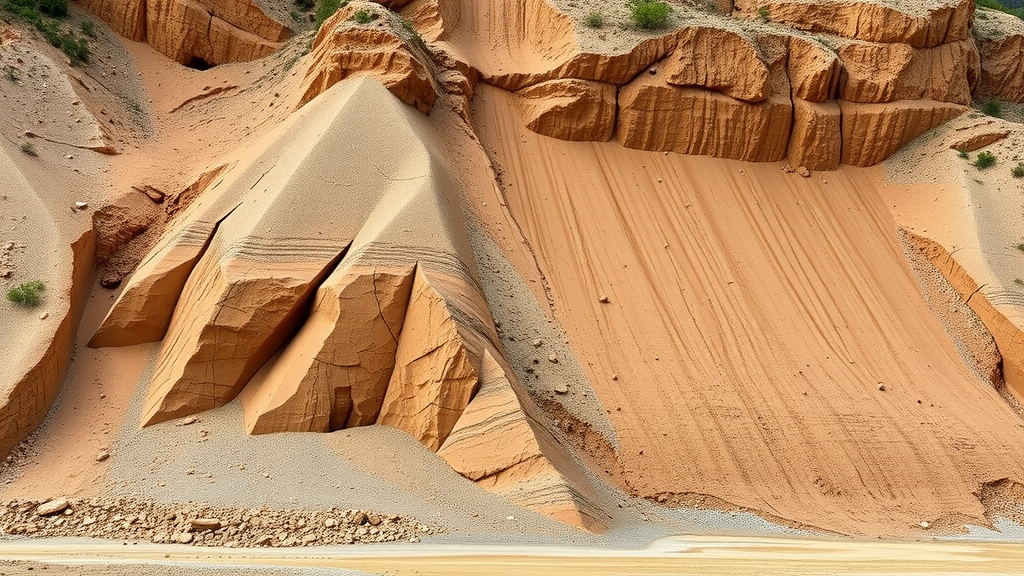
Deep in the mountains of China and across the world’s steepest terrain, enormous landslides that failed thousands of years ago lie dormant beneath forests, villages, and highways. These ancient landslide deposits look stable, but they are sleeping giants: under sustained rainfall, parts of them can stir back to life. A new study published in Natural Hazards reveals that whether one of these dormant masses reawakens as a sudden, shallow, dangerous slide or as a slow, incremental collapse may hinge on a seemingly modest variable — the amount of clay mixed into the sliding body. The finding, from Ruian Wu of the Institute of Geomechanics at the Chinese Academy of Geological Sciences and colleagues, offers engineers and hazard planners a practical material-based clue for predicting how ancient slopes will behave when the rains come.
The research team confronted a long-standing uncertainty in landslide science. Reactivation of an ancient landslide deposit under rainfall is governed by the coupled hydraulic and mechanical properties of the deposit — how quickly water moves through it, how much water it retains, and how the material’s strength changes as it wets. But scientists have lacked a clear picture of how these properties vary with clay content, and, critically, how that variation shapes the mode of failure. A deposit dominated by clay drains slowly but sticks together; a gravelly, sandy deposit drains fast but binds weakly. Which behavior dominates the response to a storm, and does that behavior change the style of reactivation? To answer that, the team ran controlled physical model tests paired with numerical simulations, isolating clay content as the key difference between two otherwise identical slopes.
The experimental design was deliberately rigorous. Both physical models shared the same geometry, the same rainfall intensity, the same material in the sliding zone at the base, the same boundary conditions, and the same monitoring layout. The only deliberate variable was the clay content of the sliding body itself. This kind of controlled comparison is rare in landslide research, where real slopes differ in a dozen confounding ways at once. By holding everything constant except the clay fraction, the researchers could attribute differences in behavior directly to changes in permeability, cohesion, and internal friction angle associated with that fraction. Matching numerical simulations allowed them to track wetting fronts and pore water pressure fields inside the slope in ways that surface instruments alone could not resolve.
What the two models did was strikingly different. The model with lower clay content had higher permeability, lower cohesion, and a slightly higher internal friction angle. Under the same rainfall, water penetrated it faster and more evenly: the wetting front advanced rapidly, the wetted zone spread spatially across a broad, continuous band of the deposit, and pore water pressure built up over an extensive area. Mechanically, the consequences followed. The slope first developed tension cracks at its rear, then failed quickly in a shallow slide along a brand-new shallow shear surface — a rapid, comparatively energetic remobilization of material that would give future inhabitants far less warning time than a slow creep.
The high-clay model told the opposite story. With lower permeability and higher cohesion, water entered the deposit reluctantly and stayed localized. Instead of a fast, shallow failure, the slope experienced an earlier localized collapse at its toe — the downstream end of the deposit — followed by a slower backward progression of instability, with the front edge collapsing much later. In other words, the clay-rich deposit failed incrementally, from the bottom up, in a staggered sequence that stretched the deformation over a longer period. For hazard purposes, the two styles represent very different risk profiles: the low-clay mode is a sudden event, while the high-clay mode is a progressive one that may offer more time for detection, evacuation, and intervention — but only if the retrogressive pattern is recognized for what it is.
Perhaps the most consequential finding is what did not happen in either model. Neither slope failed along the pre-existing sliding zone inherited from the original ancient landslide. In both experiments, the observed processes represented localized remobilization within the ancient deposit rather than a wholesale reactivation of the old failure surface. This challenges a common assumption in hazard assessment — that reactivation means the ancient slide simply slides again along its ancient track. Instead, rainfall can carve new failure surfaces within the old deposit’s mass, meaning that monitoring strategies focused exclusively on the known sliding zone may miss the deformation that actually threatens people.
The study also disentangles which physical property controls which aspect of the response, a distinction with direct engineering value. Permeability, the researchers found, mainly determined the rate, spatial pattern, and extent of rainfall infiltration — how fast the wetting front moved, how continuous the wetted zone became, and how widely pore water pressures responded. But the timing and the mode of failure could not be explained by permeability alone. Those outcomes reflected the combined changes in permeability, water retention, cohesion, and internal friction angle that come with changing clay content. In the low-clay deposit, weak cohesion and widespread wetting conspired to open tensile cracks at the rear and trigger rapid shallow sliding; in the high-clay deposit, strong cohesion delayed widespread failure while low permeability concentrated stresses near the toe, initiating a retrogressive collapse sequence.
The implications reach far beyond the laboratory. Ancient landslide deposits are abundant along steep river corridors such as the upper Jinsha River and the Sichuan–Tibet transportation corridor in China, where infrastructure corridors and growing settlements sit atop or below enormous dormant masses. Global climate change is intensifying rainfall extremes, and a substantial literature — including studies of rainfall thresholds for landslide occurrence and climate-induced reactivations — warns that reactivations of old slides are likely to become more frequent. Knowing the clay content of a deposit’s sliding body, which can be estimated from drilling, sampling, and geophysical surveys, gives practitioners a way to anticipate the failure mode before it unfolds: clay-poor deposits warrant rapid-response monitoring for shallow, fast-moving failures, while clay-rich deposits call for surveillance aimed at detecting toe deformation and progressive retrogression.
The authors note that clay content should therefore be considered when monitoring ancient landslide deposits with comparable material and geometric conditions, and when mitigating the hazards they pose. The work was supported by the National Natural Science Foundation of China, the National Key R&D Program of China, the China Geological Survey, and the China Scholarship Council. While the model tests simplify nature — real deposits are heterogeneous, layered, and shaped by their own histories — the controlled pairing of physical experiments and numerical simulation provides a mechanistic foundation that field studies alone cannot supply. The broader lesson is humbling and empowering at once: the behavior of a sleeping landslide may be written in its smallest particles, and reading that signature could be the difference between a managed hazard and a catastrophe.
Subject of Research: How clay content controls the rainfall-induced reactivation modes of ancient landslide deposits
Article Title: Effects of clay content on reactivation modes of ancient landslide deposits under rainfall
Article References: Wu, R., Guo, C., Han, B., Song, D., Li, X., & Ma, H. (2026). Effects of clay content on reactivation modes of ancient landslide deposits under rainfall. Natural Hazards, 122(20), Article 646. https://doi.org/10.1007/s11069-026-08415-z
Image Credits: AI Generated
DOI: 10.1007/s11069-026-08415-z
Keywords: ancient landslide, clay content, reactivation modes, rainfall infiltration, permeability, pore water pressure, shallow sliding, cohesion, physical model test, landslide hazard, slope monitoring, Natural Hazards
Cite Scienmag News
Courtney Benton. (September 23, 2026). How Clay Content Decides Whether Ancient Landslides Creep Back or Collapse Fast. Scienmag. https://scienmag.com/how-clay-content-decides-whether-ancient-landslides-creep-back-or-collapse-fast/
Courtney Benton. "How Clay Content Decides Whether Ancient Landslides Creep Back or Collapse Fast." Scienmag, 23 September 2026, https://scienmag.com/how-clay-content-decides-whether-ancient-landslides-creep-back-or-collapse-fast/. Accessed 5 October 2026.
Courtney Benton. "How Clay Content Decides Whether Ancient Landslides Creep Back or Collapse Fast." Scienmag. September 23, 2026. https://scienmag.com/how-clay-content-decides-whether-ancient-landslides-creep-back-or-collapse-fast/


