


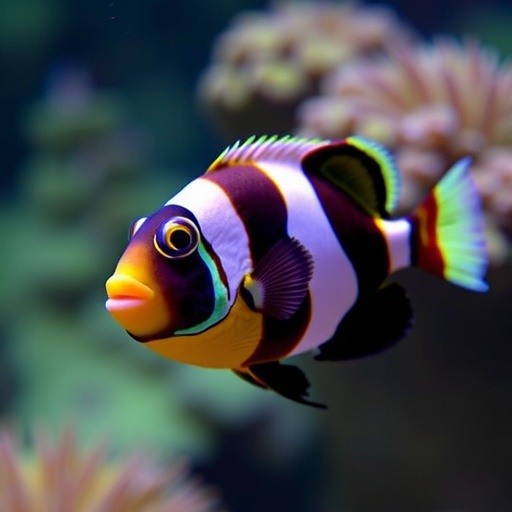
Picasso triggerfish kept in a laboratory for years behave measurably differently from newly caught reef fish, even when given the same behavioural and cognitive tests, according to an open-access study published 14 March 2026 in the journal Animal Cognition. James Cordery, Nick A. R. Jones and Cait Newport compared two groups of the same species, Rhinecanthus aculeatus—one held long-term at the University of Oxford and the other recently caught around Lizard Island in Queensland, Australia—and found differences across every one of four standard behavioural assays they used.
The Picasso triggerfish has become something of a workhorse in comparative cognition. The species is hardy in captivity, quick to feed, and has previously been trained in laboratory tasks including visual discrimination and counting-like numerosity judgements, work largely conducted in Cait Newport's laboratory. That history made it a sensible choice for the new study: if long-term laboratory experience reshapes behaviour even in a species known to perform well in cognitive tasks, the implications extend across the many fish species now used in behavioural research.
The study was motivated by anecdotal observations that fish trained in the laboratory seemed slower to learn, less motivated by food rewards and less willing to interact with experimental stimuli than field-trained counterparts. Rather than trying to isolate a single cause, the researchers set out to quantify the overall magnitude of variation that can arise when multiple uncontrolled factors differ at once. They defined "experimental context" broadly, encompassing testing site, provenance, prior experience, age, sex, transport conditions, lighting, temperature and tank size—everything that was not held constant between the two groups. This deliberate looseness mirrors the reality of most comparative research, where laboratories inevitably differ in dozens of small ways that no protocol can fully standardise.
Fourteen fish made up the Oxford group, all wild-caught but obtained from commercial suppliers and held in the laboratory for varying periods. Ten fish were collected by snorkellers around Lizard Island between 9 and 11 March 2024, under government and marine park permits, using hand-nets and a diluted clove oil anaesthetic. Field fish were transported by boat in under twenty minutes and given four to five days to acclimate before testing began—the time the researchers had previously found necessary for normal feeding and the cessation of hiding. At both sites, fish were housed individually and tested in their home tanks to minimise handling stress, fed twice daily, and not tested immediately before a feed. These shared husbandry features mattered: by testing fish in familiar home tanks rather than novel apparatus, the researchers removed at least one major source of stress that could otherwise have masked or exaggerated group differences.
The four assays were chosen because they are fast, easy to implement and widely used across animal behaviour research. The Novel Object Test presented each fish with a different unfamiliar object on four consecutive days: a 3D-printed stylized coral, a yellow pickleball, plastic aquarium seaweed and a stack of six blue-and-yellow Lego bricks. Blue and yellow were selected because Picasso triggerfish show sensory biases towards this colour combination. The researchers recorded the number of bites directed at each object, the latency to first bite, and the total time spent hiding. Novel object tests have a long history in studies of animal personality, where biting or approaching an unfamiliar item is conventionally read as boldness or exploratory tendency, and hiding as shyness or neophobia.
The results were object-specific. Recently caught Lizard Island fish bit the Lego stack and pickleball roughly five times more often than Oxford fish, and bit the coral significantly sooner. Yet the field fish also spent significantly longer hiding when the seaweed was presented—a pattern the authors interpret as increased neophobia towards some stimuli rather than simple boldness. Oxford trials more often ended with no biting at all: 45 percent of Oxford trials showed zero bites compared with 20 percent at the field site. The authors suggest that differences in past experience, or how recently those experiences occurred, may have shaped whether individuals perceived particular objects as attractants or deterrents. The finding underlines how a single "boldness" assay can yield contradictory readings depending on the stimulus chosen, since the same individuals could appear both bolder and more fearful within the same test battery.
The Puzzle Preference Test added a problem-solving component to a food choice assay. A clear plastic feeder with five wells, each covered by a transparent swivel door, was baited with five food types: mussel, squid, shrimp, mackerel and Hikari Marine-A pellets. Fish first had to learn to push the doors aside in a five-day training phase, then completed fifteen choice trials in which the first item consumed was taken as the measure of preference. Most fish at both sites solved the feeder quickly, and the difference in first-trial pass rates was not statistically significant, though three Oxford fish that never interacted with the apparatus were excluded. The researchers stress that exclusions of this kind are themselves a contextual signal: animals that refuse to engage with an apparatus are providing information about motivation, not simply missing data.
Both groups showed clear preferences, but they differed by location. Lizard Island fish most often chose mackerel first (40 percent of trials) followed by mussel, and never chose pellets first. Oxford fish favoured mussels over mackerel, with pellets also least preferred. The authors attribute this partly to food familiarity: Oxford fish are routinely fed a varied seafood diet including mackerel, whereas wild triggerfish are unlikely to encounter it. Pellets, though nutritionally consistent, appear to be a low-value reward, and the authors argue that empirically assessing reward value—or tailoring rewards to the population being tested—should be an integral part of experimental design, since tasks intended to measure cognition may instead reflect differences in hunger, reward valuation or prior experience. This point carries weight for the many learning studies in fish that rely on food rewards as motivators: a reward that one population barely values can quietly depress measured performance.
The Emergence Test, run inside each fish's home tank, measured how long an individual took to leave a grey acrylic box after its door was raised. Here the pattern reversed: Oxford fish emerged roughly 35 percent faster on average, suggesting greater exploratory tendencies or reduced hesitation—possibly because they were more familiar with controlled environments. The test also revealed substantial individual variation. Emergence time showed moderate repeatability across trials, with individual fish differing both in average speed and in consistency. Repeatability—the proportion of behavioural variation attributable to differences between individuals—is widely regarded as the upper bound of heritability for a trait, making it a key statistic in studies of animal personality. One Oxford fish, F56, took a maximum of 214 seconds to emerge—more than eighty times the Oxford group mean of 2.62 seconds—while others were significantly more variable or more consistent than average, a reminder that group means can conceal dramatic individual differences.
The Cylinder Test, adapted from the ManyFishes cross-species initiative, assessed inhibitory control: fish had to detour around a transparent cylinder to reach visible food, and touching the cylinder counted as failure. The ManyFishes project, which applies identical protocols to dozens of fish species across laboratories worldwide, depends on the assumption that results are comparable between sites—an assumption this study was designed to probe. After plate training, cylinder familiarisation and a forced trial in which fish had to swim through the cylinder, eighteen fish reached the final phase, nine from each site. All ten Lizard Island fish failed, always contacting the cylinder. Seven of nine Oxford fish achieved at least one successful pass—a highly significant difference on its face. But a methodological artefact undermined this result. The Oxford tanks have a horizontal lip supporting lids, so the dividers had notches and required a twisting motion to remove, which frequently nudged waiting fish toward the tank sides, letting them approach the cylinder at an angle. Under a conservative reading, only one Oxford trial—one fish in one trial that swam clearly around the cylinder without contact—showed unambiguous detour behaviour, and with that interpretation the group difference disappears statistically.
The authors are careful about what these results do and do not show. They cannot conclude that Picasso triggerfish lack inhibitory control, since other fish species demonstrably possess it and the fish were not habituated to retrieving food from an opaque cylinder first, a common feature of cylinder-test paradigms. The binary pass-fail format also limits the nuance of the data. Still, the authors retained the Oxford results because not all fish passed despite the shared potential bias—if the divider fully dictated behaviour, every fish should have passed every trial. Their transparency about the artefact itself illustrates a growing norm in the field: reporting potential confounds openly rather than burying them, so that other laboratories can design around them.
Analyses used generalised linear mixed models with fish identity as a random intercept, revealing significant among-individual variation in the novel object and emergence tests but not in food preference, suggesting that assays tapping personality traits such as boldness are more likely to expose individual differences. The authors also note plausible contributors to the group differences, including water temperature—Lizard Island tanks ran three to six degrees warmer than Oxford conditions, which has been linked to increased boldness in zebrafish—though temperature alone does not explain the object-specific neophobia seen in field fish. Metabolic rate, activity level and exploratory behaviour are all known to shift with thermal environment in fishes, making climate of origin and housing temperature genuine variables in cross-laboratory comparisons rather than incidental details.
The practical upshot is a recommendation for anyone comparing cognition across laboratories, wild-caught populations or captivity durations. Because the same species produced different results under different contexts even with standardised protocols, group comparisons may inadvertently capture contextual effects rather than cognitive differences. The authors propose running quick behavioural assays before cognitive experiments to measure baseline variation, informing power analyses and design. Of the four tests, the Emergence Test emerged as the most practical screening tool: sensitive to individual differences, moderately repeatable, and straightforward to run and analyse, though the authors caution that emergence assays are known to be sensitive to minor methodological differences. The novel object test detects group-level differences but loses value with habituation, while the puzzle feeder is best suited to assessing perceived reward value.
The broader lesson is that experimental context is not a nuisance variable to be mentioned in passing but a force capable of reshaping both group-level behaviour and individual variability. The factors researchers can measure and control, the authors note, are ultimately constrained by the experimenter's imagination, and the cumulative impact of all potential differences between groups cannot be fully quantified.
Cite Scienmag News
Glenn Wilkins. (August 30, 2026). How captivity experiences shape Picasso triggerfish behavior and cognition. Scienmag. https://scienmag.com/how-captivity-experiences-shape-picasso-triggerfish-behavior-and-cognition/
Glenn Wilkins. "How captivity experiences shape Picasso triggerfish behavior and cognition." Scienmag, 30 August 2026, https://scienmag.com/how-captivity-experiences-shape-picasso-triggerfish-behavior-and-cognition/. Accessed 3 September 2026.
Glenn Wilkins. "How captivity experiences shape Picasso triggerfish behavior and cognition." Scienmag. August 30, 2026. https://scienmag.com/how-captivity-experiences-shape-picasso-triggerfish-behavior-and-cognition/


