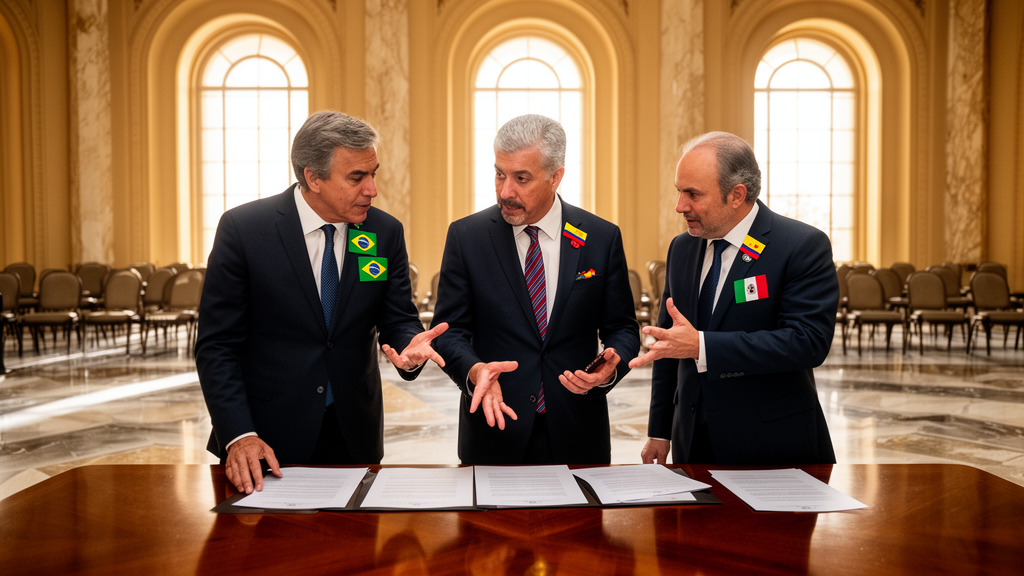
The liberal international order is not collapsing in Latin America. It is being quietly, methodically rewritten from the inside—and the evidence now comes from an unlikely trio of laboratories: Brazil, Colombia, and Mexico. A new study published in Frontiers in Political Science dissects eight years of diplomatic behavior across six governments and finds that none of these middle powers has withdrawn from a single major multilateral institution, even as each has contested specific norms, procedures, and distributions with increasing sophistication. The finding challenges the binary categories—loyal or revisionist, compliant or defiant—that have dominated debates about the crisis of the post-1945 order.
The research team, led by Carlos Hernán Gonzalez Parias of Tecnológico de Antioquia with colleagues from Esumer and Universidad Tecnológica del Perú, examined the period from 2018 to 2026, tracking how the three countries responded to leadership changes of contrasting ideological orientation. Brazil swung from the right-wing government of Jair Bolsonaro to the third administration of Luiz Inácio Lula da Silva. Colombia moved from the conservative Iván Duque to its first left-wing president, Gustavo Petro. Mexico transitioned from one variant of the left to another, from Andrés Manuel López Obrador to Claudia Sheinbaum. Each transition produced a measurable shift in what the government contested—and none produced a break with the institutions themselves.
The study’s central conceptual move is to redefine what political scientists call selective contestation as a bounded, observable category rather than an elastic label for any expression of dissatisfaction. Under the framework, a behavior qualifies as selective contestation only when three elements are jointly present: the state continues participating in a multilateral institution and fulfilling its core obligations; it targets an identifiable institutional object—a named norm, a decision-making procedure, a distribution of benefits or representation; and it seeks to modify, resist, or redirect that object rather than merely voice disapproval. Criticism aimed at abstractions such as unipolarity or globalism, the authors argue, is rhetorical criticism, not contestation. When a state seeks to leave, the behavior is exit. When it simply diversifies partnerships without changing an institutional arrangement, it exercises ordinary foreign-policy autonomy.
Within that category, the researchers distinguish four dimensions by their object. Normative contestation targets a rule of the order itself, such as democratic conditionality or the prohibitionist drug regime. Procedural contestation targets decision rules and claims to authority, including the composition of the UN Security Council and the distribution of IMF quotas. Distributive contestation targets allocations of benefits and costs, from climate finance to vaccine access. Institutional contestation targets the forum itself, through selective participation, forum shifting, or the construction of parallel institutions. The instruments used to contest these objects form a gradation of intensity: reform advocacy from within is least costly, selective non-compliance more so, and forum construction most intense because it threatens an institution’s centrality.
The empirical technique is as revealing as the findings. The team applied dictionary-based, computer-assisted content analysis to twenty-two official national statements delivered to the UN General Assembly between September 2018 and September 2025, using Python with natural language processing libraries to preprocess, tokenize, and lemmatize the texts. Each passage was coded against a four-dimensional dictionary, with explicit rules for what counts and what does not—generic sovereignty rhetoric with no institutional object, for instance, was coded as rhetorical criticism and excluded from contestation profiles. Two researchers coded the corpus independently, resolving discrepancies against the coding rules. The discourse analysis was then paired with coding of observable institutional behavior—membership records, UN voting alignment, financial obligations, and participation in alternative forums—tracked through a cut-off of 31 January 2026.
Brazil’s trajectory produces the study’s most striking contrast. Under Bolsonaro, the coding shows high normative contestation—national sovereignty terms averaged 8.5 mentions per statement—paired with almost no procedural contestation and low institutional loyalty rhetoric. Yet the institutional record tells a different story: Brazil withdrew from no major institution, its UN voting alignment with the United States rose from 45 percent in 2018 to a 62 percent average across 2019 to 2022, and it retained its self-declared developing-country status even after a joint statement with President Trump in March 2019 committed it to forgoing special and differential treatment in current and future WTO negotiations. Under Lula, the profile inverted. Multilateral cooperation terms jumped to 12.5 mentions per statement, institutional reform references to 7.0, and climate justice to 11.0. Brazil cleared accumulated arrears to the UN, WTO, and ILO, regaining suspended voting rights; used its 2024 G20 presidency to secure a Call to Action on Global Governance Reform; and leveraged its 2025 BRICS presidency and COP30 in Belém to press distributive demands on climate finance and dollar dependence.
Colombia moved from the comparison’s low-contestation pole to one of its most active cases. Under Duque, statements averaged 10.2 mentions of multilateral cooperation with only 0.8 references to institutional reform, and the government’s instrumental use of multilateral forums to pressure Venezuela did not qualify as contestation under the inclusion rule because it targeted no part of the arrangement itself. Under Petro, the coding reveals the highest-frequency theme in the entire corpus—climate crisis at 18.5 mentions per statement—combined with 7.5 references to critique of capitalism and 8.0 to institutional reform. His September 2025 address to the General Assembly challenged U.S. drug policy and called for collective UN action on Gaza, prompting the U.S. delegation to leave the chamber. The administration’s most consequential move, however, was institutional: Colombia secured a non-permanent Security Council seat for 2026 to 2027 with 180 votes on 3 June 2025, entering the system’s principal decision-making body to advance a reform agenda from within.
Mexico presents the study’s most consistent pattern, and its most codified constraints. The constitutional principles of Article 89, Section X—self-determination, non-intervention, peaceful settlement of disputes—and the Estrada Doctrine of 1930 anchor a defensive repertoire that persisted across both administrations. Under López Obrador, statements averaged 14.3 mentions of non-intervention and sovereignty, with 4.2 references criticizing unilateral sanctions; the government withdrew from the Lima Group in 2020 and proposed vaccines as global public goods. Under Sheinbaum, the same doctrine now operates with greater multilateral presence: attendance at the G20 in Rio, the CELAC summit in Tegucigalpa, and the G7 in Kananaskis, where she criticized what she termed the economy of destruction produced by rising military spending. On 3 January 2026, following the U.S. military operation in Caracas, Mexico condemned the intervention as a violation of Article 2 of the UN Charter. The authors note that this case rests on sixteen months of conduct and no presidential general-debate statement, making it the most provisional of the three findings.
From the comparison, three analytical types of selective contestation emerge. Asymmetric selective contestation, present in Brazil under Bolsonaro, pairs radical rhetorical challenge to norms with cosmopolitan content—environmental obligations, WHO authority, human-rights conditionality—with accommodation of the economic architecture. The proposed mechanism is coalitional: where a governing coalition is organized around sovereignty and identity claims but depends on internationally integrated economic sectors, contesting cosmopolitan norms is cheap and contesting economic arrangements is costly. Constructive selective contestation, present in Brazil under Lula and Colombia under Petro, combines institutional loyalty with procedural and distributive contestation, operating as a voice strategy in Hirschman’s sense: governments that regard the order as unequal but reformable press for change from within. Defensive selective contestation, present in Mexico across both governments, is doctrinally anchored, narrow in object, and triggered reactively by external events.
The explanation the authors propose locates selective contestation at the intersection of three levels, each doing distinct causal work. The systemic level—eroding U.S. hegemony, rising China, high exit costs—explains why all three states remain inside institutions and gain room to diversify, but it cannot explain why Brazil’s contestation profile reversed between 2022 and 2023 from an unchanged systemic position. The domestic level—ideology, coalition composition, leadership perceptions—explains the direction of variation: right-wing governments contested norms while accommodating economic arrangements; left-wing governments contested distributions and procedures while affirming institutional loyalty. The institutional level explains the bounds: Itamaraty’s career structure and examination-based recruitment, Mexico’s constitutionally codified doctrine, and Colombia’s inherited repertoire of alignment-with-invitation each supplied intermediate options while raising the cost of departing from them. The authors are careful about what the design can establish: with three cases selected because they display the phenomenon and no negative case examined, the four proposed conditions—exit costs, institutional flexibility, asymmetric bargaining power, domestic constraints—cannot be shown to be necessary, and the mechanisms are plausible rather than demonstrated.
What the analysis ultimately reveals is a middle-power strategy that is neither loyalty nor revisionism but recalibration. Contestation concentrates where formal equality diverges most from effective distribution—Security Council composition, climate finance, differential treatment in trade, and the drug-control regime—while trade and financial sub-orders were the least contested across all six governments, and in two were sites of active accommodation. The longer-term stakes are considerable. If institutions fail to incorporate the reform demands of their own members, the study suggests, the plausible outcome is not mass withdrawal but a gradual erosion of legitimacy from within, with incentives for alternative forums—the BRICS New Development Bank, local-currency payment mechanisms, CELAC alongside the OAS—that compete without replacing. And if middle powers conclude that selective contestation yields no substantive reform, pressure may build for more disruptive strategies, from exit coalitions to selective boycotts. Whether the institutions of the post-1945 order prove flexible enough to convert this opposition into renewal, the authors conclude, will depend on their capacity to adapt—much will hinge on that capacity, and the evidence from Latin America suggests the clock is running.
Subject of Research: Selective contestation of the liberal international order by Latin American middle powers
Article Title: Selective contestation of the liberal international order: institutional adaptation strategies in Colombia, Brazil, and Mexico (2018–2026)
Article References: Gonzalez Parias, C. H., Londoño Ossa, G. A., Velásquez Ochoa, J. A., Acosta Strobel, J. A., & Castilla Cabezudo, J. L. (2026). Selective contestation of the liberal international order: institutional adaptation strategies in Colombia, Brazil, and Mexico (2018–2026). Frontiers in Political Science, 8, Article 1957231. https://doi.org/10.3389/fpos.2026.1957231
Image Credits: AI Generated
DOI: 10.3389/fpos.2026.1957231
Keywords: Brazil, Colombia, Mexico, liberal international order, selective contestation, contested multilateralism, middle powers, UN General Assembly, UN Security Council, BRICS, G20, COP30
Cite Scienmag News
Gavin Prescott. (October 15, 2026). How Brazil, Colombia, and Mexico Are Rewriting the Rules of World Order From Within. Scienmag. https://scienmag.com/how-brazil-colombia-and-mexico-are-rewriting-the-rules-of-world-order-from-within/
Gavin Prescott. "How Brazil, Colombia, and Mexico Are Rewriting the Rules of World Order From Within." Scienmag, 15 October 2026, https://scienmag.com/how-brazil-colombia-and-mexico-are-rewriting-the-rules-of-world-order-from-within/. Accessed 15 October 2026.
Gavin Prescott. "How Brazil, Colombia, and Mexico Are Rewriting the Rules of World Order From Within." Scienmag. October 15, 2026. https://scienmag.com/how-brazil-colombia-and-mexico-are-rewriting-the-rules-of-world-order-from-within/