


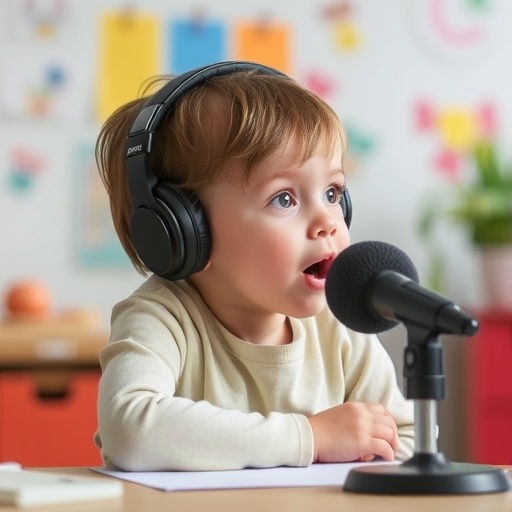
In an intriguing exploration of auditory perception, the work of Samimifar and Bulgarelli sheds new light on how adults decode child speech under varying background noise conditions. This research is particularly relevant in a world where noise pollution is ubiquitous, and where understanding the nuances of speech perception can have monumental implications for educational strategies and communication interventions. The researchers focus on how different types of background noise can significantly shape the cognition of adult listeners when attempting to understand spoken words from children.
Previous studies have established that background noise interferes with speech perception. However, this study goes a step further by specifying that not all noise is created equal. The team conducted experiments to determine how various forms of noise—such as steady-state noises and fluctuating noises—affect the decoding process of child speech. Participants were exposed to recordings of children speaking while subjected to different auditory distractions. This allowed the researchers to analyze not only the accuracy of speech recognition but also the cognitive strategies employed by adults in noisy environments.
The findings revealed that steady-state noise, such as white noise, uniquely impacts the ability of adults to understand child speech. In contrast, fluctuating noise—characterized by changeable intensity and frequency—was found to be less obstructive. This differentiation suggests that the nature of background noise plays a crucial role in auditory processing, thus urging further investigation into its implications for child communication.
One compelling aspect of Samimifar and Bulgarelli’s research is its potential application in educational settings. Teachers, parents, and caregivers who work with children can benefit from understanding how background noise influences speech comprehension. In classrooms, where distractions are common, knowing that certain types of noise can impede spoken language understanding may lead to adjustments in the learning environment to foster better communication.
Moreover, this study has significant implications for developmental psychology and child language acquisition. Since speech from children is often softer and less clearly articulated compared to adults, the pressure of noisy environments can make it even more challenging for adults to engage in effective communication with young learners. The insights gained from this research could drive the development of better educational tools and strategies that can help facilitate clearer communication.
In the realm of speech therapy, these findings also hold promise. Therapists working with children who have speech or hearing impairments can incorporate this knowledge into their practices. By recognizing the types of background noise that hinder understanding, professionals can better tailor their therapy sessions. This could involve creating quieter environments or teaching adults how to modify their speech to accommodate children’s needs in various auditory contexts.
Another fascinating component of this research pertains to the social dynamics of listening in noisy settings. It underscores a broader social context in which adults often struggle to decode messages from children, leading to potential misunderstandings. This is especially critical in family environments where rich communication is essential for emotional bonding and development. Parents equipped with this knowledge can facilitate more supportive communication practices, ensuring that children’s voices are heard amid the chaos of everyday life.
The study also ignites a conversation about urban living and its impact on communication. With cities increasingly crowded and noisy, the ability to decipher speech in such environments is becoming more vital. By mapping the relationship between background noise types and speech perception, this groundbreaking research opens avenues for future studies focused on enhancing communication strategies in urban planning and public spaces.
Considering the technological progression in our soundscape, the implications of this research could even extend into the development of noise-canceling devices aimed at improving speech understanding in crowded or distracting environments. As society continues to embrace innovations in auditory technology, integrating findings from this study could lead to significant advancements in communication aids designed specifically for children.
While the research primarily centers on adults’ perceptions of child speech, it presents opportunities to explore reciprocal dynamics, such as how children perceive adult speech in the presence of background noise. This symmetry in understanding could enrich the educational field, creating holistic approaches to teaching both language and listening skills across age groups.
In summary, Samimifar and Bulgarelli’s research on decoding child speech against a backdrop of noise not only provides vital insights into auditory processing but also emphasizes the importance of context in communication. The findings can inform various fields, from education to health care, by developing targeted strategies that enhance understanding and foster effective communication.
The influence of noise on communication cannot be underestimated, and as this study shows, recognizing the nuances in how different types of background sounds affect speech perception could lead to transformed educational practices, improved therapy approaches, and fundamentally, richer dialogues in our daily lives.
Cite Scienmag News
Glenn Wilkins. (January 18, 2026). How Background Noise Affects Child Speech Comprehension. Scienmag. https://scienmag.com/how-background-noise-affects-child-speech-comprehension/
Glenn Wilkins. "How Background Noise Affects Child Speech Comprehension." Scienmag, 18 January 2026, https://scienmag.com/how-background-noise-affects-child-speech-comprehension/. Accessed 3 September 2026.
Glenn Wilkins. "How Background Noise Affects Child Speech Comprehension." Scienmag. January 18, 2026. https://scienmag.com/how-background-noise-affects-child-speech-comprehension/


