

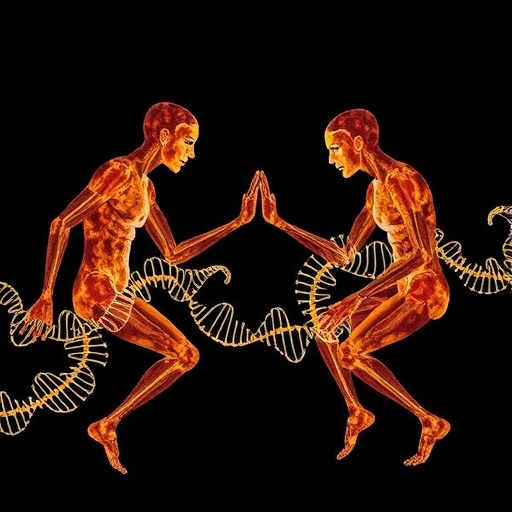
In an illuminating new study reshaping our understanding of human evolution, researchers at the University of Pennsylvania have unveiled compelling genetic evidence pointing to a strongly sex-biased pattern of interbreeding between Neanderthals and anatomically modern humans. This paradigm-challenging discovery originates from an in-depth analysis of genomic data revealing a striking asymmetry in the distribution of Neanderthal DNA, particularly across the X chromosome, that refutes long-standing assumptions about the mechanisms reducing Neanderthal genetic legacy in modern humans.
For decades, scientists have grappled with the mystery of why Neanderthal ancestry, though present across the genomes of most contemporary humans outside Africa, is conspicuously absent from large swaths of the X chromosome, famously termed “Neanderthal deserts.” The conventional narrative imposed natural selection as the predominant force—believing that these “deserts” arose because certain Neanderthal alleles were deleterious, toxic when paired with human genes, and thus selectively purged to enhance biological fitness.
However, the Penn research team, led by Sarah Tishkoff and senior scientist Alexander Platt, has rigorously investigated this phenomenon and uncovered a far more nuanced and socially influenced genetic history. Their data-driven exploration deployed comprehensive comparative genomics between modern human populations and three well-documented Neanderthal genomes—Altai, Chagyrskaya, and Vindija—while also incorporating diverse African genomes as a control group to robustly isolate signals uninfluenced by Neanderthal admixture.
The study’s revelations invert the prevailing assumption regarding reproductive incompatibility. Remarkably, whereas modern humans lack significant Neanderthal X chromosomal DNA, Neanderthals themselves possess a pronounced surplus—approximately 62% more—of modern human DNA on their X chromosomes relative to their autosomes. This mirror-image genetic imbalance serves as a powerful indicator that biological incompatibility does not fully account for the observed patterns.
Instead, the research supports a compelling hypothesis of sex-biased gene flow, wherein interbreeding predominantly occurred between Neanderthal males and human females. This mating directionality provides a mechanistic explanation for why Neanderthal X chromosomes are depleted in modern human genomes while the converse is not true for Neanderthals’ genetic makeup. The differential inheritance patterns of X chromosomes, where females carry two copies and males only one, shape these outcomes biologically, influencing the retention or loss of specific alleles.
Mathematical modeling developed by the researchers corroborated that this sex bias in mating preferences could replicate the distinctive genetic signatures observed in the genomes examined. Alternative hypotheses—including sex-biased migration patterns—were evaluated but required far more elaborate, less parsimonious assumptions involving shifting demographic variables over time and space to fit the data.
This discovery profoundly emphasizes the vital role of social dynamics and behavioral choices in sealing the fate of genetic material passed through generations, expanding evolutionary theory beyond strict natural selection paradigms. The findings suggest that mate choice, cultural behaviors, and social structures played crucial roles in shaping human genomic architecture, sculpting the DNA landscapes we observe today.
Sarah Tishkoff highlights that these insights invite a reevaluation of human-Neanderthal interactions, encompassing not only biological but also social evolutionary processes. The longstanding divergence between modern humans and Neanderthals, occurring roughly 600,000 years ago, created distinct genetic pools as populations adapted to Africa and Eurasia respectively, yet episodic contacts and interbreeding episodes left lasting legacies that are now being decoded.
Looking ahead, the Penn team is delving into the pressing “why” behind the sex-biased gene flow, aiming to uncover the evolutionary, ecological, or social pressures that might have influenced mating behaviors. They are exploring whether patterns of genetic diversity across X chromosomes and autosomes could reveal insights into Neanderthal societal structures—for example, whether female Neanderthals tended to remain in natal groups while males dispersed, a practice with analogs in many modern primate species.
By reconstructing these ancient interactions with genomic precision, the research not only enriches our understanding of human origins but also sheds light on the complex interplay between genetics, behavior, and evolution in our closest evolutionary cousins. This work stands as a testament to the transformative power of integrating molecular genetics with anthropological inquiry to illuminate the profound and intimate chapters of human history.
Daniel Harris, co-first author and research associate in the Tishkoff lab, emphasizes the significance of employing diverse genomic datasets, including African populations unaffected by Neanderthal admixture, to bolster the robustness of their conclusions. Such comparative genomics provides critical control conditions that sharpen interpretations of admixture and gene flow.
This research, published in the prestigious journal Science, was conducted with support from the National Institutes of Health and the American Diabetes Association, underscoring the interdisciplinary nature of modern evolutionary genomics that bridges basic genetic research with advanced computational modeling.
Ultimately, the findings articulate a narrative where social interaction nuances—human preferences, cultural mating dynamics, and sex-specific gene transmission—coalesce to influence species interactions at a genomic scale. This reconceptualization invites broader contemplation of human evolution as a complex mosaic of biology and sociality, altering how evolutionary success and survival are conceptualized.
Subject of Research: People
Article Title: Interbreeding between Neanderthals and modern humans was strongly sex biased
News Publication Date: 26-Feb-2026
Web References:
Keywords:
Human evolution, Neanderthals, Human origins, Human adaptation, Human population, Evolutionary ecology, Extinction, Evolutionary genetics, Darwinism, Phylogenetic analysis, Population studies


