

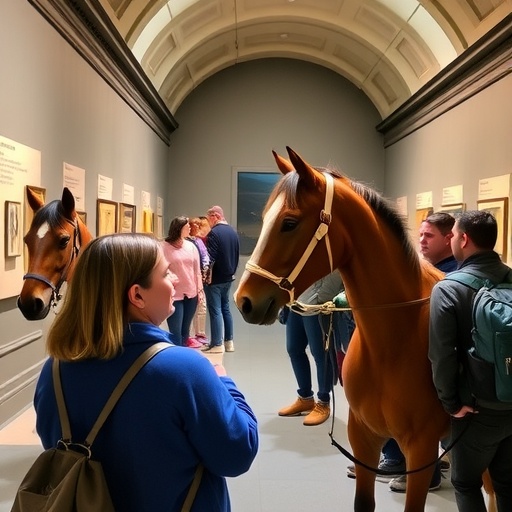
Visitors to museums often appreciate the significance of cultural heritage but rarely feel a meaningful connection to it in their daily lives. This challenge has long troubled museum educators and conservationists alike. Now, a groundbreaking study by researchers from Nagoya University and Gifu University in Japan suggests an unconventional yet highly effective way to bridge that emotional gap: multisensory engagement, including the evocative and unexpected scent of horse manure.
At the heart of this research lies the Kiso horse, a native Japanese breed nearly lost to history. This sturdy horse, once indispensable to mountainous agricultural communities, nearly faced extinction after 20th-century policies favored larger military horses. Through the remarkable survival story of a stallion named Dai-san Haruyama, whose skeleton is now preserved in the Nagoya University Museum, the researchers found a compelling cultural and ecological narrative that could captivate modern audiences if presented in the right way.
The team’s inquiry began with a 2022-2023 exhibition focusing on Dai-san Haruyama, which revealed a persistent problem: visitors recognized the Kiso horse’s cultural importance but consistently viewed it as part of an extraordinary world, distanced from their everyday experiences. This disconnect resulted in superficial engagement, lacking the depth needed to inspire conservation awareness or personal responsibility.
To counter this, the researchers developed an innovative educational framework named the Sense-Science-Significance (S-S-S) model. This model begins by immersing visitors in direct sensory experiences, moves to guided scientific analyses, and culminates in reflective consideration of cultural and ecological significance. This carefully structured progression encourages visitors to internalize heritage as part of their personal world.
In implementing the S-S-S model during a 2024 exhibition at the Kiso Town Cultural Exchange Center, the museum invited visitors to explore more than static displays. Attendees handled hoof models from both Kiso horses and Thoroughbreds, tactilely appreciating the Kiso’s unique build optimized for mountainous terrain. They also smelled horse manure at various stages of fermentation, an experience that deepened understanding of the practical aspects of horse husbandry and highlighted the tangible realities behind conservation.
Alongside these sensory encounters, visitors listened to archival recordings from traditional Kiso horse markets, evoking the vibrant atmosphere of a dying practice. The exhibition paired each sensory activity with scientific explanations of the horse’s biology, ecology, and history, fostering analytical thinking and a curiosity-driven learning environment.
Surveys conducted after the exhibition illustrated the model’s success. A significant majority of participants reflected on ecological and functional considerations they had not previously contemplated. When asked about what they would share with others regarding the Kiso horse, 72% offered detailed, expressive answers—indicating a transformative engagement beyond mere recognition.
The S-S-S framework has since been integrated into over 30 museum education events annually at Nagoya University Museum. Its adaptability allows educators to apply it across a variety of subjects, from physical biological specimens to broader environmental concerns, effectively reaching diverse audiences that include both children and senior adults.
This multisensory, structured approach confronts a fundamental challenge in heritage conservation: how to move visitors from detached admiration to committed concern. By closely tying scientific knowledge to sensory and emotional experience, the model generates a personal relevance that documentary labels and visual displays alone often cannot achieve.
Furthermore, the inclusion of less glamorous sensory elements—like the smell of fermenting manure—helps break down romanticized, superficial notions of cultural heritage, replacing them with authentic, nuanced understandings. Such realism cultivates empathy for the ecological and cultural struggles embedded within living heritage.
According to lead researcher Ayako Umemura, the S-S-S model is not a one-size-fits-all prescription but a flexible guide, designed to be tailored to different contexts and cultural narratives. Its success in Japan points towards global applications, presenting museums worldwide with a powerful tool to reshape how public engagement and conservation education intersect.
As museums strive to remain relevant in the digital age, where fleeting attention competes with immersive experiences at every turn, frameworks like the Sense-Science-Significance model show promise in rekindling deeper, lasting connections between people and their heritage. This research opens exciting new frontiers for conservation, education, and the multisensory storytelling potential of museums as dynamic cultural institutions.
The study underscores a critical lesson for the future of cultural heritage: genuine care emerges not from passive observation, but from active, embodied engagement entangled with sensory experience, scientific insight, and personal reflection. Through the unexpected pathway of horse manure’s scent to emotional investment, this innovative approach redefines the art and science of museum education.
Subject of Research: People
Article Title: Sense–Science–Significance Model: A Museum Education Framework for Engaging Visitors with Cultural Heritage
News Publication Date: 16-Feb-2026
Web References: http://dx.doi.org/10.1080/10598650.2026.2619268
Image Credits: Ayako Umemura, Nagoya University Museum
Keywords: Kiso horse, cultural heritage, museum education, multisensory experience, conservation, Sense-Science-Significance model, visitor engagement, heritage perception, ecological education, Japanese native breeds


