

Recent findings presented at the American College of Cardiology’s Annual Scientific Session (ACC.26) deliver a detailed evaluation of alcohol consumption’s influence on mortality, revealing nuanced health outcomes dependent not only on the quantity but critically on the type of alcoholic beverage consumed. This expansive study leverages data from over 340,000 British adults enrolled in the UK Biobank, scrutinizing patterns of alcohol intake alongside mortality over an extended follow-up period exceeding 13 years. The insights extend previous blanket understandings that “less alcohol is better” by articulating how low to moderate consumption of wine may diverge healthwise from similar intakes of beer, cider, or spirits.
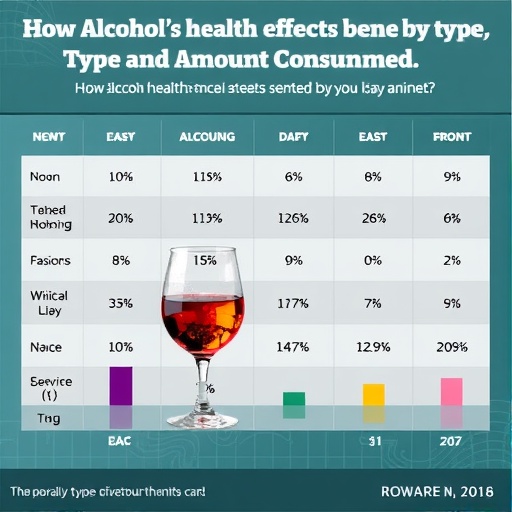
In the realm of cardiovascular health and cancer mortality, the investigation underscores that excessive alcohol intake unequivocally exacerbates risk, with high consumers experiencing a 24% elevated all-cause mortality rate, alongside a 36% increase in cancer-related deaths and a 14% heightened cardiovascular mortality risk compared to those who never or only occasionally drink. However, the stratification into beverage type reveals a compelling differential: low and moderate wine intake correlates with a significant reduction in mortality risk, particularly marked in cardiovascular outcomes, whereas similar quantities of spirits, beer, or cider portend opposite effects, increasing mortality likelihood.
This study delves deeply into consumption levels by defining discrete categories grounded on grams of pure ethanol per day and week. For reference, a standard alcoholic drink uniformly contains approximately 14 grams of pure alcohol, whether it’s beer, wine, or distilled spirits. Participants were meticulously segmented into never/occasional drinkers (less than 20 grams/week), low consumption (men: 20 g/week–20 g/day; women: 20 g/week–10 g/day), moderate consumption (men: 20–40 g/day; women: 10–20 g/day), and high consumption groups (men above 40 g/day; women above 20 g/day). These rigorous exposure definitions afforded an analytical precision rarely attained in observational alcohol epidemiology.
A striking revelation from the data is the contrasting cardiovascular mortality risk: while moderate wine drinkers displayed a notable 21% reduction in deaths from cardiovascular disease, even low intake of spirits, beer, or cider was linked to an increased 9% risk. These outcomes implicate not only ethanol content but potentially bioactive components and consumption context as modifiers of risk. Red wine, rich in polyphenols and antioxidants, may exert cardioprotective effects through mechanisms including endothelial function enhancement, oxidative stress reduction, and modulation of inflammatory mediators. The study posits that these compounds could partially explain the disparity in health consequences relative to other alcoholic beverages.
Moreover, lifestyle patterns associated with different beverage preferences are a salient factor. Wine consumption frequently occurs concomitantly with meals and within a framework of generally higher diet quality and healthier behavioral profiles. In contrast, spirits, beer, and cider consumption may be more prevalent outside structured meals and associate with less optimal dietary patterns and other cardiovascular risk behaviors. This complex interplay suggests that observed mortality differences cannot be attributed solely to alcohol type but must consider the wider nutritional and behavioral milieu.
The researchers employed multifactorial adjustments encompassing demographic, socioeconomic, lifestyle, cardiometabolic parameters, and pertinent family histories of diabetes, cancer, and cardiovascular disease. Nevertheless, the intrinsic limitations of observational research persist, notably reliance on self-reported consumption recorded at baseline with no subsequent updates, which introduces exposure misclassification potential and precludes causal inference. Additionally, the UK Biobank cohort tends to be healthier than the general population, possibly limiting external validity.
Despite these constraints, the magnitude of the cohort and the granularity of the data provide a powerful analytical framework. The extensive follow-up duration enables capturing long-term risk trajectories, adding robustness to the conclusions drawn. Compared to prior studies, the present investigation offers an unprecedentedly detailed characterization of alcohol consumption’s nuanced health implications, dissecting both quantity and beverage-specific effects on mortality causes.
These findings wield important implications for public health guidelines and clinical advisories. The current paradigm increasingly advocates total alcohol reduction to mitigate health risks, yet this study punctuates that beverage choice warrants distinct consideration. Recommendation frameworks might evolve to differentiate between wine and other alcohol types, optimizing harm reduction strategies and patient counseling.
Moreover, the data highlights that even minimal consumption of spirits, beer, or cider may undermine cardiovascular health, challenging nostalgic or culturally entrenched views that “a little is harmless” irrespective of beverage type. The documented 9% risk elevation, although modest, has substantial population health implications given the widespread consumption patterns of these drinks globally.
This research emphasizes an integrative understanding where biochemical properties of beverage constituents, their interaction with dietary habits, consumption contexts, and broader lifestyle factors converge to mediate health outcomes—a complexity that demands nuanced scientific investigation and tailored public messaging.
Further research is necessary, ideally incorporating randomized controlled trials to delineate causality more clearly and explore underlying biological mechanisms. Such trials should also account for dynamics in drinking patterns over time, rather than relying on static baseline assessments, to better mirror real-world scenarios.
In summation, the work presented from the UK Biobank cohort offers vital insight into the differentiated health consequences of varying alcohol consumption levels and types. It strengthens evidence challenging simplistic consumption models, advocating for individualized, context-aware prevention strategies, and refining our understanding of alcohol’s role in cardiometabolic and oncologic mortality.
Subject of Research: Alcohol consumption patterns and their impact on all-cause and cause-specific mortality, focusing on beverage type differences.
Article Title: Alcohol Use at Mid-Life and All-Cause and Cause-Specific Mortality.
News Publication Date: March 28, 2026.
Web References: Not provided in the original content.
Keywords: Alcohol consumption, mortality, cardiovascular disease, cancer, wine, spirits, beer, cider, polyphenols, antioxidants, epidemiology, UK Biobank, ACC.26.


