


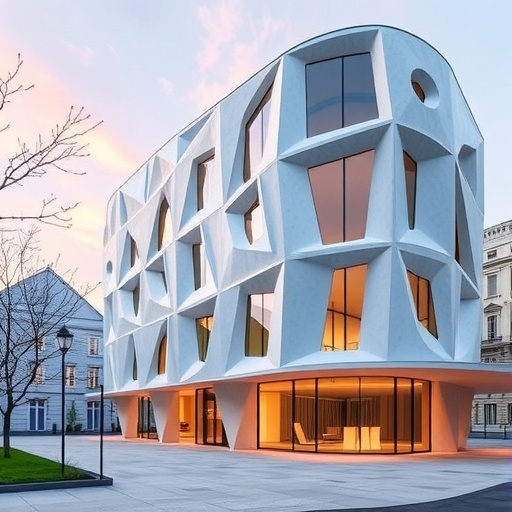
Architecture is entering an era in which buildings may be designed long before they are ever touched, assembled, or even imagined as physical structures. A new analysis published in AI & Society argues that artificial intelligence is accelerating a long-running transformation in architecture: materials are increasingly treated not as active, resistant, sensory substances, but as abstract data points that can be searched, compared, optimized, and recombined by software. The paper, written by Derya Uzal of Istanbul Technical University, describes this shift as a crisis of materiality. Its central warning is that artificial intelligence may not simply change architectural design methods. It may deepen the separation between architecture and the physical behavior of matter itself.
The problem, Uzal argues, did not begin with generative AI. Architecture had already been moving toward abstraction through industrial catalogues, standardized products, technical specifications, and digital building databases. These systems made materials easier to classify and distribute across global construction markets. A stone, brick, timber component, or metal panel could increasingly be represented through dimensions, performance ratings, cost, color, availability, and environmental certification. Such information is valuable for construction, but it also changes what counts as architectural knowledge. The tactile experience of weight, texture, fragility, weathering, smell, sound, and resistance becomes secondary to a clean digital description. In the catalogue, matter is converted into a manageable inventory. In the database, it becomes a record that can be filtered and selected without direct physical contact.
This historical process has also shaped the movement toward circular construction. Platforms designed to support the reuse of building components attempt to challenge the waste produced by demolition and new construction. Uzal discusses Rotor’s Opalis platform, which documents reclaimed materials and connects them with potential users. Circular economy databases, material passports, and “buildings as material banks” initiatives can provide crucial information about where materials are located, how much is available, what condition they are in, and how they might be reused. They can also support urban mining, in which cities are treated as reservoirs of existing resources rather than places where materials are extracted, consumed, and discarded. Yet the paper contends that even these progressive systems remain dependent on abstraction. They may preserve information about materials without restoring the situated encounters through which craftspeople and builders historically learned what those materials could do.
A reclaimed beam, for example, is not fully understood by its species, dimensions, carbon history, or structural rating. Its behavior may depend on hidden knots, previous loading, moisture, insect damage, tool marks, warping, repairs, and the experience of the person handling it. A database can record some of these features, but it cannot automatically reproduce the practical judgment developed through inspection and use. The distinction is technically important. Material properties are not always fixed values; they are often relational and context-dependent. The same piece of timber may perform differently according to how it is cut, supported, joined, exposed, or maintained. A component’s past can become part of its future performance. Uzal’s argument is not that digital documentation is useless, but that it cannot substitute for embodied knowledge, because the physical object continually produces new information through contact, stress, aging, and failure.
The paper frames this issue through new materialist theory, especially Jane Bennett’s concept of “vibrant matter.” In this view, materials are not passive substances waiting for human intentions to shape them. They possess forms of agency, meaning that they participate in events and influence outcomes through their properties, movements, limitations, and transformations. A wall can crack, a metal can fatigue, a timber joint can shift, and a surface can weather in ways that alter a building’s use and meaning. Architectural practice has often depended on responding to such behavior, even when it has described design as an act of human control. The craftsman learns by adjusting to the material, while the material effectively answers through resistance. This exchange is central to the practical intelligence of construction.
Artificial intelligence introduces a different model of intelligence. Large language models process vast collections of text by identifying statistical relationships among tokens, while image-generation systems use neural networks to infer patterns from enormous collections of visual data. Diffusion models, for instance, are trained to reverse a process of visual noise, gradually generating an image that corresponds to a textual or visual prompt. In architectural applications, these systems can produce convincing buildings in seconds by combining learned associations among styles, forms, materials, and spatial compositions. They can imitate concrete, brick, glass, timber, stone, or experimental composites with extraordinary visual fluency. But the image does not need to obey the physical constraints that govern those substances. Concrete can appear weightless, timber can bend without structural logic, and stone can be rendered with a texture that has no relationship to its density, fracture behavior, or method of extraction.
Uzal describes this process as an amplification of catalogue logic. The AI system does not encounter materials directly; it encounters representations of them. Those representations may be photographs, product descriptions, architectural drawings, specifications, online portfolios, and previously generated images. The model then produces new combinations based on patterns in the training data. This creates a recursive loop in which images of materials become sources for more images of materials, progressively separating visual identity from physical origin. A material is reduced to the features that can be captured and recognized computationally: color, grain, reflectivity, roughness, geometry, and stylistic association. What disappears is the material’s capacity to interrupt the design process. An AI-generated surface may look like weathered steel, but it cannot rust, stain, conduct heat, require maintenance, or impose a fabrication sequence until someone translates the image into a buildable specification.
The consequences extend beyond aesthetics. If architecture becomes increasingly organized around images, the stages of design may begin to prioritize visual plausibility over constructional truth. A generated image can circulate online, attract attention, inspire commentary, and influence clients without ever being tested against a site, a supply chain, a structural model, or a worker’s skill. This is what the paper connects to Neil Leach’s idea of a “hallucinatory turn,” in which architecture exists primarily as a field of circulating images. Digital tools such as building information modeling can connect drawings to quantities, schedules, and technical coordination, but image-generation systems operate differently when they are used without comparable physical verification. Their outputs are not necessarily false in a simple sense; they are speculative compositions whose apparent coherence can conceal missing information.
That concealment raises ethical and political questions. Every dataset reflects decisions about what is photographed, archived, measured, labeled, and made available. Online architectural imagery disproportionately represents certain regions, building types, design cultures, materials, and professional institutions. When AI systems learn from these collections, they may reproduce dominant visual conventions while marginalizing local construction knowledge, informal practices, repair traditions, and materials that are poorly documented online. The apparent neutrality of automated design can therefore hide historical inequalities. It can also shift responsibility. When an AI system suggests a design that is structurally unrealistic, environmentally damaging, or impossible to build, accountability still belongs to the architects, clients, engineers, manufacturers, and institutions that authorize the result. The machine may generate the proposal, but it does not bear the consequences of collapse, waste, displacement, or unsafe labor.
The analysis does not call for architects to reject every digital tool or abandon circular databases. Instead, it proposes critical practices capable of working within the contradictions of contemporary design. Architects can intervene in dataset politics by asking whose materials, buildings, crafts, and environments are represented and whose are absent. They can preserve direct encounters with materials through workshops, site visits, mock-ups, repair practices, demolition surveys, and collaboration with craftspeople. They can treat AI-generated images as provisional hypotheses rather than finished designs, subjecting every visual proposal to tests involving structure, climate, fabrication, maintenance, sourcing, and human use. Most importantly, Uzal argues for sustained skepticism toward claims that automated systems possess a form of design intelligence equivalent to material knowledge. AI may expand the speed and range of architectural imagination, but it does not touch, bend, age, break, or resist. Unless architecture keeps those physical realities at the center of its practice, the buildings of the future may become increasingly impressive as images while becoming increasingly detached from the materials that make buildings real.
Cite Scienmag News
Denise Maddox. (August 26, 2026). How AI and Material Agency Are Reshaping Architecture Amid Its Crisis. Scienmag. https://scienmag.com/how-ai-and-material-agency-are-reshaping-architecture-amid-its-crisis/
Denise Maddox. "How AI and Material Agency Are Reshaping Architecture Amid Its Crisis." Scienmag, 26 August 2026, https://scienmag.com/how-ai-and-material-agency-are-reshaping-architecture-amid-its-crisis/. Accessed 4 September 2026.
Denise Maddox. "How AI and Material Agency Are Reshaping Architecture Amid Its Crisis." Scienmag. August 26, 2026. https://scienmag.com/how-ai-and-material-agency-are-reshaping-architecture-amid-its-crisis/


