

Saturday, September 5, 2026
Science
No Result
View All Result
  • Login
  • HOME
  • SCIENCE NEWS
  • CONTACT US
  • HOME
  • SCIENCE NEWS
  • CONTACT US
No Result
View All Result
Scienmag
No Result
View All Result
Home Science News Earth Science

Hot traces in rock

July 23, 2024
in Earth Science
Violet Maxwell
By Violet Maxwell Scienmag Editorial Profile - Natural Hazards
Reading Time: 3 mins read
0
Hot traces in rock
66
SHARES
599
VIEWS
Share on FacebookShare on Twitter
ADVERTISEMENT

Climate archive in the rock

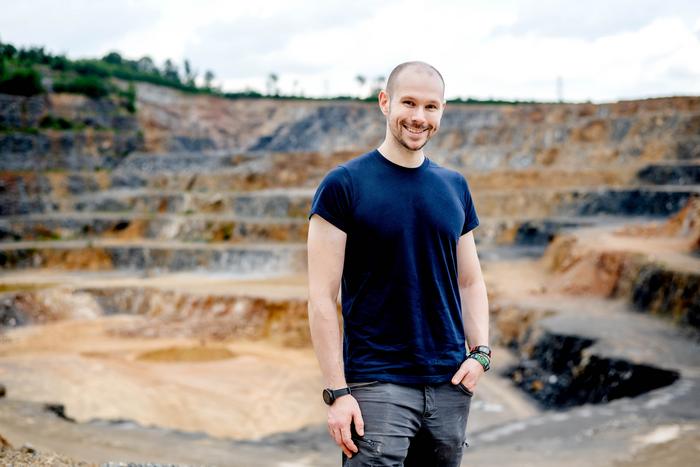
Mathias Müller

Credit: © RUB, Marquard

Climate archive in the rock

In order to gain a better understanding of today’s climate, it can help to look into the past. Researchers use so-called proxies for this purpose: indirect indicators of the climate in natural archives such as ice cores, tree rings or dripstones. “If we want to learn anything about the climate several million or even billions of years ago, we examine sedimentary rocks that may even have stored the seawater temperature from hundreds of millions of years ago,” explains Mathias Müller.

One thing that can make this type of far-reaching climate research considerably more difficult is the subsequent change in the climate signatures stored in these rocks. This process is called diagenesis. It begins shortly after sediment deposition in seawater and can continue to this day. “Very old rocks are usually buried to depths of several kilometers,” says Mathias Müller. “Changes in climate information are then caused by hot fluids circulating at depth.” Where they can penetrate the rock, they often lead to recrystallization or new mineral growth in the rock. In addition, when rocks are lifted from the depths to the earth’s surface, they are affected by the weather. This so-called meteoric diagenesis can also impact old climate information or render it completely useless.

From the shallow sea to the mountains

Together with an international research team, Mathias Müller reconstructed in detail which climate information from the shallow sea during the Devonian period is still stored in the rock in the Hagen-Hohenlimburg area and by which processes and under which conditions it has since been changed. The researchers analyzed numerous systematically collected rock samples from the Steltenberg quarry using petrographic and geochemical methods.

“We were surprised that the changes in the rock enabled us to identify a large number of significant geological events, such as the opening of the North Atlantic in the Jurassic and the onset of the folding and subsequent uplift of the Alps hundreds of kilometers away since the late Cretaceous period,” lists Mathias Müller. He considers radiometric uranium-lead dating to be the key to the chronological classification of the so-called overprinting events stored in the rock. “We were particularly pleased to discover during our research that climate information from the Devonian period can still be found even in heavily overprinted rocks,” stresses the researcher.

From climate research to geothermal energy

The findings of the study are also of interest when it comes to the exploitation of rocks for deep geothermal energy, which could be a contributing factor to the energy transition. Predicting which conditions will be encountered in which areas of the subsurface has been a major challenge for researchers to date. “Particularly in carbonate rocks, diagenetic overprinting can lead to both precipitation and dissolution phenomena in the rock, which can have a dramatic effect on the potential viability of geothermal energy,” says Mathias Müller.

The results of the current study allow tentative optimistic conclusions that some of the characterized processes in the deeper subsurface may have increased the usability for geothermal energy. Together with researchers from the Fraunhofer Research Institution for Energy Infrastructures and Geothermal Energy IEG and the Geological Survey of North Rhine-Westphalia, Mathias Müller currently aims to find out which implications the findings from the earth’s surface have for the applicability of geothermal energy at depth. 


Journal

Geochimica et Cosmochimica Acta

DOI

10.1016/j.gca.2024.04.029

Method of Research

Observational study

Subject of Research

Not applicable

Article Title

Towards a Better Understanding of the Geochemical Proxy Record of Complex Carbonate Archives

Article Publication Date

1-Jul-2024

Subject of Research: Earth Science

Article Title: Hot traces in rock

Article References: Original research article

Image Credits: AI Generated

DOI: Not provided

Keywords: Not provided

Cite Scienmag News

Violet Maxwell. (July 23, 2024). Hot traces in rock. Scienmag. https://scienmag.com/hot-traces-in-rock/

Violet Maxwell. "Hot traces in rock." Scienmag, 23 July 2024, https://scienmag.com/hot-traces-in-rock/. Accessed 5 September 2026.

Violet Maxwell. "Hot traces in rock." Scienmag. July 23, 2024. https://scienmag.com/hot-traces-in-rock/

Share26Tweet17
Previous Post

New research identifies less invasive method for examining brain activity following traumatic brain injury

Next Post

Natural drylands are grossly under-protected and are predicted to face major threats due to human land-use conversion in the 21st century

Related Posts

Post-wildfire flash floods and debris flows drive rising US losses
Earth Science

Post-wildfire flash floods and debris flows drive rising US losses

September 5, 2026
What shapes where juvenile parrotfish graze on Atlantic reefs
Earth Science

What shapes where juvenile parrotfish graze on Atlantic reefs

September 5, 2026
Two dryland trees respond differently to summer rainfall pulses in Rajasthan
Earth Science

Two dryland trees respond differently to summer rainfall pulses in Rajasthan

September 5, 2026
What Drives Residents to Join Environmental Sanitation Programmes in Nigerian Town
Earth Science

What Drives Residents to Join Environmental Sanitation Programmes in Nigerian Town

September 5, 2026
Tiger feces reveal heavy metal exposure in China’s Tumen River Basin
Earth Science

Tiger feces reveal heavy metal exposure in China’s Tumen River Basin

September 5, 2026
Optimizing river water quality monitoring networks in polluted regions using data-driven methods
Earth Science

Optimizing river water quality monitoring networks in polluted regions using data-driven methods

September 5, 2026
Next Post

Natural drylands are grossly under-protected and are predicted to face major threats due to human land-use conversion in the 21st century

  • Mothers who receive childcare support from maternal grandparents show more optimized

    Mothers who receive childcare support from maternal grandparents show more parental warmth, finds NTU Singapore study

    27656 shares
    Share 11059 Tweet 6912
  • University of Seville Breaks 120-Year-Old Mystery, Revises a Key Einstein Concept

    1061 shares
    Share 424 Tweet 265
  • Bee body mass, pathogens and local climate influence heat tolerance

    682 shares
    Share 273 Tweet 171
  • Researchers record first-ever images and data of a shark experiencing a boat strike

    546 shares
    Share 218 Tweet 137
  • Groundbreaking Clinical Trial Reveals Lubiprostone Enhances Kidney Function

    531 shares
    Share 212 Tweet 133
Science

Embark on a thrilling journey of discovery with Scienmag.com—your ultimate source for cutting-edge breakthroughs. Immerse yourself in a world where curiosity knows no limits and tomorrow’s possibilities become today’s reality!

RECENT NEWS

  • DHA eases colitis by rebalancing gut microbes and repairing the gut barrier
  • Surfactant-aided hydrothermal synthesis boosts MnWO4 nanomaterial electrochemical performance
  • New 3D pediatric brain phantom validated for CT neuroimaging research
  • Post-wildfire flash floods and debris flows drive rising US losses

Categories

  • Agriculture
  • Anthropology
  • Archaeology
  • Athmospheric
  • Biology
  • Biotechnology
  • Blog
  • Bussines
  • Cancer
  • Chemistry
  • Climate
  • Earth Science
  • Editorial Policy
  • Marine
  • Mathematics
  • Medicine
  • Pediatry
  • Policy
  • Psychology & Psychiatry
  • Science Education
  • Social Science
  • Space
  • Technology and Engineering

Subscribe to Blog via Email

Enter your email address to subscribe to this blog and receive notifications of new posts by email.

Join 5,151 other subscribers

© 2025 Scienmag - Science Magazine

Welcome Back!

Login to your account below

Forgotten Password?

Retrieve your password

Please enter your username or email address to reset your password.

Log In
No Result
View All Result
  • HOME
  • SCIENCE NEWS
  • CONTACT US

© 2025 Scienmag - Science Magazine

Discover more from Science

Subscribe now to keep reading and get access to the full archive.

Continue reading