


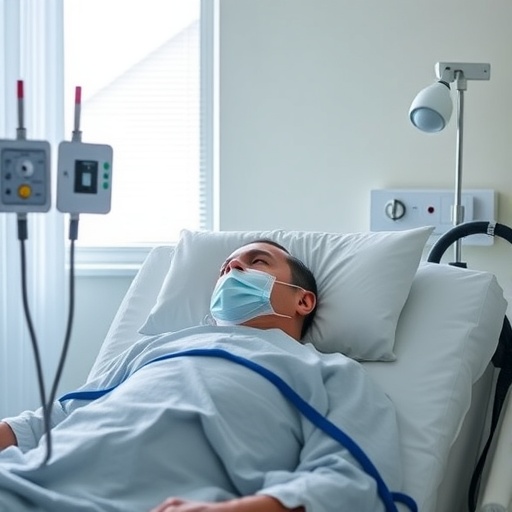
The risk of death among hospitalized patients exhibiting dyspnoea, or shortness of breath, has been found to be significantly higher—up to sixfold—according to groundbreaking research recently published in ERJ Open Research. Unlike pain assessments, which are routinely performed in clinical settings, evaluation of dyspnoea rarely receives similar attention despite its profound implications for patient outcomes. This study, led by Associate Professor Robert Banzett of Beth Israel Deaconess Medical Center and Harvard Medical School, highlights the urgency of integrating dyspnoea ratings into standard hospital monitoring protocols.
Dyspnoea, a complex and distressing sensation often described as suffocation or air hunger, serves as a critical physiological warning signal indicating compromised respiratory function. Unlike pain, which can arise from non-life-threatening causes, dyspnoea signals an existential threat to homeostasis, representing inadequate oxygenation or ventilation. The body’s chemoreceptors located in the lungs, heart, and peripheral tissues are finely tuned to detect these disruptions, initiating a cascade of autonomic and behavioral responses. However, despite its diagnostic and prognostic significance, healthcare providers traditionally deprioritize routine patient-reported assessments of breathlessness.
The research involved a prospective observational study of nearly 10,000 adult inpatients admitted to a major academic medical center over a two-and-a-half-year period. Nurses were trained to record patient-reported dyspnoea severity twice daily, on a numeric scale ranging from zero (no breathlessness) to ten (worst imaginable breathlessness)—a procedure requiring approximately 45 seconds per encounter. These subjective scores were then linked to patient outcomes over a two-year follow-up period, including mortality, intensive care admissions, and rapid response interventions.
Analyses demonstrated that patients manifesting new or worsening dyspnoea during hospitalization were six times more likely to succumb before discharge compared to counterparts without breathlessness. Moreover, a dose-dependent relationship emerged: higher dyspnoea scores correlated robustly with increased mortality risk. Patients discharged with persistent dyspnoea showed a striking 25% mortality rate within six months, underscoring the symptom’s prognostic utility not only during acute care but also in long-term outcomes. Notably, pain severity ratings bore no significant association with mortality, suggesting dyspnoea offers unique predictive insights beyond conventional symptom assessments.
These findings underscore the inadequacy of current clinical paradigms that prioritize pain monitoring while neglecting dyspnoea evaluation. Dyspnoea is an evolutionarily conserved alarm system reflecting critical impairment in pulmonary gas exchange and cardiovascular function. Its subjective nature does not diminish its clinical relevance; indeed, patients consistently possess reliable insight into their respiratory discomfort, making self-report an invaluable tool for early detection of clinical deterioration.
Incorporating dyspnoea measurement into routine vital sign assessment could therefore transform inpatient care. Recognizing breathlessness early would alert multidisciplinary teams to potential respiratory failure, prompting timely interventions such as oxygen supplementation, respiratory therapy, diagnostic imaging, and escalation to intensive care. This approach promises improved triage efficiency and resource allocation in acute settings, ultimately enhancing patient survival rates.
The study’s lead author emphasizes that dyspnoea, while associated with elevated mortality, is not a definitive death sentence. Most patients, even those reporting severe breathlessness, survive their hospital stay and beyond. However, the symptom signals underlying pathophysiological stress warranting close clinical scrutiny. Routine dyspnoea scoring can facilitate personalized care pathways, optimize clinical decision-making, and improve symptom management, alleviating patient distress.
This research also provoked thoughtful commentary from independent experts. Professor Hilary Pinnock, Chair of the European Respiratory Society’s Education Council, highlighted the resurgence of interest in subjective breathlessness assessment amid growing skepticism about traditional vital sign monitoring. She underscored the scalability of the simple numeric rating scale, which requires minimal time investment while yielding powerful prognostic data. Likewise, Dr. Cláudia Almeida Vicente, General Practice Chair for the European Respiratory Society, noted the critical role of dyspnoea as an early warning sign of clinical decline and advocated for its integration into both inpatient monitoring and post-discharge follow-up protocols.
The observations draw attention to the pathophysiological mechanisms that underlie dyspnoea as a marker of impending respiratory or cardiovascular collapse. Such mechanisms include impaired ventilation-perfusion matching, hypoxemia, hypercapnia, and increased work of breathing, often driven by acute or chronic pulmonary diseases including chronic obstructive pulmonary disease, pneumonia, heart failure, and asthma exacerbations. Early identification of deteriorating gas exchange via patient-reported breathlessness heralds the need for escalated therapeutic interventions.
Future research directions aim to validate these results across diverse healthcare systems and patient populations globally. Additionally, clinical trials are needed to determine whether routine dyspnoea assessment followed by targeted interventions directly improves morbidity and mortality. The complexity of such studies lies in ethical considerations, as awareness of dyspnoea symptomatology is likely to influence clinical management, challenging the establishment of controlled experimental designs.
In summary, this pioneering investigation provides compelling evidence that patient-reported dyspnoea is a potent predictor of hospital mortality and adverse clinical events. Its routine incorporation into hospital protocols represents a simple, rapid, and cost-effective strategy with profound implications for patient care, resource utilization, and healthcare outcomes. As the medical community embraces patient-centered metrics, dyspnoea rating stands out as a vital vital sign deserving widespread adoption.
Cite Scienmag News
Courtney Benton. (November 10, 2025). Hospital Patients Experiencing Shortness of Breath Face Sixfold Increase in Mortality Risk. Scienmag. https://scienmag.com/hospital-patients-experiencing-shortness-of-breath-face-sixfold-increase-in-mortality-risk/
Courtney Benton. "Hospital Patients Experiencing Shortness of Breath Face Sixfold Increase in Mortality Risk." Scienmag, 10 November 2025, https://scienmag.com/hospital-patients-experiencing-shortness-of-breath-face-sixfold-increase-in-mortality-risk/. Accessed 4 September 2026.
Courtney Benton. "Hospital Patients Experiencing Shortness of Breath Face Sixfold Increase in Mortality Risk." Scienmag. November 10, 2025. https://scienmag.com/hospital-patients-experiencing-shortness-of-breath-face-sixfold-increase-in-mortality-risk/


