


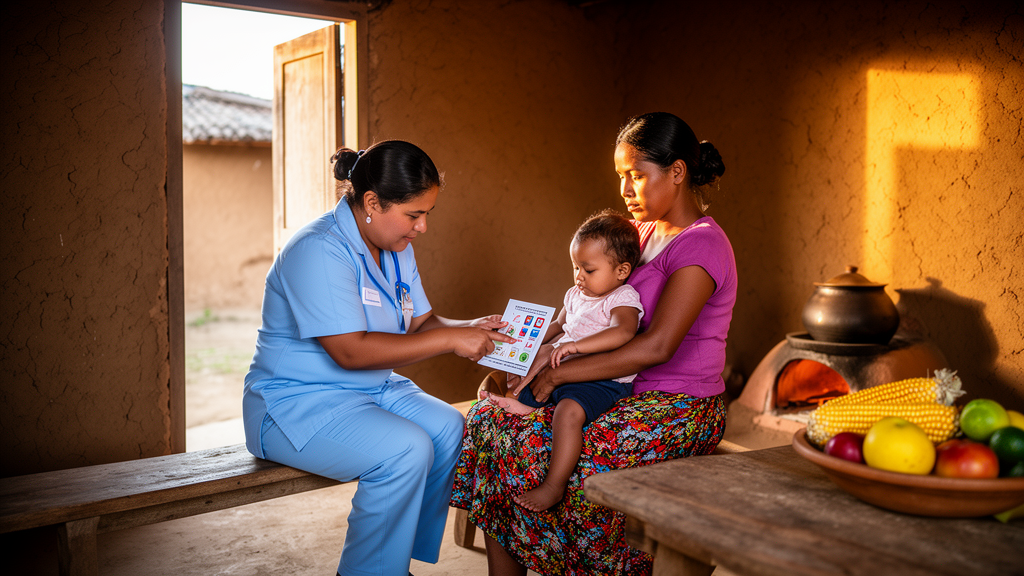
In a rural community in the Ecuadorian province of Santa Elena, where nearly three in ten children under two years old live with stunting, a six-month program of family-centered home visits appears to have delivered a clear, measurable gain in what mothers know about preventing and managing chronic child malnutrition. What it did not deliver, at least by the numbers, was a statistically significant change in the mothers’ reported everyday practices or in how competent they felt making food and care decisions. That split result, reported in an uncontrolled pre-post study published in Frontiers in Public Health, offers both an encouraging signal and a sobering lesson about how difficult it is to move the behaviors that shape child nutrition, not just the information behind them.
The study followed 208 pregnant women or mothers of children under three years old who enrolled in the first cohort of a community program funded by the Guayaquil Charity Board, in coordination with local public services and with academic support from Universidad Casa Grande. Every family received biweekly home visits over roughly six months, guided by the principles of Family-Centered Practices, an approach developed originally in early intervention services that emphasizes collaborative partnerships between professionals and caregivers, respect for family priorities, and strategies built into everyday routines rather than imposed from outside. Alongside the visits, all enrolled households received a monthly food kit of approximately 20 kilograms, containing rice, pasta, oats, beans, lentils, chickpeas, canned fish, powdered milk, oil, sugar, and salt.
The stakes are considerable. Ecuador’s most recent national survey focused specifically on child malnutrition, ENDI 2022–2023, estimated stunting prevalence at 20.1 percent among children under two and 17.5 percent among children under five nationwide. In Santa Elena, the province where the study took place, the figures rise to 29.8 percent among children under two, the third-highest prevalence among the country’s 24 provinces, and 27.5 percent among children under five. Chronic child malnutrition is associated with long-term adverse effects on physical, cognitive, and social development, particularly when it strikes early in life, and it clusters in rural communities experiencing long-standing social disadvantage.
To measure change, the research team built a study-specific 34-item scale covering three domains: knowledge, practices, and perceived competencies, each rated on a six-point scale. The instrument was piloted with 70 mothers from a neighboring, non-participating community and reviewed by specialists in nutrition and instrument development, but the authors are explicit that its formal validity has not been established. Internal consistency in the study sample was reasonable, with Cronbach’s alpha of 0.783 before the intervention and 0.814 after. The scale was administered during the second home visit and again at the end of the six-month period, with community health workers reading the questions aloud and recording responses digitally.
The headline quantitative result was a statistically significant rise in the total scale score, from a mean of 148.70 at baseline to 156.73 afterward, a mean difference of 8.03 points with a 95 percent confidence interval of 4.53 to 11.53 and a small paired effect size of dz = 0.31. But the domain-level breakdown tells a more precise story. The Knowledge domain showed the only statistically significant and clearly robust change, with a moderate effect size of dz = 0.66. Practices barely moved, with dz = 0.06 and p = 0.425, and Competencies showed a small, non-significant shift of dz = 0.12 with p = 0.080. In other words, the mothers learned; their reported routines and self-assessed confidence, taken as aggregate scores, did not demonstrably change.
The item-by-item analysis sharpens that picture further. Twenty-two of the 34 items showed statistically significant changes before correction for multiple comparisons, and 16 survived Holm-Bonferroni correction. The largest effects clustered tightly around core malnutrition knowledge: knowing the problems chronic malnutrition can cause a child, knowing how to prevent it, and knowing what to do if a child receives the diagnosis, with effect sizes of 0.89, 0.86, and 0.90 respectively. Knowledge of the benefits of continuing breastfeeding until age two also rose substantially, with an effect size of 0.54. Two other large effects, concerning what to do about stunted growth and low weight, rest on much smaller valid samples of 84 and 61 mothers because of high post-test missing data, and the authors flag them as exploratory.
Within the Practices domain, the aggregate score was flat, but individual items related to dietary diversity did improve significantly, including variety in daily meals, the mother’s own diet, and her perception of eating adequately. In the Competencies domain, only three items survived correction: satisfaction with the food served at the table, feeling one feeds the family properly, and perceiving that the family enjoys good health. A subgroup analysis by caregiver-reported nutritional status found significant within-group improvement for families with no reported anemia or malnutrition, malnutrition only, and anemia plus malnutrition, but not for the anemia-only group. The authors caution that a formal group-by-time interaction test was not statistically significant, and that a strong negative association between baseline scores and change, consistent with regression to the mean, offers a more parsimonious explanation for the subgroup pattern than any claim of differential effectiveness.
The study’s embedded qualitative component, brief written responses from 25 purposively selected mothers, echoed the quantitative findings in human terms. Several mothers wrote that they had absorbed the message about safe water, with comments such as “Thanks to the visits, I know how important safe water is” and “Everyone in my family drinks safe water.” Others described incorporating legumes into daily cooking, reporting “More nutritious foods every day: lentils and chickpeas” and “With beans, I have a more varied diet.” Still others expressed new confidence in choosing and preparing food, saying “Now I serve a balanced and proper diet” and “I’ve incorporated foods that my child did not eat before.” These accounts suggest that some participants perceived changes that felt meaningful within their own routines, though the authors stress that such self-reports complement rather than confirm behavioral change.
The implementation itself was unusually consistent for a community program. Five community health workers with backgrounds in nursing, early childhood education, or primary education each carried a caseload of 42 families, after receiving 48 hours of in-service training plus ongoing reflective supervision that included joint visits and group case discussion. Around 2,446 visits were completed over an effective five-month implementation period, averaging roughly 11.75 visits per family, and fewer than 2 percent of scheduled visits were canceled. However, no structured fidelity-monitoring instrument was used, and the same workers who delivered the intervention also collected the outcome data, a design feature the authors acknowledge could inflate self-reported improvement through social-desirability or expectancy effects.
The limitations are substantial and the authors do not soften them. Without a comparison group, the design cannot establish causation or rule out maturation, seasonal variation, repeated-test familiarity, or the influence of the monthly food kits, which the study explicitly cannot disentangle from the effect of the home visits. Nutritional status was based on caregiver report of prior clinical diagnoses rather than anthropometric or biochemical measurement, and no objective child outcomes of any kind were collected, so the study cannot say whether the knowledge gains translated into better child nutrition. Fifty mothers who enrolled after the first assessment window were excluded prospectively, and their comparability to the analyzed sample could not be verified. The authors conclude that the findings are preliminary and hypothesis-generating, and they call for controlled evaluations with validated measures, independent outcome assessment, and objective nutritional and developmental indicators before any conclusions about the effectiveness of family-centered support for malnutrition prevention can be drawn.
Subject of Research: A family-centered home-visiting program for chronic child malnutrition prevention in rural Ecuador
Article Title: Changes in family knowledge, practices, and perceived competencies after a family-centered home-visiting program for chronic child malnutrition prevention in rural Ecuador: an uncontrolled pre-post study
Article References: Escorcia-Mora, C. T., Frugone-Jaramillo, M., García-Grau, P., Portaluppi, C., Barros-Cárdenas, D., & Muñoz-Seminario, M. A. (2026). Changes in family knowledge, practices, and perceived competencies after a family-centered home-visiting program for chronic child malnutrition prevention in rural Ecuador: an uncontrolled pre-post study. Frontiers in Public Health, 14, Article 1925365. https://doi.org/10.3389/fpubh.2026.1925365
Image Credits: AI Generated
DOI: 10.3389/fpubh.2026.1925365
Keywords: chronic child malnutrition, stunting, Ecuador, family-centered practices, home visiting, maternal knowledge, child nutrition, community health, pre-post study, Santa Elena, parenting competencies, public health nutrition
Cite Scienmag News
Phoebe Ingram. (October 26, 2026). Home Visits in Rural Ecuador Boosted Mothers’ Knowledge of Child Malnutrition, but Habits Proved Harder to Shift. Scienmag. https://scienmag.com/home-visits-in-rural-ecuador-boosted-mothers-knowledge-of-child-malnutrition-but-habits-proved-harder-to-shift/
Phoebe Ingram. "Home Visits in Rural Ecuador Boosted Mothers’ Knowledge of Child Malnutrition, but Habits Proved Harder to Shift." Scienmag, 26 October 2026, https://scienmag.com/home-visits-in-rural-ecuador-boosted-mothers-knowledge-of-child-malnutrition-but-habits-proved-harder-to-shift/. Accessed 26 October 2026.
Phoebe Ingram. "Home Visits in Rural Ecuador Boosted Mothers’ Knowledge of Child Malnutrition, but Habits Proved Harder to Shift." Scienmag. October 26, 2026. https://scienmag.com/home-visits-in-rural-ecuador-boosted-mothers-knowledge-of-child-malnutrition-but-habits-proved-harder-to-shift/


