


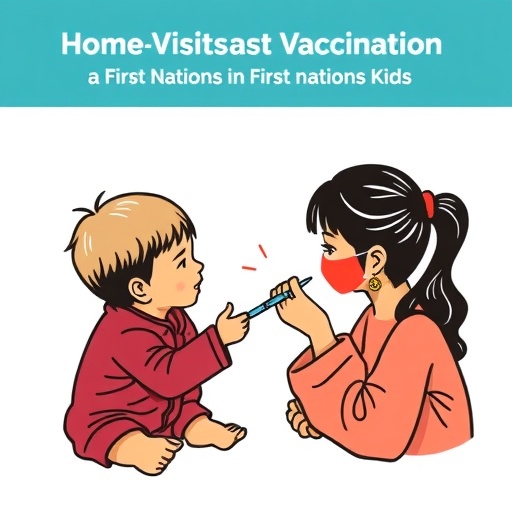
In an illuminating new study that holds profound implications for public health efforts among Indigenous populations, researchers have rigorously examined the efficacy of a targeted home visiting program designed to overcome entrenched barriers to childhood vaccination in a First Nations community. Vaccination uptake within Indigenous groups has historically lagged behind national averages due to a complex web of logistical, cultural, and systemic challenges. This groundbreaking research not only uncovers the root causes of low immunization rates but also offers a replicable model for enhancing vaccine delivery in marginalized populations worldwide.
Childhood vaccinations represent one of the most successful public health interventions, dramatically reducing morbidity and mortality associated with infectious diseases. However, within many First Nations communities, immunization rates often fall short of public health goals, leaving children vulnerable to preventable illnesses. This discrepancy is frequently attributed to access issues, cultural misunderstandings, and mistrust toward health care systems, all of which compound to create significant barriers. The study meticulously dissects these multifaceted impediments, providing critical insight into the lived realities that shape vaccination behaviors.
Central to the researchers’ approach is the deployment of a home visiting program, a strategic intervention designed to bring healthcare services directly into the family environment. Unlike conventional clinic-based vaccination initiatives, home visiting programs engage families on their own terms and within their own spaces, fostering trust and accessibility. This model particularly resonates within communities where healthcare infrastructure may be sparse or where the act of visiting a clinic may invoke logistical or cultural discomfort.
The research team employed a mixed-methods design, combining quantitative vaccine uptake data with rich qualitative narratives from families and healthcare providers. This dual approach allowed for a nuanced understanding of how the home visiting program modifies vaccination behaviors. Statistical analyses demonstrated a marked increase in immunization rates following program implementation, with children in the program cohort significantly more likely to receive their full series of vaccines on time. These quantitative findings were complemented by personal stories reflecting transformed attitudes towards vaccination.
One of the most striking revelations of the study is the role of culturally sensitive communication in altering vaccine perceptions. Home visitors, drawn from or trained within the community, utilized culturally resonant messaging and built rapport over time. The approach emphasized respect for traditional knowledge and addressed historical mistrust stemming from past injustices in health care. This culturally embedded strategy emerged as fundamental in overcoming vaccine hesitancy, which is often rooted not merely in misinformation but in deeply held mistrust.
Furthermore, logistical barriers, such as lack of transportation, conflicting work schedules, and limited clinic hours, were effectively mitigated through home visits. This practical dimension of the intervention underscores that accessibility is more than geographic proximity; it involves fitting health services into the complex rhythms of family life. By adapting the delivery mechanism, the program lowered the tangible costs and inconveniences associated with vaccination, removing a critical obstacle that too often goes unaddressed.
The study also sheds light on the importance of building long-term relationships between healthcare workers and families. Unlike episodic healthcare encounters, continuous engagement through home visiting fostered ongoing dialogue and incremental trust-building. This relational aspect not only improved vaccination rates but laid the groundwork for broader health promotion and education efforts, potentially catalyzing improvements across multiple health domains.
Significantly, the research critiques the conventional top-down approach to public health interventions, advocating instead for community-led, tailored strategies that acknowledge and honor Indigenous sovereignty and perspectives. The home visiting program aligns with principles of equity, partnership, and self-determination, recognizing that sustainable health gains require interventions co-designed and sustained by the communities themselves.
The implications of these findings extend well beyond the immediate context of childhood vaccination in a single First Nations community. They challenge health policymakers and practitioners to rethink assumptions about access, persuasion, and engagement in health care delivery. The demonstrated success of a home visiting model in this setting suggests potential applicability in other marginalized populations facing similar barriers, whether rural, immigrant, or socioeconomically disadvantaged.
Moreover, the research adds a vital empirical voice to ongoing discussions about vaccine equity in the global health landscape. As challenges ranging from misinformation to distribution inequities continue to undermine vaccination efforts worldwide, the home visiting program offers a compelling proof-of-concept for interventions that go beyond information dissemination to encompass relationship-building and culturally competent service delivery.
The study also acknowledges limitations and areas for future exploration. While the home visiting program significantly improved vaccine uptake, the researchers note the necessity of long-term follow-up to assess sustainability of gains and the broader impacts on community health. Additionally, questions remain about scalability and resource allocation, particularly in resource-strapped settings where home visiting programs require investment and trained personnel.
Nevertheless, this pioneering work marks a critical step toward equity-focused health interventions that respect and incorporate Indigenous knowledge and agency. By reframing vaccination uptake not simply as a matter of individual choice but as an outcome shaped by systemic, cultural, and relational factors, the research offers a holistic blueprint for transformative public health practice.
As public health systems grapple with persistent challenges of vaccine hesitancy and health disparities, this study’s insights resonate with urgency and promise. It reinforces that the pathway to immunization equity is not merely through mandates or campaigns but through empathetic, accessible, and culturally grounded engagement that meets communities where they are. The ripple effects of such an approach hold the potential to bolster trust, health literacy, and well-being well beyond childhood vaccinations.
In sum, the innovative home visiting program analyzed in this compelling research transcends traditional immunization strategies by embedding care within community structures and cultural frameworks. By doing so, it illuminates a path forward in the global quest to ensure that all children, regardless of their heritage or geography, are afforded the protective benefits of vaccination. This study exemplifies the power of tailored, interpersonal health interventions to dismantle barriers and foster health equity in some of the world’s most underserved populations.
Cite Scienmag News
Courtney Benton. (November 29, 2025). Home Visits Boost Vaccination in First Nations Kids. Scienmag. https://scienmag.com/home-visits-boost-vaccination-in-first-nations-kids/
Courtney Benton. "Home Visits Boost Vaccination in First Nations Kids." Scienmag, 29 November 2025, https://scienmag.com/home-visits-boost-vaccination-in-first-nations-kids/. Accessed 4 September 2026.
Courtney Benton. "Home Visits Boost Vaccination in First Nations Kids." Scienmag. November 29, 2025. https://scienmag.com/home-visits-boost-vaccination-in-first-nations-kids/


