


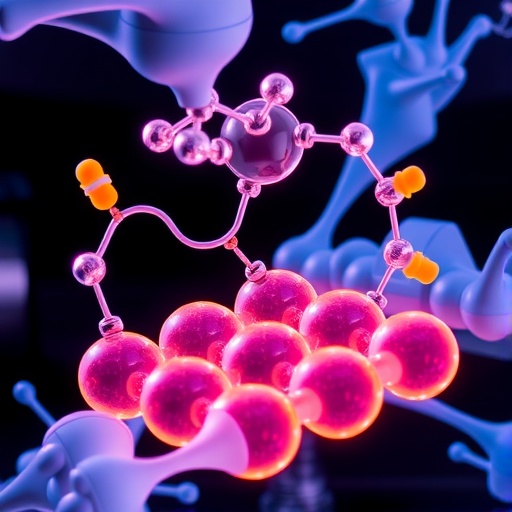
In a groundbreaking advance that could redefine the landscape of polymer chemistry and material science, researchers at The Hong Kong University of Science and Technology (HKUST) have harnessed the power of quantum mechanics and machine learning to unlock new insights in interfacial polymerization. This innovative approach deciphers how water molecules act as critical facilitators within these molecular reactions, thus unraveling the complexities of a technique pivotal to creating cutting-edge functional materials.
Interfacial polymerization is a chemical process foundational to the fabrication of materials with highly specialized properties; it operates at the interface where two immiscible phases meet, typically liquid-liquid boundaries. This reaction produces polymers that form the basis of membranes, coatings, and microcapsules used in diverse fields such as drug delivery, environmental engineering, and sensor technology. Despite its widespread application, the microscopic mechanisms driving these reactions have remained elusive, hindering the ability to precisely tailor material properties.
At the heart of the HKUST breakthrough lies the integration of quantum mechanical simulations with state-of-the-art machine learning algorithms. Quantum mechanics, the fundamental theory describing interactions at atomic and subatomic levels, provides a detailed depiction of chemical phenomena but is often computationally prohibitive for complex systems. Machine learning, conversely, excels at pattern recognition and prediction when trained on extensive datasets. By combining these approaches, the researchers have created a computational framework capable of both simulating and predicting the behavior of molecular interactions in interfacial polymerization with unprecedented accuracy.
Their investigations revealed that water molecules are not passive bystanders but active participants that catalyze and accelerate polymerization reactions. Through hydrogen-bonding networks and dynamic molecular arrangements, water stabilizes transient intermediates and lowers reaction energy barriers. This novel understanding overturns previous assumptions that largely neglected water’s instrumental role at the interface, highlighting an intricate dance of molecules critical to polymer formation.
Simultaneously, the team tackled another longstanding challenge in materials science: optimizing the design of polymer microcapsules. Traditionally, developing these microscopic containers—used for encapsulating drugs, fragrances, or reactive chemicals—has relied on iterative trial-and-error experimentation. This laborious process could take months or years to fine-tune material properties like permeability, mechanical strength, and release profiles.
By leveraging their integrated quantum-machine learning platform, the HKUST researchers transformed microcapsule engineering from an artisan craft into a predictive science. Their models can simulate how variations in chemical composition, reaction conditions, and interfacial dynamics influence microcapsule formation and performance, enabling rational design with minimal experimental overhead. This marks a significant leap toward accelerating innovation cycles in pharmaceutical formulation and beyond.
The implications of these dual breakthroughs are vast. Materials created through interfacial polymerization find applications in water purification membranes that remove contaminants at high efficiency, in self-healing coatings that prolong the lifespan of infrastructure, and in responsive microcapsules that release drugs precisely where needed in the human body. Improved mechanistic understanding empowers scientists to tailor polymers at a molecular level, potentially unlocking functionalities previously thought unattainable.
Furthermore, the fusion of quantum chemistry and machine learning showcased by the HKUST team exemplifies a broader trend in scientific research: the use of artificial intelligence to surmount traditional computational and experimental barriers. By training algorithms on quantum-generated data, the approach circumvents the intractability of simulating entire reaction networks explicitly, enabling predictive insights into complex chemical systems that were once out of reach.
This research also contributes to the burgeoning field of materials informatics, where data-driven methodologies streamline the discovery of novel materials by identifying promising candidates through machine learning predictions rather than brute-force synthesis. The paradigm shift from empirical to predictive material design promises to rejuvenate fields such as catalysis, energy storage, and biomedicine.
The HKUST team’s methodology involved meticulous quantum chemical calculations of reaction pathways at the interface, accounting for the fluctuating presence of water and solvent molecules. These results provided a rich dataset fed into sophisticated machine learning models, which captured subtle patterns and inferred generalizable rules governing polymerization kinetics. Subsequent experimental validations confirmed the accuracy of their predictions, underscoring the synergy between theory and practice.
Looking forward, the research paves the way for AI-augmented laboratories where complex materials can be designed, tested, and optimized in silico before being synthesized in the lab. This reduces time, cost, and resource consumption, propelling sustainable innovation. It also opens avenues to explore exotic polymer architectures and multifunctional composites tailored at the atomic level for specific tasks.
In summary, the HKUST research group has made a seminal contribution by elucidating the molecular role of water in interfacial polymerization through the marriage of quantum mechanics and machine learning. They have also redefined microcapsule design as a predictive science, demonstrating how integrating computational physics with AI can revolutionize material development. These findings herald a new era of precision polymer chemistry with far-reaching impacts across science and industry.
News Publication Date: Not specified.
Web References: Not specified.
References: Not specified.
Cite Scienmag News
Hazel Monroe. (June 11, 2026). HKUST Reveals How Interfacial Polymerization Speeds Up: New Mechanistic Insights Uncovered. Scienmag. https://scienmag.com/hkust-reveals-how-interfacial-polymerization-speeds-up-new-mechanistic-insights-uncovered/
Hazel Monroe. "HKUST Reveals How Interfacial Polymerization Speeds Up: New Mechanistic Insights Uncovered." Scienmag, 11 June 2026, https://scienmag.com/hkust-reveals-how-interfacial-polymerization-speeds-up-new-mechanistic-insights-uncovered/. Accessed 3 September 2026.
Hazel Monroe. "HKUST Reveals How Interfacial Polymerization Speeds Up: New Mechanistic Insights Uncovered." Scienmag. June 11, 2026. https://scienmag.com/hkust-reveals-how-interfacial-polymerization-speeds-up-new-mechanistic-insights-uncovered/


