


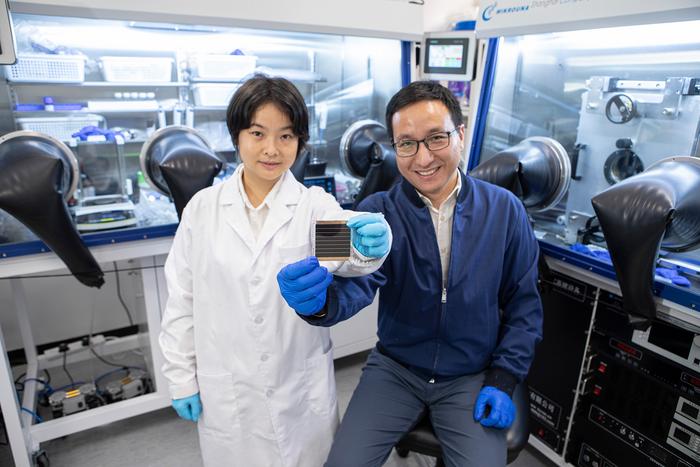
A research team led by the School of Engineering of the Hong Kong University of Science and Technology (HKUST) has constructed an unprecedented chiral-structured interface in perovskite solar cells, which enhances the reliability and power conversion efficiency of this fast-advancing solar technology and accelerates its commercialization.

Credit: HKUST
A research team led by the School of Engineering of the Hong Kong University of Science and Technology (HKUST) has constructed an unprecedented chiral-structured interface in perovskite solar cells, which enhances the reliability and power conversion efficiency of this fast-advancing solar technology and accelerates its commercialization.
A perovskite solar cell (PSC) is a type of solar cell that includes perovskite-structured compound materials, which are inexpensive to produce and simple to manufacture. Unlike conventional silicon solar cells that require expensive high-temperature, high-vacuum fabrication processes, perovskites can be easily made into thin films using various printing techniques at low cost. The performance of PSCs has climbed very rapidly in recent years, but there are still significant barriers to commercialization, particularly concerning their various stability aspects under real-world conditions. An outstanding challenge was the insufficient adhesion between the different layers of the cells, resulting in limited interfacial reliability.
To address this issue, Prof. ZHOU Yuanyuan, Associate Professor of the Department of Chemical and Biological Engineering (CBE) at HKUST, and his research team got inspiration from the mechanical strength of natural chiral materials and constructed an unprecedented chiral-structured interface in PSCs, unlocking very high reliability.
The team inserted chiral-structured interlayers based on R-/S-methylbenzyl-ammonium between the perovskite absorber and electron transport layer to create a strong, elastic heterointerface. The encapsulated solar cells retained 92% of their initial power conversion efficiencies after 200 cycles between −40°C and 85°C for 1,200 hours, tested under the International Electrotechnical Commission (IEC) 61215 solar cell standards.
“The intriguing mechanical properties of chiral materials are associated with the helical packing of their subunits, which resembles a mechanical spring,” said the first author of this work, Dr. DUAN Tianwei, currently a Research Assistant Professor in the CBE Department at HKUST and a previous Research Grants Council postdoctoral fellow. “Incorporating a chiral-structured interlayer at the crucial device interface makes the perovskite solar cell more mechanically durable and adaptable under various operational states,” she added.
“It is really the dawn for the commercialization of perovskite solar cells. Given the high efficiencies of these cells, if we could ultimately overcome the reliability issue, billions of energy markets will be seen,” said Prof. Zhou.
This breakthrough holds great promise for the future of solar energy. With the potential for enhanced reliability and power conversion efficiency, future perovskite solar panels could become even more dependable in various weather conditions, ensuring continuous electricity generation over extended periods.
The team’s research work, titled “Chiral-Structured Heterointerfaces Enable Durable Perovskite Solar Cells”, was recently published in prestigious journal Science. The paper was co-written by Dr. Duan (the lead first author) and Prof. Zhou (the lead corresponding author), as well as collaborators from the US National Renewable Energy Laboratory, Hong Kong Baptist University, and Yale University.
Journal
Science
Method of Research
Experimental study
Subject of Research
Not applicable
Article Title
Chiral-structured heterointerfaces enable durable perovskite solar cells
Article Publication Date
24-May-2024
Cite Scienmag News
Denise Maddox. (August 9, 2024). HKUST engineering researchers enhance perovskite solar cells durability with first-of-its-kind chiral-structured “springy” interface. Scienmag. https://scienmag.com/hkust-engineering-researchers-enhance-perovskite-solar-cells-durability-with-first-of-its-kind-chiral-structured-springy-interface/
Denise Maddox. "HKUST engineering researchers enhance perovskite solar cells durability with first-of-its-kind chiral-structured “springy” interface." Scienmag, 9 August 2024, https://scienmag.com/hkust-engineering-researchers-enhance-perovskite-solar-cells-durability-with-first-of-its-kind-chiral-structured-springy-interface/. Accessed 5 September 2026.
Denise Maddox. "HKUST engineering researchers enhance perovskite solar cells durability with first-of-its-kind chiral-structured “springy” interface." Scienmag. August 9, 2024. https://scienmag.com/hkust-engineering-researchers-enhance-perovskite-solar-cells-durability-with-first-of-its-kind-chiral-structured-springy-interface/

