

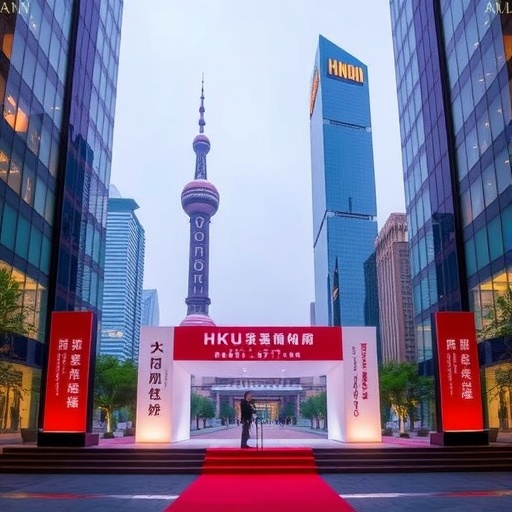
The University of Hong Kong (HKU) has embarked on a transformative journey into the heart of China’s Yangtze River Delta, marking a historic milestone in its 115-year legacy of academic and research excellence. From February 28 to March 1, 2026, HKU unveiled a series of landmark initiatives and facilities in Shanghai, signalling its commitment to fostering innovation, interdisciplinary research, and international collaboration on a global scale. This ambitious expansion establishes Shanghai as a strategic nexus, intertwining HKU’s pioneering spirit with the city’s role as a premier hub of economic, technological, and scientific advancement.
Central to this strategic expansion is the inauguration of the HKU Zhangjiang Base within Zhangjiang Science City, a state-of-the-art complex designed to extend the university’s acclaimed School of Computing and Data Science presence into mainland China. This facility serves as an epicenter for cutting-edge inquiry into areas such as smart computing architectures, future electronics, and advanced materials science. By nurturing collaborative interdisciplinary research, the Zhangjiang Base aims to accelerate development cycles, enhance technological convergence, and cultivate novel methodologies that respond to the increasingly complex challenges of the modern information era.
Complementing Zhangjiang’s innovative thrust lies the HKU Caohejing Base, situated in the renowned Caohejing Hi-Tech Oasis. This institute harnesses the development zone’s strengths to amplify translational research efforts—transforming laboratory breakthroughs into robust industrial applications. Concentrating on cross-disciplinary synergies, the base integrates emergent technologies with market-driven imperatives, fostering an ecosystem where innovation cascades elegantly from hypothesis to commercialization. Here, world-class scholars join forces with entrepreneurial ventures, bridging gaps between theoretical exploration and pragmatic solutions, positioning HKU at the forefront of China’s technological renaissance.
Anchoring these specialized facilities is the HKU Shanghai Headquarters, housed in the historically significant Bund 22 building. This headquarters functions as a central collaborative platform, uniting alumni, researchers, entrepreneurs, and scholars from both Shanghai and Hong Kong. By facilitating seamless interactions across disciplines and industries, the headquarters strengthens HKU’s global network, driving a continuum of knowledge exchange and fostering innovative partnerships that transcend geographic and cultural boundaries. This sets a new paradigm for educational institutions integrating heritage with future-forward collaboration.
Further enhancing HKU’s Shanghai footprint is the Bund SOHO Base, led by the HKU Business School. Positioned as a vibrant international platform, the Base uniquely amalgamates fintech advancement, digital intelligence, and entrepreneurial incubation, where technology interfaces with humanities and social sciences. This nexus is tailored to harness advanced analytics, artificial intelligence, and blockchain innovations, supporting emergent startups while deepening academic discourse on digital transformation’s societal implications. It embodies a forward-thinking vision that integrates commercial acumen with ethical and societal considerations.
The unveiling event series also featured a distinguished gathering of eminent intellectuals, including Nobel Laureates and a Fields Medalist newly appointed as HKU Chair Professors. Professors Sir Andre Geim and Ferenc Krausz, both Nobel Prize winners in Physics, and Fields Medalist Professor Ngô Bảo Châu engaged in profound discussions elucidating their current scientific endeavors and the future trajectories of their respective fields. These dialogues underscored the vitality of interdisciplinary research and highlighted the complex interdependencies between quantum physics, cutting-edge materials science, and mathematical innovation driving contemporary scientific revolutions.
Throughout the celebrations, a recurring theme was HKU’s endeavor to integrate scientific excellence with societal progress. Dr. Peter Wong, Chairman of the HKU Council, reflected on the university’s century-plus tradition of wisdom and virtue, emphasizing how HKU’s expansion into Shanghai exemplifies adapting institutional legacy to emergent global challenges. This vision is amplified through the university’s dedication to fostering leaders equipped to navigate the dynamic interfaces of science, technology, and policy essential for sustained innovation.
Professor Xiang Zhang, President and Vice-Chancellor of HKU, underscored the strategic significance of Shanghai’s economic and technological ecosystem. By embedding HKU’s academic rigor within Shanghai’s multifaceted innovation landscape, HKU positions itself as a critical contributor to China’s broader national development strategy. This involves not merely knowledge dissemination but actively shaping sectors such as finance, trade, and advanced manufacturing through research-led interventions and high-impact scientific inquiry.
Integral to this vision are HKU’s efforts to accelerate the conversion of scientific insights into tangible societal benefits. The interdisciplinary research institutes established across its Shanghai bases embody a systems-oriented approach to problem-solving—addressing challenges like sustainable manufacturing, artificial intelligence ethics, and next-generation electronic materials. These institutes adopt a holistic framework, combining empirical rigor with computational simulation and industrial collaboration to maximize research translational impact.
HKU’s Shanghai initiatives culminated in the 115th Anniversary High Table Dinner, featuring a keynote by Professor R. May Lee, President of Olin College of Engineering. Professor Lee’s address on innovation and education articulated forward-looking pedagogical paradigms essential for cultivating visionary scientists and engineers. Emphasizing experiential learning, interdisciplinary curricula, and entrepreneurial mindset development, her insights resonated strongly with HKU’s mission to blend academic excellence with real-world problem-solving aptitude.
The event series not only celebrated HKU’s historical achievements but also embodied a broader narrative about the evolving role of universities in a globalized knowledge economy. Through this bold leap into Shanghai, HKU reaffirms its position as a transnational institution—nurturing talent, pioneering scientific discoveries, and bridging cultural divides. Such international collaboration will be pivotal in addressing global challenges ranging from climate change to digital transformation and public health innovation.
In this milestone year, HKU’s commitment to “Sapientia et Virtus” (Wisdom and Virtue) serves as a guiding principle underpinning its expansion strategy. It seeks to foster a scholarly ecosystem where intellectual rigor meets ethical responsibility, advancing not only academic frontiers but also social equity and sustainable development. As HKU continues to intertwine its distinguished legacy with emergent global priorities, the Shanghai venture marks an auspicious prelude to an ambitious future characterized by transformative research, dynamic partnerships, and societal impact.
Ultimately, the University of Hong Kong’s inauguration of its Shanghai strategic bases signals a powerful reinvigoration of its mission in the 21st century. This initiative is not merely a geographical expansion but a complex integration of scientific inquiry, academic leadership, and innovation ecosystems—heralding an era where HKU’s knowledge generation and dissemination resonate deeply across regional and global spheres, inspiring new generations and advancing humanity’s collective future.
Subject of Research: Interdisciplinary Research and Innovation Ecosystems at The University of Hong Kong’s Shanghai Bases
Article Title: The University of Hong Kong’s Bold Expansion into Shanghai: Bridging Tradition and Innovation for a New Era of Scientific Excellence
News Publication Date: March 3, 2026
Web References:
https://www.hku.hk/news/press-releases/detail/29401.html
Image Credits: The University of Hong Kong
Keywords: University of Hong Kong, Shanghai, interdisciplinary research, innovation, scientific collaboration, Nobel Laureates, Fields Medalist, Zhangjiang Science City, Caohejing Hi-Tech Oasis, fintech, digital intelligence, academic excellence, knowledge economy


