


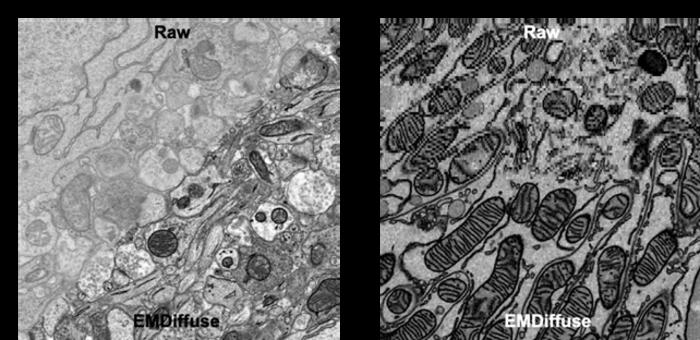
Electron microscope (EM) has revolutionised our ability to visualise the intricate details inside cells. The advancement to 3D electron microcopy, known as volume EM (vEM), has further expanded this three-dimensional, nanoscale imaging capacity. However, trade-offs between imaging speed, quality, and sample size still limit the achievable imaging area and volume. Concurrently, artificial intelligence (AI) is emerging as a pivotal force across various scientific domains, driving breakthroughs and serving as a vital tool in the scientific process.

Credit: The University of Hong Kong
Electron microscope (EM) has revolutionised our ability to visualise the intricate details inside cells. The advancement to 3D electron microcopy, known as volume EM (vEM), has further expanded this three-dimensional, nanoscale imaging capacity. However, trade-offs between imaging speed, quality, and sample size still limit the achievable imaging area and volume. Concurrently, artificial intelligence (AI) is emerging as a pivotal force across various scientific domains, driving breakthroughs and serving as a vital tool in the scientific process.
Inspired by the recent breakthroughs in AI-powered image generation models, specifically the development of advanced diffusion models, a research team led by Professor Haibo JIANG from the Department of Chemistry and Professor Xiaojuan QI from the Department of Electrical and Electronic Engineering at The University of Hong Kong (HKU) has developed a suite of diffusion model-based algorithms called EMDiffuse. This innovative solution aims to enhance imaging capabilities and resolve the trade-offs faced by EM and vEM. Their findings have recently been published in Nature Communications.
For conventional 2D EM, EMDiffuse excels at restoring realistic, high-quality visuals with high-resolution ultrastructural details, even from noisy or low-resolution inputs. Unlike other deep learning-based denoising or super-resolution methods, EMDiffuse adopts a unique approach by sampling the solution from the target distribution. EMDiffuse incorporates low-quality images as a condition or constraint at each step of its diffusion-based process to ensure the accuracy of the generated structure. This means the low-quality input is actively used to guide and shape the restoration rather than just being the starting point. Diffusion model can effectively prevent blurriness, maintaining resolution comparable to ground truth, which is crucial for detailed ultrastructural studies. Moreover, the generalisability and transferability of EMDiffuse allow its application to various datasets directly or after minimal fine-tuning with just one pair of training images.
In vEM, current hardware often struggles to capture high-resolution 3D images of large samples, especially in the depth (or ‘z-direction’), making it difficult to fully study the 3D structure of important cell components like mitochondria and the endoplasmic reticulum.
EMDiffuse addresses this issue with two flexible approaches. It can use ‘isotropic’ training data – 3D image datasets with uniform, high resolution in all dimensions — to learn how to enhance the axial resolution of other 3D data. Alternatively, EMDiffuse can analyse existing 3D images and improve their depth resolution through self-supervised techniques without requiring specialised training data. This versatility allows EMDiffuse to enhance the quality and usefulness of 3D electron microscopy data across different research applications.
The restored volumes demonstrate exceptional accuracy in studying ultrastructural details, such as mitochondrial cristae and interactions between mitochondria and the ER, which are challenging to observe in original anisotropic volumes. Since EMDiffuse does not require isotropic training data, it can be directly applied to any existing anisotropic volume to improve its axial resolution.
EMDiffuse represents an important advancement in the imaging capabilities of both EM and vEM, enhancing image quality and axial resolution of the data produced. ‘With this foundation, we can envision further development and acceleration of the EMDiffuse algorithm, paving the way for in-depth investigations into the intricate subcellular nanoscale ultrastructure within large biological systems,’ said Professor Haibo Jiang, one of the corresponding authors of the paper. ‘As this AI-powered imaging technology matures, we are excited to see how it enables researchers to uncover the previously undiscovered operational mechanisms within biological systems,’ echoed Professor Xiaojuan Qi, another corresponding author of the paper.
For more detailed information, please refer to the journal paper titled ‘Diffusion-based deep learning method for augmenting ultrastructural imaging and volume electron microscopy’ published in Nature Communications:
Learn more about the research:
More information about Professor Haibo Jiang: https://www.haibojianglab.com and Professor Xiaojuan Qi:
For media enquiries, please contact Ms Casey To, Assistant Manager (Communications) (Tel: 3917 4948; email: caseyto@hku.hk ) / Ms Cindy Chan, Assistant Communications Director of HKU Faculty of Science (Tel: 3917-5286; email: cindycst@hku.hk).
Images download and captions: https://www.scifac.hku.hk/press.
Journal
Nature Communications
Article Title
Diffusion-based deep learning method for augmenting ultrastructural imaging and volume electron microscopy
Article Publication Date
18-Aug-2024
Cite Scienmag News
Denise Maddox. (August 27, 2024). HKU scientists develop AI-driven method to enhance electron microscopy imaging capabilities of complex biological systems. Scienmag. https://scienmag.com/hku-scientists-develop-ai-driven-method-to-enhance-electron-microscopy-imaging-capabilities-of-complex-biological-systems/
Denise Maddox. "HKU scientists develop AI-driven method to enhance electron microscopy imaging capabilities of complex biological systems." Scienmag, 27 August 2024, https://scienmag.com/hku-scientists-develop-ai-driven-method-to-enhance-electron-microscopy-imaging-capabilities-of-complex-biological-systems/. Accessed 3 September 2026.
Denise Maddox. "HKU scientists develop AI-driven method to enhance electron microscopy imaging capabilities of complex biological systems." Scienmag. August 27, 2024. https://scienmag.com/hku-scientists-develop-ai-driven-method-to-enhance-electron-microscopy-imaging-capabilities-of-complex-biological-systems/

