

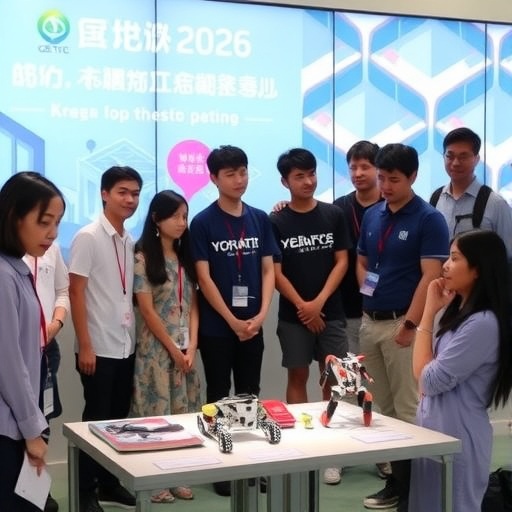
In an era marked by the escalating challenges of climate change and the resulting surge in extreme weather events, the crucial need to enhance disaster preparedness and response systems has never been more urgent. The Department of Mechanical Engineering at The University of Hong Kong (HKU), in collaboration with the CETIC Foundation, recently held the grand finale of MeckUp Quest 2026 — a pioneering AI robotics challenge designed to push the boundaries of technology in disaster scenario management. This event took place at HKU’s Hui Pun Hing Lecture Hall, drawing together some of the brightest young minds in robotics and artificial intelligence (AI) from across Hong Kong, mainland China, and Vietnam.
MeckUp Quest 2026 focused intensely on the theme of “Post-Typhoon Disaster Scenario Response,” a subject of critical importance given the increasing frequency and severity of typhoons in the Asia-Pacific region. The competition tasked 19 elite student teams with developing robotic systems capable of navigating complex, simulated environments replicating disaster-stricken urban landscapes. These environments featured obstacles typical of post-typhoon conditions, such as debris, flooded zones, and unstable structures, demanding sophisticated sensing, mobility, and decision-making autonomies from the robots. The contest highlighted how the frontier of AI and robotics can be harnessed for effective emergency rescue operations, spotlighting youth-led innovation as a beacon for social good.
Distinguished from a purely academic exercise, MeckUp Quest 2026 demanded that participant teams independently engineer robots with advanced autonomous functionalities. This entailed meticulous steps including mechanical design optimization for terrain adaptability, algorithm programming for real-time navigation, and integration of sensor arrays capable of environmental mapping and victim detection. The AI software underpinning these robots leveraged machine learning models trained on disaster-response datasets to enable adaptive path planning and contingency handling—an approach pushing beyond conventional robotics to embody genuine intelligent response systems.
The competition culminated with Team Pai-neer from Guanghua Cambridge International School in Shanghai seizing the coveted Grand Champion Award. Their robot exemplified a commanding blend of technical prowess and operational effectiveness, showcasing adaptive locomotion strategies to overcome debris-strewn terrain and robust object recognition abilities to identify rescue targets in simulated post-typhoon conditions. Beyond technical execution, their victory was also attributed to a compelling community support proposal, reinforcing the competition’s dual emphasis on innovation and societal impact.
Central to MeckUp Quest’s philosophy is the principle that technology must serve social good, particularly as AI becomes an ever-present force in global development. The challenge serves as a practical incubator, where youth teams are encouraged to envision and actualize solutions that can be directly translated into real-world humanitarian contexts. By engaging with these complex systems from design through deployment, students not only refine their technical skills but also cultivate empathy and a deep-seated sense of responsibility toward disaster-affected communities.
This competition additionally fosters a rich ecosystem of collaboration among academia, industry, and emerging talent. The HKU Academy for the Talented played an instrumental support role throughout the event, facilitating knowledge-sharing and mentorship to fortify student capacities. Industry players including Intel, XRP, csl, and Netvigator contributed resources and expertise, reinforcing a high-caliber “theory plus practice” innovation platform. Such partnerships are crucial in equipping the next generation of engineers with the tools and perspectives needed to tackle multifaceted global challenges.
From a technical standpoint, the robots featured a confluence of innovations in mobility, perception, and AI-driven decision-making. Mobility systems incorporated adaptive suspension mechanisms and all-terrain traction controls, engineered to maintain stability and maneuverability on varied and hazardous surfaces. Perception modules integrated LiDAR, infrared imaging, and multispectral cameras to create dynamic, multi-layered environmental maps, enabling the robots to detect obstacles and potential victims with precision. At the AI core, combining supervised and reinforcement learning paradigms allowed these systems to autonomously adjust strategies in response to unpredictable conditions—a capability central to effective disaster response.
The judging panel for MeckUp Quest 2026 represented a remarkable assembly of leadership from both the STEM academic world and industry sectors, ensuring a rigorous, multi-dimensional evaluation of participant projects. Experts such as Dr. Match Ko from HKU’s Mechanical Engineering Department and Ms. Elisa Aristizabal Soto from XRP contributed their domain insights, while senior figures from Intel and HKT enriched the assessment with perspectives on scalability, digital readiness, and product potential. This cross-disciplinary scrutiny underscored the competition’s holistic approach, valuing not just engineering innovation but also teamwork, feasibility, and social applicability.
Dr. Match Ko emphasized that the competition transcends mere contest and points toward a broader, sustainable ecosystem of AI-integrated education. It aspires to build continuous learning environments where teachers and students alike deepen their engagement with intelligent technologies year-round. This vision aligns with the urgent imperative to adapt educational models for the realities of an AI-pervasive future, promoting innovation trajectories that prioritize human welfare and societal advancement.
Furthermore, the event highlighted strategic regional efforts to bolster Asia’s presence on the global stage of robotics and AI innovation. Ms. Elisa Aristizabal Soto remarked on the robust development of Asia’s FIRST Robotics ecosystem and the importance of global networks like XRP in opening pathways for more students to compete internationally and ascend as leaders in technology. These initiatives contribute not only to regional capacity-building but also to a diversified and inclusive global technology community.
The competition’s real-world relevance is deeply encouraging—post-disaster scenarios demand rapid, precise, and adaptive response capabilities. By training student teams to engineer robotic solutions that operate effectively under these stringent conditions, MeckUp Quest 2026 is cultivating the designers and programmers of tomorrow’s lifesaving technologies. These robots may one day be deployed in actual disaster zones, providing critical assistance that can reduce human risk and accelerate recovery efforts.
As AI becomes ubiquitous, platforms like MeckUp Quest exemplify how the fusion of cutting-edge technology and youthful innovation can be strategically oriented toward enhancing societal resilience. The event underscores a proactive agenda, positioning AI and robotics not just as tools of convenience or economic boom but as essential contributors to global disaster management infrastructures. The palpable enthusiasm and demonstrated capabilities of the student teams reveal a promising future pipeline for responsible AI practitioners who grasp the vital interplay between technology and humanity.
In summary, MeckUp Quest 2026 stands as a landmark in leveraging AI and robotics for disaster response, fostering intergenerational collaboration, and driving social impact through technological excellence. Events of this caliber provide not only a competitive arena but also an incubator for breakthroughs that may well redefine how communities respond to climate-induced crises. By centering youth innovation and practical application, HKU’s initiative creates a dynamic model that can inspire similar efforts worldwide, ultimately helping to build a safer, smarter, and more empathetic global society.
Subject of Research: Artificial Intelligence and Robotics Applications in Post-Disaster Response
Article Title: Youth-Powered AI Robotics Innovate Post-Typhoon Disaster Response at HKU’s MeckUp Quest 2026
News Publication Date: Not specified in the source text
Web References:
https://mediasvc.eurekalert.org/Api/v1/Multimedia/ba765ea8-a535-4bea-9504-939d8eae1913/Rendition/low-res/Content/Public
Image Credits: The University of Hong Kong
Keywords: Applied sciences and engineering, Computer science, Artificial intelligence, Computer modeling


