


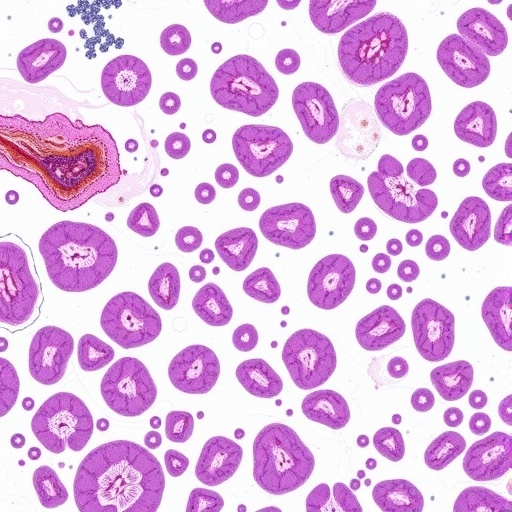
In a groundbreaking development at the intersection of artificial intelligence and medical diagnostics, researchers have unveiled a novel AI-driven system named HistoGPT, designed to revolutionize the generation of dermatopathology reports from gigapixel whole slide images (WSIs). The research, recently published in Nature Communications, introduces a cutting-edge deep learning framework that processes the immense and intricate data inherent in gigapixel WSIs, automating and enhancing the precision of dermatopathological assessments. This advancement promises to significantly alleviate the workload of pathologists while improving diagnostic accuracy in skin cancer and other dermatological conditions.
Whole slide imaging has transformed pathology by digitizing glass slides at ultra-high resolutions, often generating images spanning billions of pixels. These gigapixel images provide the detailed morphological information vital for accurate diagnosis but pose substantial challenges for both human interpretation and computational analysis due to their size and complexity. Traditional image analysis methods struggle to process gigapixel WSIs efficiently, often requiring downscaling or patch-based approaches that risk losing critical contextual information. HistoGPT, however, capitalizes on a novel architecture that can ingest these massive images in their entirety, maintaining spatial coherence and enabling comprehensive analysis.
At the core of HistoGPT lies an advanced adaptation of generative pre-trained transformer (GPT) architectures, originally developed for natural language processing tasks. By integrating vision transformer models with generative language models, the researchers have engineered a system that not only interprets visual data from WSIs but also translates these complex imagery patterns into coherent, detailed, and clinically relevant pathology reports. This multimodal learning approach marks a significant leap, transforming image data directly into text with a high degree of fidelity and nuance.
One of the key technical innovations underpinning HistoGPT is its ability to handle hierarchical image representations, enabling it to zoom in and out within the gigapixel WSIs to detect features at multiple scales—ranging from cellular structures to larger tissue architecture. This hierarchical processing mimics the diagnostic approach of human dermatopathologists, who shuttle between high magnification for cellular detail and lower magnification for tissue context. Such a capability ensures that diagnostic reports generated by HistoGPT incorporate microscopic pathological features alongside broader tissue-level abnormalities.
Training HistoGPT required the assembly of a vast and expertly annotated dataset of dermatopathology WSIs paired with corresponding diagnostic reports. The meticulous curation of this dataset was essential not only for teaching the model the complex morphological signatures of diverse dermatological conditions but also for enabling it to learn the language conventions and report structuring used by clinical pathologists. The model’s training regimen involved pre-training on visual and textual data separately before fine-tuning on the integrated multimodal task, a process that substantially enhanced its understanding and fluency in both image interpretation and medical storytelling.
Performance evaluation of HistoGPT demonstrated remarkable results. When benchmarked against human dermatopathologists, the AI system generated reports with substantial concordance in diagnostic terminology, lesion characterization, and treatment recommendations. Importantly, the model achieved this level of performance while operating considerably faster than traditional manual workflows, highlighting its potential to accelerate diagnostic processes in busy clinical environments without compromising quality.
Beyond mere accuracy, HistoGPT exemplifies explainability and transparency, two critical attributes necessary for clinical AI integration. The system is equipped with attention visualization tools that allow users to identify which regions of an image contributed most heavily to specific parts of the generated report. This feature fosters trust among healthcare professionals, ensuring that AI-generated insights can be readily verified and contextualized alongside pathologists’ expertise.
The implications of HistoGPT extend far beyond dermatopathology. As a proof-of-concept for AI-enabled report generation directly from gigapixel WSIs, it lays the groundwork for analogous applications in other pathology subfields, including hematopathology, neuropathology, and oncologic pathology. Each of these disciplines grapples with the dual challenges of large image datasets and complex diagnostic narratives, making HistoGPT’s framework broadly relevant and adaptable.
Moreover, the scalability of this system holds promise for addressing disparities in diagnostic expertise globally. In regions where there is a shortage of highly trained dermatopathologists, AI systems like HistoGPT could act as diagnostic force multipliers, providing high-quality assessments and reports that might otherwise be inaccessible. Such democratization of dermatopathological expertise could lead to earlier diagnoses, improved patient outcomes, and more equitable healthcare delivery worldwide.
However, the integration of AI systems like HistoGPT into routine clinical practice will necessitate stringent validation protocols, regulatory approval, and ongoing surveillance to ensure safety and efficacy. Ethical considerations, including data privacy, informed consent, and the mitigation of algorithmic bias, must be thoroughly addressed before widespread deployment. The authors of this study emphasize collaborative efforts between AI specialists, clinicians, and policymakers to create robust frameworks for responsible AI implementation in healthcare.
Interestingly, HistoGPT’s approach of directly linking raw imaging data to textual reports also presents opportunities for enhancing medical education. By generating detailed and annotated reports from complex WSIs, such systems could serve as interactive teaching tools to train both pathology residents and practicing clinicians, exposing them to diverse case presentations and diagnostic reasoning paths in a highly accessible format.
The research team envisions future iterations of HistoGPT incorporating multimodal data beyond histological images, potentially integrating genomic, proteomic, and clinical metadata to create even richer diagnostic narratives. This comprehensive approach aligns with the growing trend toward precision medicine, where multi-dimensional data synthesis informs tailored therapeutic strategies and prognostic assessments.
As the boundaries of AI and medical imaging continue to blur, HistoGPT represents a compelling example of how transformer-based architectures and deep learning can bridge the gap between visual data comprehension and natural language generation in clinical workflows. Its success heralds a new era where AI not only supports but actively participates in the complex cognitive tasks of medical diagnosis and reporting.
In conclusion, the arrival of HistoGPT is a landmark moment in computational pathology. By effectively translating gigapixel dermatopathology WSIs into structured, accurate, and clinically meaningful reports, it promises to transform diagnostic pathology from a largely manual, labor-intensive endeavor into a streamlined, AI-augmented discipline. As ongoing research refines and validates this technology, patients and clinicians alike stand to benefit from faster, more precise dermatological diagnoses, and a future where AI becomes an indispensable partner in personalized medicine.
Cite Scienmag News
Ophelia Keating. (May 27, 2025). HistoGPT Transforms Gigapixel Dermatopathology Report Generation. Scienmag. https://scienmag.com/histogpt-transforms-gigapixel-dermatopathology-report-generation/
Ophelia Keating. "HistoGPT Transforms Gigapixel Dermatopathology Report Generation." Scienmag, 27 May 2025, https://scienmag.com/histogpt-transforms-gigapixel-dermatopathology-report-generation/. Accessed 5 September 2026.
Ophelia Keating. "HistoGPT Transforms Gigapixel Dermatopathology Report Generation." Scienmag. May 27, 2025. https://scienmag.com/histogpt-transforms-gigapixel-dermatopathology-report-generation/


