


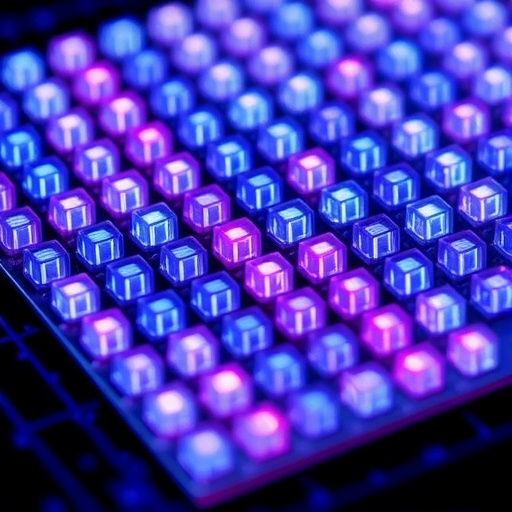
In a groundbreaking advance set to redefine the landscape of microdisplay technology, researchers Jing, Yao, Yang, and their colleagues have unveiled a pioneering approach to fabricating high-resolution Micro-Quantum Light-Emitting Diodes (Micro-QLEDs) utilizing photolithographic techniques. This innovation promises to significantly elevate color-conversion microdisplays, potentially revolutionizing sectors from augmented reality to compact display devices. The study, recently published in Light: Science & Applications, marks a milestone in precise, scalable microfabrication that overcomes previously insurmountable challenges in Micro-QLED production.
Micro-QLEDs represent the frontier in display technology, offering exceptional brightness, efficiency, and color purity compared to conventional organic LEDs. However, achieving ultrahigh resolution in Micro-QLED arrays has been hindered by difficulties in patterning millions of equally tiny and uniform light-emitting pixels. Conventional methods like inkjet printing or conventional photolithography often falter due to issues such as poor pixel uniformity, difficulty in alignment, and material compatibility. The novel photolithographic process introduced by Jing and colleagues deftly navigates these challenges to enable precise, high-density Micro-QLED architectures.
At the heart of their approach is an advanced photolithography process calibrated to pattern micro-emitters at unprecedented resolution levels. By refining the photoresist formulation and exposure protocols, the team achieved pixel sizes down to the micrometer scale, essential for microdisplays demanding pixel densities exceeding those found in today’s best smartphones. This technique supports the integration of complex multilayer structures necessary for full-color operation, which is critical in achieving true color fidelity via efficient color conversion.
Color conversion itself is a pivotal aspect addressed by their work. Microdisplays typically require red, green, and blue pixels, but direct fabrication of certain wavelengths often encounters material limitations. Here, the researchers employed a color-conversion layer meticulously aligned on top of high-performance blue Micro-QLED arrays, which then emit red or green wavelengths via phosphor or quantum dot conversion. The ability to pattern these layers with photolithographic precision assures high pixel packing density and eliminates color bleeding or cross-talk, issues that historically degraded image quality.
Moreover, their methodology advances scalability beyond academic demonstrations by presenting fabrication steps fully compatible with existing semiconductor manufacturing infrastructure. This compatibility is a critical enabler for commercial adoption, as it promises a path from lab-scale prototypes to mass production. The reproducibility of the process was confirmed through several fabrication cycles, demonstrating consistency in pixel morphology, emission characteristics, and device yield rates.
Crucially, the team’s innovation significantly boosts the luminance and efficiency of Micro-QLEDs compared to traditional fabrication routes. Enhanced electrical contact formation and improved emitter uniformity result in minimized energy losses and longer operational lifetimes. These factors together not only improve the visual performance of microdisplays but also extend device durability, addressing long-standing reliability concerns.
Another essential dimension explored by the researchers is the integration of Micro-QLED arrays with micro-optics to optimize light extraction and viewing angles. By co-fabricating micro-lens arrays using the same photolithographic workflow, the team enhanced the overall brightness without increasing power consumption, delivering a more immersive and vivid visual experience. This synthesis of electronic and optical patterning within one streamlined process is a testament to the versatility and robustness of their approach.
The implications of this breakthrough extend beyond consumer electronics. High-resolution Micro-QLED microdisplays could dramatically impact wearable technologies, including augmented reality (AR) and virtual reality (VR) headsets, by providing ultracompact, high-brightness displays capable of conforming to ergonomic design constraints. Additionally, such displays hold promise for biomedical imaging devices, portable diagnostics, and advanced instrumentation requiring high fidelity color rendering in miniature form factors.
Underlying the success is the collaboration across material science, engineering, and applied physics disciplines. The researchers carefully optimized quantum dot formulations, photoresist chemistries, and device architectures in parallel, illustrating the interdisciplinary synergy needed to push Micro-QLED frontiers. This holistic approach accentuates how modern device innovation requires integrating chemical, electronic, and optical expertise in harmony.
Looking forward, the authors suggest that further refinement of photolithographic patterning resolution and the introduction of novel quantum dot materials with tailored emission spectra will propel Micro-QLED microdisplays to new heights. They also highlight the potential for flexible and transparent substrates, which could enable next-generation wearable devices with seamless integration in clothing or eyewear. Such developments would pave the way for electronics that are not only powerful but also unobtrusive and organic in form.
In summary, this research decisively bridges the gap between experimental Micro-QLEDs and practical, high-resolution, multi-color microdisplays suitable for widespread application. By establishing a scalable, efficient photolithographic process, Jing and colleagues address the critical issues of pixel miniaturization, color conversion accuracy, and manufacturing feasibility. Their work charts a promising roadmap for the next era of ultra-compact, high-performance displays poised to redefine human-machine interaction.
As the microelectronics industry anticipates these advancements, the ripple effect could catalyze innovations in adjacent fields such as photonics, quantum computing displays, and sensory interfaces. The refinement of Micro-QLED fabrication is not merely an incremental improvement but a paradigm shift with profound technological and commercial ramifications.
Ultimately, this pioneering study accentuates the role of precision microfabrication techniques in unlocking new technological capabilities. It stands as a powerful demonstration of how photolithography, a mature and widely accessible technology, can be reinvented to meet the stringent demands of emerging nanoscale devices. With this breakthrough, the visual displays of tomorrow are set to become brighter, more vivid, and astonishingly miniature, fulfilling the dreams long held by engineers and consumers alike.
Cite Scienmag News
Denise Maddox. (October 20, 2025). High-Resolution Micro-QLEDs via Photolithography for Displays. Scienmag. https://scienmag.com/high-resolution-micro-qleds-via-photolithography-for-displays/
Denise Maddox. "High-Resolution Micro-QLEDs via Photolithography for Displays." Scienmag, 20 October 2025, https://scienmag.com/high-resolution-micro-qleds-via-photolithography-for-displays/. Accessed 4 September 2026.
Denise Maddox. "High-Resolution Micro-QLEDs via Photolithography for Displays." Scienmag. October 20, 2025. https://scienmag.com/high-resolution-micro-qleds-via-photolithography-for-displays/


