


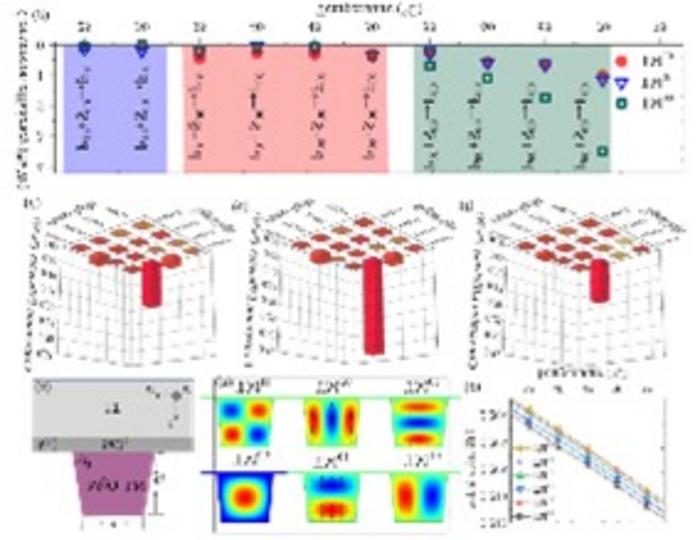
A new publication from Opto-Electronic Science; DOI 10.29026/oes.2024.230036 discusses high-intensity spatial-mode steerable frequency up-converter toward on-chip integration.

Credit: OES
A new publication from Opto-Electronic Science; DOI 10.29026/oes.2024.230036 discusses high-intensity spatial-mode steerable frequency up-converter toward on-chip integration.
Integrated photonic devices consisting of micro-lasers, amplifiers, optical waveguides, frequency converters, and modulators on a single chip, enabling control over photon’s spatial modes, frequencies, angular momenta, and phases, are essential for preparing high-dimensional quantum entangled states, high-capacity photon information processing, all-optical communication, and miniaturization of photonic computing. However, current nonlinear waveguide devices, integrating spatial modes and photon frequency conversions, heavily rely on external optical path control and spatial light modulators, failing to meet the crucial requirement of on-chip integration for photonic devices. To address this, the authors of this article propose the on-chip integration of a spatial mode steerable nonlinear frequency up-conversion device based on spatial mode competition under high mixing light intensity. This approach achieves high-intensity spatial modes during nonlinear frequency conversion of a LN waveguide and can be controlled by tuning both temperature and fundamental wavelengths.
Based on the inter-mode phase matching principle of optical waveguide, the temperature, fundamental signal frequency, and intensity conditions required for the generation of different spatial modes during the nonlinear up-conversion process were deduced, obtaining the structural parameters of the spatial-mode steerable frequency up-conversion waveguide (see Figure 1). Subsequently, utilizing photolithography combined with the process of forming structure inversion and precision cutting techniques with a diamond knife, they fabricated PPLN multi-mode waveguides that meet the conditions for inter-mode phase matching and nonlinear frequency up-conversion (see Figure 2).
Using a 976 nm DFB laser as the pump light and a C-band tunable narrow linewidth fiber laser as the signal light, steerable high-intensity outputs between TM01, TM10, and TM00 modes were achieved under variable temperature and signal light wavelengths (see Figure 3). Since this process does not require additional optical path control or using the bulky spatial light modulators, it lays an important foundation for further on-chip integration of high-dimensional quantum entanglement devices and large-capacity mode-division multiplexing devices.
# # # # # #
Prof. Wenxiong Lin’s group at Fujian Institute of Research on the Structure of Matter, Chinese Academy of Sciences, primarily conducts research on solid-state laser technology, integrated optoelectronic devices, and additive manufacturing technology. They have undertaken more than twenty major research projects and developed over twenty high-performance lasers covering wavelengths from deep ultraviolet at 190 nm to mid-infrared at 3~5 μm, for various research institutions in China. Their work has addressed numerous key technical challenges in national defense, scientific research, and industrial technology development, forming a complete set of system integration and engineering application technologies with independent intellectual property rights in materials, devices, and equipment. In recent years, they have published over 80 papers in prestigious domestic and international journals, won one second prize for national scientific and technological progress, and received two provincial and ministerial-level science and technology awards.
Prof. Wanguo Liang’ group at Fujian Institute of Research on the Structure of Matter, Chinese Academy of Sciences, mainly focuses on the research of optical superlattice crystals and nonlinear optics. In recent years, the team has undertaken projects such as the National “863” Program, the Fujian Provincial Science and Technology Major Project, the Instrumentation and Equipment Project of Chinese Academy of Sciences, the STS Project of Chinese Academy of Sciences, and the Project of Fujian Science & Technology Innovation Laboratory for Optoelectronic Information of China (Mingdu Innovation Laboratory) Project. They have published more than 60 papers in high-level domestic and international academic journals and conferences, translated and published a book titled “Waveguide Nonlinear Optical Devices,” and obtained over 80 patents, including 30 invention patents and 5 software copyright authorizations.
Associate Professor Chen Huaixi’s group at Fujian Normal University relies on the Key Laboratory of Opto-Electronic Science and Technology for Medicine of Ministry of Education, and the Fujian Provincial Key Laboratory of Photonics Technology. They have established a comprehensive platform for the design, processing, and R&D of lithium niobate-based optical waveguide devices and medical multi-wavelength laser devices. The College of Optoelectronics and Information Engineering, where the group belongs to, has two first-level discipline doctoral degree authorizations in Optical Engineering and Physics (Optics), two first-level discipline master’s degree authorizations in Optical Engineering and Information and Communication Engineering, and a second-level discipline authorization for a master’s degree in Optics. It is an important base for the cultivation of national optoelectronic engineering talents. The discipline of Optical Engineering is a leading provincial key discipline in the optoelectronics field and has been selected into the provincial-level national key discipline cultivation plan in Fujian Province.
# # # # # #
Opto-Electronic Science (OES) is a peer-reviewed, open access, interdisciplinary and international journal published by The Institute of Optics and Electronics, Chinese Academy of Sciences as a sister journal of Opto-Electronic Advances (OEA, IF=9.682). OES is dedicated to providing a professional platform to promote academic exchange and accelerate innovation. OES publishes articles, reviews, and letters of the fundamental breakthroughs in basic science of optics and optoelectronics.
# # # # # #
Editorial Board: /editorialboard/list
OES is available on OE journals (/archive)
Submission of OES may be made using ScholarOne (https://mc03.manuscriptcentral.com/oes)
CN 51-1800/O4
ISSN 2097-0382
Contact Us: oes@ioe.ac.cn
Twitter: @OptoElectronAdv (https://twitter.com/OptoElectronAdv?lang=en)
WeChat: OE_Journal
# # # # # #
Huang HZ, Chen HX, Liu HG et al. High-intensity spatial-mode steerable frequency up-converter toward on-chip integration. Opto-Electron Sci 3, 230036 (2024). doi: 10.29026/oes.2024.230036
Journal
Opto-Electronic Advances
Cite Scienmag News
Denise Maddox. (May 1, 2024). High-intensity spatial-mode steerable frequency up-converter toward on-chip integration. Scienmag. https://scienmag.com/high-intensity-spatial-mode-steerable-frequency-up-converter-toward-on-chip-integration/
Denise Maddox. "High-intensity spatial-mode steerable frequency up-converter toward on-chip integration." Scienmag, 1 May 2024, https://scienmag.com/high-intensity-spatial-mode-steerable-frequency-up-converter-toward-on-chip-integration/. Accessed 6 September 2026.
Denise Maddox. "High-intensity spatial-mode steerable frequency up-converter toward on-chip integration." Scienmag. May 1, 2024. https://scienmag.com/high-intensity-spatial-mode-steerable-frequency-up-converter-toward-on-chip-integration/

