
Saturday, February 28, 2026
Science
No Result
View All Result
  • Login
  • HOME
  • SCIENCE NEWS
  • CONTACT US
  • HOME
  • SCIENCE NEWS
  • CONTACT US
No Result
View All Result
Scienmag
No Result
View All Result
Home Science News Medicine

High BMI linked to reduced brain volume and increased white matter lesions

May 22, 2024
in Medicine
Reading Time: 2 mins read
0
Causal association betweem BMI and brain health
66
SHARES
598
VIEWS
Share on FacebookShare on Twitter
ADVERTISEMENT

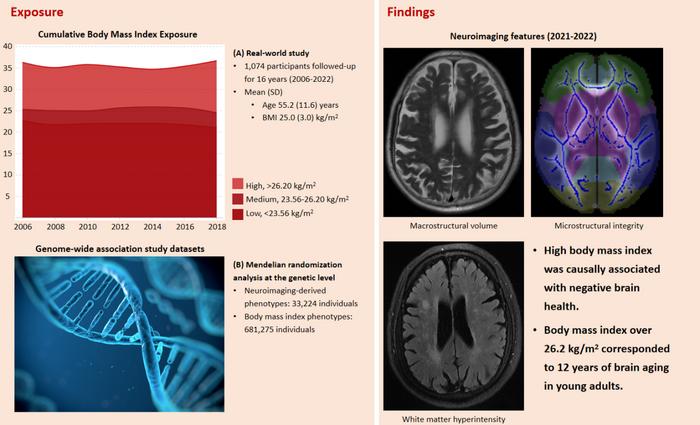
A recent study published in Health Data Science, a Science Partner Journal, reveals the significant impact of high cumulative body mass index (BMI) on brain health. The research, led by Associate Professor Han Lv from Beijing Friendship Hospital, Capital Medical University, found that high BMI is associated with smaller brain volume, larger white matter lesions, and abnormal microstructural integrity.

Causal association betweem BMI and brain health

Credit: Lv, Han; Beijing Friendship Hospital, Capital Medical University

A recent study published in Health Data Science, a Science Partner Journal, reveals the significant impact of high cumulative body mass index (BMI) on brain health. The research, led by Associate Professor Han Lv from Beijing Friendship Hospital, Capital Medical University, found that high BMI is associated with smaller brain volume, larger white matter lesions, and abnormal microstructural integrity.


The study analyzed data from a 16-year population-based cohort to investigate the effects of cumulative BMI on neuroimaging features in adults aged 25 to 83 years. Researchers discovered that high BMI was linked to smaller brain volume and larger volumes of white matter hyperintensity (WMH), particularly in adults younger than 45 years and those older than 60 years.


“High cumulative BMI is detrimental to brain health, especially for younger adults under 45 years, where it corresponds to approximately 12 years of brain aging,” said Associate Professor Han Lv. “Maintaining a BMI below 26.2 kg/m² is suggested for better brain health.”


The study utilized a generalized linear model to evaluate the association between cumulative BMI and various neuroimaging features, including brain macrostructure, white matter integrity, and brain microstructure. Additionally, Mendelian randomization analysis was performed to establish causal relationships using genetic data.


The results indicated that high BMI is causally linked to smaller gray matter volume and increased fractional anisotropy in certain brain regions, highlighting the importance of maintaining a healthy BMI throughout adulthood to preserve brain health.


“This research provides crucial insights into the relationship between BMI and brain health, emphasizing the need for public health strategies to control BMI for better neurological outcomes,” concluded Associate Professor Han Lv. “Future studies should focus on acquiring longitudinal neuroimaging data to further explore these associations.”


Journal

Health Data Science

DOI

10.34133/hds.0087

Article Title

Association between Body Mass Index and Brain Health in Adults: A 16-Year Population-Based Cohort and Mendelian Randomization Study

Article Publication Date

15-Mar-2024

Share26Tweet17
Previous Post

Comprehensive bibliographic dataset advances health AI research

Next Post

Sun’s magnetic field originates surprisingly close to the surface

Related Posts

blank
Medicine

Physical Activity Slows Aging-Related Physical Decline

February 28, 2026
blank
Medicine

X-ray Activated Platinum Complex Boosts Cancer Immunotherapy

February 28, 2026
blank
Medicine

Botulinum Toxin Causes Masseter Atrophy via Autophagy Impairment

February 28, 2026
blank
Medicine

Creating Effective Fall Programs for Older Adults

February 28, 2026
blank
Medicine

Spinal Cord Organoids Reveal Injury and Therapy Insights

February 28, 2026
blank
Medicine

Ataluren Boosts Mitochondria, Cuts Stress in FANCA Cells

February 28, 2026
Next Post
Sun's magnetic field

Sun’s magnetic field originates surprisingly close to the surface

  • Mothers who receive childcare support from maternal grandparents show more parental warmth, finds NTU Singapore study

    Mothers who receive childcare support from maternal grandparents show more parental warmth, finds NTU Singapore study

    27618 shares
    Share 11044 Tweet 6902
  • University of Seville Breaks 120-Year-Old Mystery, Revises a Key Einstein Concept

    1022 shares
    Share 409 Tweet 256
  • Bee body mass, pathogens and local climate influence heat tolerance

    665 shares
    Share 266 Tweet 166
  • Researchers record first-ever images and data of a shark experiencing a boat strike

    532 shares
    Share 213 Tweet 133
  • Groundbreaking Clinical Trial Reveals Lubiprostone Enhances Kidney Function

    517 shares
    Share 207 Tweet 129
Science

Embark on a thrilling journey of discovery with Scienmag.com—your ultimate source for cutting-edge breakthroughs. Immerse yourself in a world where curiosity knows no limits and tomorrow’s possibilities become today’s reality!

RECENT NEWS

  • Physical Activity Slows Aging-Related Physical Decline
  • X-ray Activated Platinum Complex Boosts Cancer Immunotherapy
  • New Study Shows Belzutifan and Pembrolizumab Combo Extends Cancer-Free Survival in High-Risk Kidney Cancer Patients After Surgery
  • Botulinum Toxin Causes Masseter Atrophy via Autophagy Impairment

Categories

  • Agriculture
  • Anthropology
  • Archaeology
  • Athmospheric
  • Biology
  • Biotechnology
  • Blog
  • Bussines
  • Cancer
  • Chemistry
  • Climate
  • Earth Science
  • Editorial Policy
  • Marine
  • Mathematics
  • Medicine
  • Pediatry
  • Policy
  • Psychology & Psychiatry
  • Science Education
  • Social Science
  • Space
  • Technology and Engineering

Subscribe to Blog via Email

Enter your email address to subscribe to this blog and receive notifications of new posts by email.

Join 5,190 other subscribers

© 2025 Scienmag - Science Magazine

Welcome Back!

Login to your account below

Forgotten Password?

Retrieve your password

Please enter your username or email address to reset your password.

Log In
No Result
View All Result
  • HOME
  • SCIENCE NEWS
  • CONTACT US

© 2025 Scienmag - Science Magazine

Discover more from Science

Subscribe now to keep reading and get access to the full archive.

Continue reading