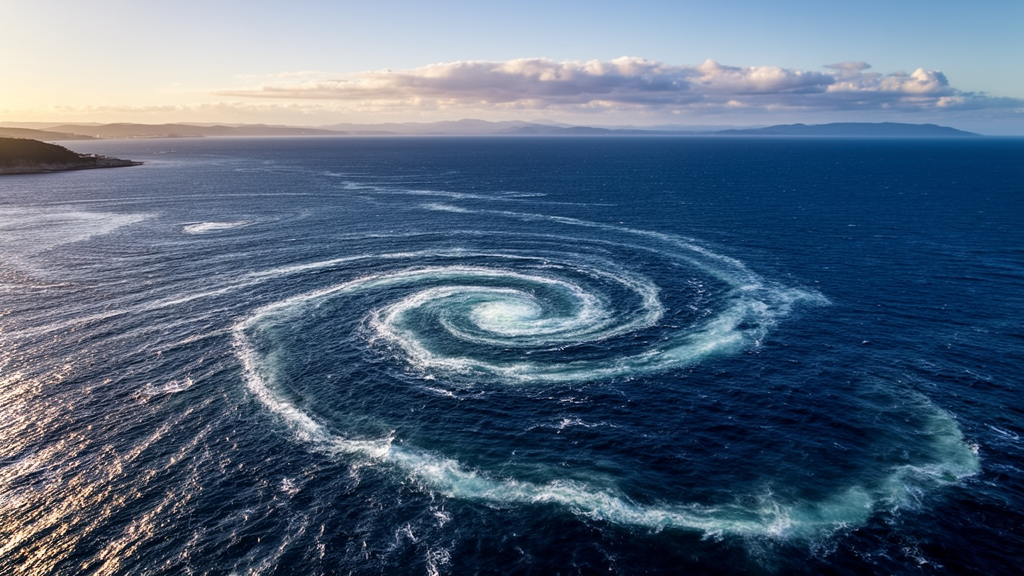
Satellite radar measurements have revealed narrow bands of negative and positive wind stress curl running parallel to the Kuroshio current in the East China Sea, a fine-scale atmospheric signature that coarse-resolution wind products completely miss. A new modeling study published in Geoscience Letters shows that these small-scale wind variations, once realistically included in an eddy-resolving ocean model, measurably alter the velocity of one of the world’s strongest western boundary currents, cool the sea surface along its path, and even shift the surface kinetic energy of the current far downstream south of Japan.
The fine structure was first documented in observations from the QuikSCAT satellite radar scatterometer, which measured near-surface wind speed and direction at a resolution of 25 kilometers. Over the Kuroshio, the data show negative wind stress curl on the inshore side of the current and positive curl on the offshore side. Such a pattern does not appear in wind products built from coarse-resolution numerical weather prediction models, such as those of the U.S. National Centers for Environmental Prediction, which smooth away these compact ocean-anchored wind features.
Two mechanisms are thought to generate these perturbations. Ocean surface velocity injects relative motion into the wind stress calculation, which can either amplify or damp the wind power delivered to the ocean depending on wind direction, and it contributes to the paired curl bands seen over both the Gulf Stream and the Kuroshio. Sea surface temperature gradients act through downward momentum transport and through pressure adjustment. When downward momentum transport dominates, warm water enhances vertical mixing and increases wind speed, so wind stress divergence resembles the SST gradient; when pressure adjustment dominates, wind stress divergence instead resembles the Laplacian of SST. Earlier work identified pressure adjustment as the dominant mechanism over the Kuroshio in the East China Sea and over the Gulf Stream.
The perturbations are not static. Monthly maps of spatially high-pass filtered QuikSCAT wind stress fields show that the wind stress along the Kuroshio path strengthens in winter and spring, with the largest amplitude in spring. Because background wind speed peaks in winter while the SST front is largest in spring, the ocean-surface-velocity mechanism alone cannot explain this seasonal cycle; the sea surface temperature gradient mechanism must contribute as well. This persistent, seasonally varying forcing is precisely what previous studies, which focused only on current-induced wind modifications, had left untested.
To quantify the effect, the authors used a 1/8-degree eddy-resolving ocean model based on the Regional Ocean Modeling System, configured over the North Pacific within a domain spanning 20 degrees south to 60 degrees north and 100 degrees east to 70 degrees west. The model was driven by monthly climatological wind stress, net freshwater flux, and net air-sea heat flux, with temperature and vertically integrated velocity nudged toward climatological fields on a 360-day time scale. The small-scale wind stress perturbations were extracted from climatological monthly mean QuikSCAT data covering July 1999 to November 2009 using a loess spatial high-pass filter, following the approach of Chelton and colleagues, and were added only over the East China Sea with an exponentially decaying weight function at the box boundaries.
Two ten-year experiments were compared. The first used monthly mean QuikSCAT wind stress fields with the small-scale features removed; the second added them back over the Kuroshio region. The difference between the runs isolates the ocean’s response. Along the Kuroshio path, the sea surface temperature cooled slightly, by less than 0.05 degrees Celsius, with warming on both flanks. Surface velocity showed an anomalous southwestward change on the onshore side and an anomalous northeastward change on the offshore side, with the largest values around 0.05 meters per second. In effect, the small-scale winds weakened the current on its inshore side and strengthened it offshore.
The vertical structure of the response is more intricate. At the PN section crossing the Kuroshio, the surface cooling is confined to a thin layer centered near 127 degrees east. Below it, an anomalous warming extends through the upper 100 meters, followed by deep-reaching cooling at mid-depth in the Okinawa Trough. Pronounced temperature changes also appear northeast of Taiwan, southwest of Kyushu, and around the Ryukyu Islands, regions tied to the Kuroshio intrusion, branching, and countercurrent, making them especially sensitive to variations in the current. The authors attribute these patterns to the Ekman upwelling and downwelling driven by the wind stress curls and to the accompanying changes in current velocity.
The consequences reach well beyond the forcing region. As the Kuroshio expanded offshore in the East China Sea, surface kinetic energy decreased on the onshore side there, but a larger change occurred south of Japan, where the current migrated onshore, mirroring the path-variation patterns described by Kawabe. In other words, small-scale winds prescribed only in the East China Sea alter the state of the Kuroshio and propagate their influence downstream. Changes in the three-dimensional velocity at the cross-shelf transect amount to 5 to 10 percent of the largest values in the mean fields, a non-trivial fraction for a forcing feature that most wind products do not resolve at all.
The small-scale winds also modulate the current’s seasonal behavior. Observations from hydrographic data spanning 1987 to 2010 and shipboard ADCP measurements from 1993 to 2008 at the PN section show that the Kuroshio is weakest at its core in autumn, its offshore countercurrent is strongest in spring, and its inshore northeast flow is strongest in autumn. The model reproduces the November minimum and the March countercurrent maximum, and adding the small-scale winds shifts the zero velocity line offshore by about 0.1 degrees east. Interestingly, although the wind perturbations peak in spring, the induced velocity changes are larger from March to September, possibly because upstream ocean state adjustments propagate into the East China Sea.
The study comes with caveats the authors examine explicitly. The constant drag coefficient used in the wind stress calculation underestimates wind stress amplitude by roughly 20 percent compared with the established COARE formulation, likely damping the simulated ocean response. The nudging scheme may also suppress mesoscale variability, as suggested by the model’s January mesoscale SST strength of 0.9 degrees Celsius in the Kuroshio Extension against an observed 1.1 degrees Celsius, although the along-path cooling persists even when nudging is switched off. Conversely, omitting active air-sea feedbacks may overestimate the response, since cooling the surface stabilizes the marine boundary layer and would naturally weaken the small-scale winds. The small-scale forcing does slightly correct the model’s onshore intensification bias, moving the simulated current axis closer to the observed position at 127.1 degrees east, but a significant bias remains. As ocean models improve, the authors suggest, representing these compact wind whorls may become not optional but essential.
Subject of Research: The impact of small-scale satellite-observed wind stress variations over the Kuroshio on ocean current simulations in the East China Sea
Article Title: Effect of small scale wind variations over the Kuroshio in the East China Sea
Article References: Wei, Y., Pei, Y., & Chen, D. (2026). Effect of small scale wind variations over the Kuroshio in the East China Sea. Geoscience Letters, 13(1), Article 57. https://doi.org/10.1186/s40562-026-00508-8
Image Credits: AI Generated
DOI: 10.1186/s40562-026-00508-8
Keywords: Kuroshio, East China Sea, wind stress curl, QuikSCAT, ocean modeling, sea surface temperature, Ekman pumping, eddy-resolving model, air-sea interaction, surface kinetic energy, seasonal variability, western boundary current
Cite Scienmag News
Violet Maxwell. (October 29, 2026). Hidden Wind Whorls Over the Kuroshio Reshape Ocean Currents Far Downstream. Scienmag. https://scienmag.com/hidden-wind-whorls-over-the-kuroshio-reshape-ocean-currents-far-downstream/
Violet Maxwell. "Hidden Wind Whorls Over the Kuroshio Reshape Ocean Currents Far Downstream." Scienmag, 29 October 2026, https://scienmag.com/hidden-wind-whorls-over-the-kuroshio-reshape-ocean-currents-far-downstream/. Accessed 4 November 2026.
Violet Maxwell. "Hidden Wind Whorls Over the Kuroshio Reshape Ocean Currents Far Downstream." Scienmag. October 29, 2026. https://scienmag.com/hidden-wind-whorls-over-the-kuroshio-reshape-ocean-currents-far-downstream/