


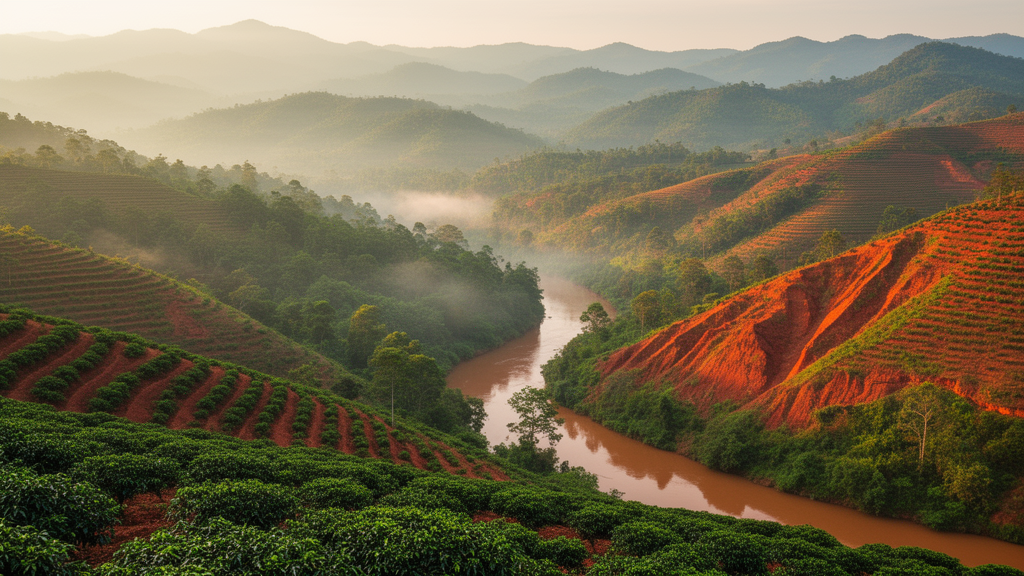
Vietnam’s Central Highlands have long been celebrated for their coffee plantations, basaltic soils, and dramatic monsoon rhythms, but the region’s water future is increasingly uncertain. A new study published in Frontiers in Sustainable Resource Management has reconstructed more than four decades of streamflow in two agriculturally critical sub-basins of the Ea Súp semi-plain, revealing a hydrological regime so sharply seasonal that up to 93 percent of annual runoff arrives within just five months of the year. The findings offer one of the most detailed quantitative portraits yet of surface water availability in this drought-prone corner of the lower Srêpôk River system, a major Mekong tributary.
The research team, led by Ngoc-Anh Nguyen of Hanoi University of Natural Resources and Environment and the Vietnam Academy of Science and Technology, together with Tu T. Tran and colleagues, focused on the Ia H’leo and Ia Lốp river basins. Together these basins drain roughly 4,600 square kilometers of terrain spanning Đắk Lắk and Gia Lai provinces, with headwaters rising above 900 meters near Ia Drăng commune and on the southern slopes of Hàm Rồng Mountain. Their combined flow crosses the Vietnam-Cambodia border before joining the Srêpôk River, making them strategically important not only for local agriculture but also for downstream water supply to urban centers such as Buôn Ma Thuột and, indirectly, Pleiku.
What makes the region hydrologically distinctive is its semi-plain morphology. Unlike the steeper plateaus that dominate much of the Central Highlands, the Ea Súp area features gentler gradients, higher potential evapotranspiration, and limited subsurface storage capacity. These characteristics mean that although rainfall can be abundant during the wet season, water is quickly lost to evaporation and rapid runoff rather than being stored for gradual release. The consequence is a pronounced dry-season deficit precisely when irrigation demand reaches its annual peak, creating a structural imbalance that climate variability only amplifies.
To quantify this imbalance, the researchers employed the MIKE-NAM rainfall-runoff model, a lumped conceptual tool originally developed in the 1970s at the Technical University of Denmark. NAM, which stands for Nedbør-Afstrømnings-Model or rainfall-runoff model in Danish, represents each catchment as a series of interconnected reservoirs corresponding to surface storage, root-zone soil moisture, and two groundwater stores. Fluxes between these stores are governed by parameters calibrated against observed discharge, allowing the model to capture the seasonal water balance of catchments with pronounced wet-dry contrasts using a relatively modest dataset. This parsimony is precisely what makes NAM valuable in data-scarce, monsoon-influenced basins where physically based distributed models would demand extensive monitoring infrastructure that simply does not exist.
And data scarcity is the defining constraint of this study. Despite a relatively dense network of six rain gauges providing daily records from 1980 to 2022, no continuous natural streamflow gauging stations operate along free-flowing river reaches within the study basins. The only discharge observations suitable for calibration and validation are reservoir inflow records from three facilities: Ea Súp Thượng on the Ea Súp River, Ia Mo on the Ia Mo River, and Plei Pai on the Ia Gle River. These records are reliable and quality-controlled only from approximately 2019 onward, meaning the researchers could calibrate the model over just three years, from 2019 to 2021, and validate it against an independent 2022 record. The team is explicit that this short calibration window is a data-driven necessity rather than an arbitrary choice, and that extending calibration to earlier decades without trustworthy discharge observations would undermine parameter robustness.
The performance metrics tell a story of generally acceptable to good model fidelity. Nash-Sutcliffe Efficiency values ranged from 0.73 to 0.95 during calibration and from 0.84 to 0.91 during validation, while Kling-Gupta Efficiency, which balances correlation, bias, and variability simultaneously, ranged from 0.68 to 0.82. Percent bias values spanned from -8.4 percent to +22.5 percent, with Ea Súp Thượng and Plei Pai falling into the very good category and Ia Mo showing a positive bias likely attributable to uncertainty in precipitation spatial distribution over its upper catchment, where a single rain gauge represents a large contributing area. Flow duration curves confirmed reasonable agreement across medium- and high-flow conditions, though deviations in the lower tail at high exceedance probabilities revealed that low-flow and dry-season simulations remain more uncertain than wet-season estimates.
A sensitivity analysis based on 2,001 calibration trials per catchment using the SCE-UA algorithm added quantitative depth to these findings. Spearman rank correlations between model parameters and the aggregated objective function revealed that maximum root-zone storage capacity, the baseflow recession constant, and the groundwater recharge threshold were the most influential parameters across all three catchments. This pattern indicates that the reconstructed streamflow series, particularly during the dry season, is strongly controlled by subsurface storage and baseflow processes rather than by surface runoff dynamics alone. The calibrated parameters also varied meaningfully between catchments, with Ia Mo showing higher storage capacities consistent with deeper basaltic soils and greater forest cover, while Plei Pai exhibited a slower baseflow recession consistent with gentler topography and more permeable geology.
With the calibrated model in hand, the team reconstructed monthly streamflow for the full 1980 to 2022 period. The results confirm moderate to high runoff potential: the Ia Lốp basin generates approximately 2.3 billion cubic meters of water annually with a runoff modulus of 43.2 liters per second per square kilometer, while the Ia H’leo basin produces about 3.1 billion cubic meters with a modulus of 33.1 liters per second per square kilometer. Combined, the two basins yield roughly 5.37 billion cubic meters per year. Rainfall across the region ranges from 1,551 millimeters at Bản Đôn to 2,333 millimeters at Chu Prông, reflecting strong orographic effects, with the rainy season from May to October contributing on average 88.6 percent of annual precipitation and the dry season from November to April delivering a mere 11.4 percent.
Perhaps the most striking finding is the multi-decadal variability embedded within the reconstructed series. Analysis of standardized cumulative departure curves reveals a prolonged dry phase from 1990 to 2008, followed by a distinctly wetter interval from 2009 to 2019, with water availability since 2020 hovering near average and possibly transitioning toward another drier cycle. This pronounced inter-annual variability, layered atop the extreme intra-annual seasonality, means that water managers in the Ea Súp semi-plain must contend not only with predictable seasonal scarcity but also with the possibility of multi-year droughts that could persist for nearly two decades at a time.
The implications extend well beyond hydrology into the Water-Energy-Food nexus. The researchers demonstrate that reduced dry-season flow directly increases energy demand for irrigation pumping, with a simple calculation showing that lifting one million cubic meters of water requires approximately 19.5 megawatt-hours at a five-meter head with 70 percent pump efficiency, rising to 90.8 megawatt-hours at a twenty-meter head with 60 percent efficiency. As dry-season flows decline, farmers and water utilities must pump from greater depths or over longer distances, intensifying cross-sectoral competition for both water and energy. The study argues that this vulnerability is best addressed through a combination of structural measures and Nature-based Solutions, including headwater forest restoration, riparian buffer protection, wetland conservation, and managed aquifer recharge, all of which can enhance infiltration, support baseflow, and reduce dependence on energy-intensive pumping. Climate projections suggesting temperature increases of 1.0 to 1.6 degrees Celsius by mid-century, accompanied by declining dry-season rainfall, make these adaptation strategies not merely advisable but urgent for the long-term water security of Vietnam’s Central Highlands.
Subject of Research: Seasonal streamflow variability and surface water assessment in the Ia Lo^́p and Ia H'leo basins of the Ea Súp semi-plain, Central Highlands of Vietnam
Article Title: Seasonal streamflow variability and surface water assessment in the Ia Lo^́p and Ia H'leo basins of the Ea Súp semi-plain, Central Highlands of Vietnam
Article References: Seasonal streamflow variability and surface water assessment in the Ia Lo^́p and Ia H'leo basins of the Ea Súp semi-plain, Central Highlands of Vietnam. (n.d.). https://doi.org/10.3389/fsrma.2026.1887583
Image Credits: AI Generated
DOI: 10.3389/fsrma.2026.1887583
Keywords: MIKE-NAM, rainfall-runoff modeling, seasonal streamflow variability, surface water assessment, Ea Súp semi-plain, Central Highlands Vietnam, Srêpôk River Basin, Water-Energy-Food nexus, drought-prone basin, Nature-based Solutions, reservoir inflow calibration, multi-decadal hydrological variability
Cite Scienmag News
Violet Maxwell. (October 16, 2026). Hidden Water Cycles of Vietnam’s Central Highlands Revealed in 43-Year Streamflow Reconstruction. Scienmag. https://scienmag.com/hidden-water-cycles-of-vietnams-central-highlands-revealed-in-43-year-streamflow-reconstruction/
Violet Maxwell. "Hidden Water Cycles of Vietnam’s Central Highlands Revealed in 43-Year Streamflow Reconstruction." Scienmag, 16 October 2026, https://scienmag.com/hidden-water-cycles-of-vietnams-central-highlands-revealed-in-43-year-streamflow-reconstruction/. Accessed 16 October 2026.
Violet Maxwell. "Hidden Water Cycles of Vietnam’s Central Highlands Revealed in 43-Year Streamflow Reconstruction." Scienmag. October 16, 2026. https://scienmag.com/hidden-water-cycles-of-vietnams-central-highlands-revealed-in-43-year-streamflow-reconstruction/


