


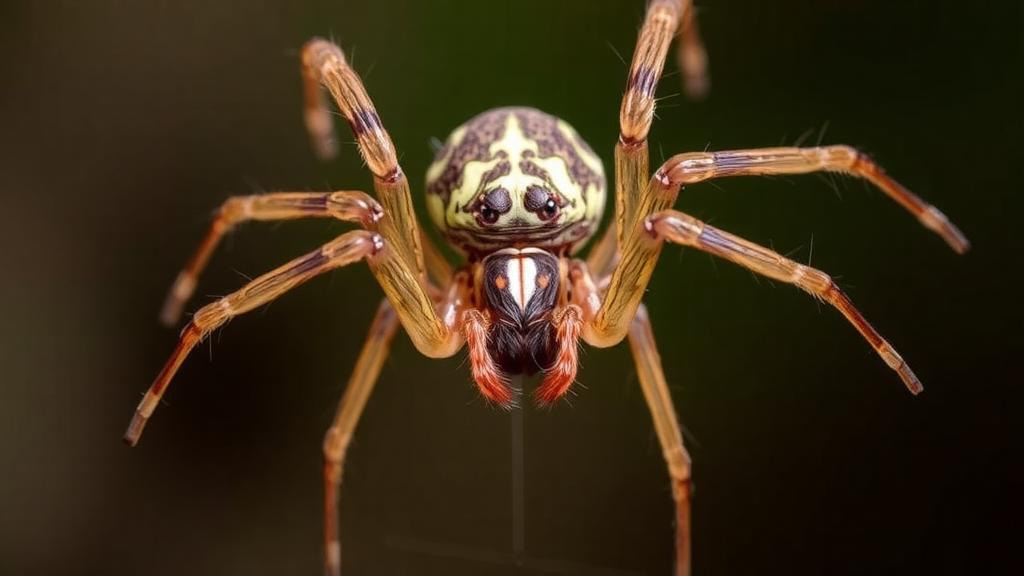
Deep in a deciduous forest near a small village outside Tbilisi, under a pile of roof tiles, a spider was quietly waiting to rewrite a chapter of arachnological history. A team working within the Caucasus Barcode of Life (CaBOL) project has described a new species of spiny-legged sac spider from Georgia, and in the process resurrected a genus name that had been buried under a 150-year-old taxonomic blunder. The new species, Drapeta caucasica, is the third member of a genus long considered to contain only a single species, and its discovery was first flagged not by morphology but by a snippet of DNA.
The family Liocranidae, to which the new species belongs, is a group of small to medium-sized ground hunters found across the globe, currently comprising 247 species in 36 genera. These spiders, often called spiny-legged sac spiders, roam forest floors and arid habitats alike, actively pursuing prey rather than building webs. Yet despite their ecological versatility, the family is a notorious puzzle for taxonomists. Because it lacks pronounced shared derived features, or synapomorphies, the precise boundaries of the family remain contested, and scholars have proposed strikingly different subfamily arrangements. Some recognize two subfamilies, Cybaeodinae and Liocraninae; others argue for a single subfamily, Oedignathinae, without further subdivision; and one team has even described an additional subfamily, Paratinae, based on the copulatory organs and body form of a particular genus. A recent survey of spider diversity in Central Asia even revealed features within the family unknown in all other spiders, underscoring how much remains to be learned.
In the Caucasus, the study of liocranids has been sparse. Until the beginning of the twenty-first century, a single species, Sagana rutilans, described in 1875, was the only representative known from the region, recorded from the Black Sea coast of Georgia at Batumi, Poti, Makhinjauri, and the Gumista Reserve, and from Khosta in Russia. Thanks to collecting efforts carried out largely within the CaBOL project, the local diversity has grown to nine species in six genera, most richly represented in Georgia. The new study raises the Georgian count further, reporting the first records of Apostenus cf. humilis and Liocranoeca spasskyi in the country, and bringing the number of Georgian liocranid species from two to eight, including the newly described species.
The story behind the genus name is a classic tale of taxonomic preoccupation. In 1875, the Swedish arachnologist Tord Torell established what he believed was a new spider genus and placed within it a species he named Sagana rutilans, along with another species, Drapeta aeneus, described by Menge in the same year. What Torell did not realize was that the name Sagana had already been used in 1855 for a genus of saturniid moths, currently placed within Copaxa. Because the same name cannot be used for two different animal genera, the spider name was invalid. Bertkau supported the synonymy in 1880, and the moth genus name took precedence. To resolve this homonymy, the authors of the new study have resurrected the older genus Drapeta, originally established by Menge in 1875, and transferred its type species, D. rutilans, along with D. concolor, into it as new combinations.
The new species itself, Drapeta caucasica, was first revealed through DNA barcoding of the mitochondrial COI gene. A single female from the vicinity of Kveda Agara Village in the Adjara region, originally identified as D. rutilans, produced a barcode that did not match any known species. This prompted a more detailed morphological examination, which confirmed that the specimen represented something new. Subsequent collecting near Telovani Village outside Tbilisi yielded both males and females, allowing a full description based on the male and female reproductive structures, the primary characters used to distinguish closely related spider species.
Morphologically, the male of the new species differs from its relative D. rutilans in a combination of features best viewed in retrolateral perspective. The retrolateral tegular apophysis, a sclerite on the male palp, is bifurcated rather than claw-shaped. The retrolateral tibial apophysis, a projection on the tibia of the palp, ends in a pointy tip rather than an oblique one. And the basal cymbial extension, a protrusion at the base of the cymbium, is more prominent than in the related species. Females can be separated from those of D. rutilans and D. concolor by more closely positioned copulatory ducts and an overall darker epigyne. The epigynal plate is semitransparent and triangular, with deeply cut lateral margins diverging posteriorly at an angle of roughly forty degrees, and the anterior pocket is wide with a medially protruding anterior margin, features that contrast with the shallower cuts and concave margins of the related species.
Barcoding results reinforce the distinctness of the new species. Two nearly identical COI barcodes were obtained from specimens from Telovani and Adjara, differing by a p-distance of only 0.46 percent, and were assigned to a single Barcode Index Number in the BOLD database. The nearest neighbor in the database is Sagana rutilans from Greece, with a mean p-distance of 8.36 percent, a substantial genetic gap that supports the morphological evidence for species status. The holotype male was collected in October 2023 in a deciduous forest at 888 meters elevation, under a pile of roof tiles, and several paratypes were collected at the same location across different seasons, including a juvenile reared to adulthood in the laboratory.
The discovery carries broader implications for the Caucasus fauna. Previous records of D. rutilans from the Black Sea coast of Georgia and Russia, published without diagnostic illustrations, most probably refer to the new species, given the strong resemblance of female habitus and copulatory organs and the fact that the genus was long considered monotypic. Re-examining and barcoding of previously recorded specimens is needed to validate these historical records. The authors note that the actual diversity of Liocranidae in the Caucasus is likely to increase further as new species are discovered and documented, particularly in remote and historically understudied areas, and that continued DNA barcoding combined with morphological scrutiny promises to reveal more hidden taxa in this enigmatic family of spiders.
Subject of Research: Zoology
Article Title: Notes on Liocranidae ( Arachnida , Araneae , Dionycha) from Georgia with description of a new species
Article References: Seropian, A., Bulbulashvili, N., & Krammer, H.-J. (2024). Notes on Liocranidae (Arachnida, Araneae, Dionycha) from Georgia with description of a new species. Caucasiana, 3, 171-181. https://doi.org/10.3897/caucasiana.3.e132725
Image Credits: AI Generated
DOI: 10.3897/caucasiana.3.e132725
Keywords: spiders, taxonomy, Georgia, Caucasus, DNA barcoding, new species, Liocranidae, Drapeta caucasica, Notes, Arachnida, Araneae, Dionycha
Cite Scienmag News
Margaret Porter. (October 17, 2026). Hidden Spider Species Uncovered in Georgia After 150-Year-Old Naming Mistake. Scienmag. https://scienmag.com/hidden-spider-species-uncovered-in-georgia-after-150-year-old-naming-mistake/
Margaret Porter. "Hidden Spider Species Uncovered in Georgia After 150-Year-Old Naming Mistake." Scienmag, 17 October 2026, https://scienmag.com/hidden-spider-species-uncovered-in-georgia-after-150-year-old-naming-mistake/. Accessed 17 October 2026.
Margaret Porter. "Hidden Spider Species Uncovered in Georgia After 150-Year-Old Naming Mistake." Scienmag. October 17, 2026. https://scienmag.com/hidden-spider-species-uncovered-in-georgia-after-150-year-old-naming-mistake/


