


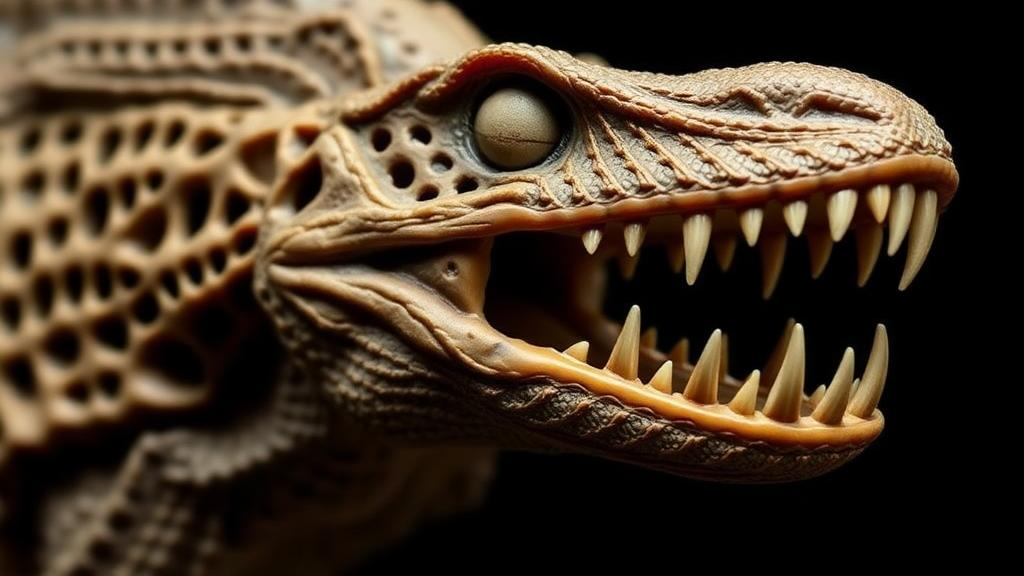
For more than three decades, a small, crushed fossil from Scotland has occupied a place of extraordinary importance in the story of vertebrate evolution. Known to paleontologists around the world by its affectionate nickname, Lizzie, the 345-million-year-old specimen of Westlothiana lizziae was long celebrated as one of the earliest known reptiles and frequently cited as a landmark in discussions of when and how amniotes—the group that includes reptiles, birds, and mammals—first conquered dry land. Now a new study, published in Nature and led by researchers at the American Museum of Natural History and the University of Oxford in collaboration with the European Synchrotron Radiation Facility, has dismantled that long-standing interpretation, revealing that the fossil belongs to a far more ancient lineage and lived a life spent largely in the water.
The story of Westlothiana began in 1984, when the fossil was discovered in Scotland embedded in two slabs of rock. When it was formally described in 1990, researchers could rely only on what was visible at the surface of the crushed specimen. Even so, the skeleton appeared remarkable: a nearly complete body with four limbs, ending in fingers and toes tipped with superficially claw-like structures. At a time when many of its contemporaries retained fin-like limbs better suited to swimming than walking, these features seemed to mark Westlothiana as a pioneer of terrestrial life. Its lizard-like appearance earned it the nickname Lizzie, and its five-toed hands and feet—a configuration familiar from modern mammals and reptiles—reinforced the impression that this was an animal adapted for life on land.
Because of those surface features, Westlothiana was widely treated as the earliest land-adapted amniote, and for nearly 30 years it served as a calibration point in debates about the origin and timing of the amniote lineage. Textbooks, phylogenetic analyses, and popular accounts of early land vertebrates repeatedly leaned on the Scottish fossil as evidence that reptile-like anatomy had emerged by the Early Carboniferous. The fossil, however, was deformed and notoriously difficult to interpret, and its status rested almost entirely on external anatomy that generations of researchers had never been able to examine from the inside.
That changed when a research team led by Xavier Jenkins, a postdoctoral fellow in the American Museum of Natural History’s Division of Paleontology, and Ben Igielman, who began the research during his graduate work at the University of Oxford, turned to high-resolution x-ray imaging. At the European Synchrotron Radiation Facility in Grenoble, France, the team used x-ray scanning to peer through the rock surrounding the specimen and reconstruct anatomical structures that had been invisible from the surface for four decades. The technique allowed the researchers to build a three-dimensional picture of the animal’s internal anatomy without damaging the fragile fossil, exposing features that would ultimately overturn its scientific identity.
What the scans revealed came as a profound shock. Inside the rock, the team found a surprisingly primitive skull, ossified internal gills, and a fish-like mouth lined with thousands of tiny teeth. Each of these features is incompatible with the interpretation of Westlothiana as a reptile or as any kind of amniote ancestor. Internal gills in particular point to an aquatic or amphibious lifestyle, while the primitive skull indicates that the animal belonged to a lineage far more ancient than the amniote stem. As Jenkins put it, Lizzie has been an icon for the early evolution of amniotes for decades, but once the researchers were finally able to see inside the fossil, they found an animal that looked very different from what anyone had expected.
Igielman emphasized just how deceptive the fossil’s outward appearance had been. The surprisingly primitive features of the skull, he noted, show that Lizzie was not only not a reptile but belonged to a much more ancient lineage altogether. In other words, the lizard-like silhouette that captivated paleontologists in 1990 masked an anatomy rooted deep in the tetrapod family tree, and the animal lived a completely different lifestyle than previously believed—one spent in and around water rather than striding across dry ground.
The implications extend well beyond the reclassification of a single specimen. The study concludes that several anatomical traits once assumed to be exclusive to land-adapted amniotes had, in fact, already evolved among earlier, more aquatic members of the stem lineage of tetrapods—the broader group of four-limbed animals that includes amniotes as well as amphibians. Claws and the five-toed foot structure of Westlothiana, long treated as hallmarks of terrestrial adaptation, now appear to have arisen piecemeal in animals that were still amphibious. Roger Benson, the Museum’s Macaulay Curator of Paleontology and a co-author of the study, described the result as a big surprise, noting that although amphibians are commonly thought of as more primitive than reptiles today, some of the traits associated with reptiles were already present in the ancestor of both groups.
The findings also carry weight for one of the most contentious questions in early vertebrate paleontology: the timing of the amniote origin. In recent years, fossil trackways—preserved impressions of animals walking on four limbs with claw-like digits—have been used to argue that amniotes originated during the Devonian Period, more than 359 million years ago. The logic seemed straightforward: clawed, weight-bearing tracks implied a clawed, land-adapted animal, and clawed, land-adapted animals were presumed to be amniotes. The new work breaks that chain of inference. If early tetrapod relatives such as Westlothiana also possessed claws, then the presence of clawed tracks alone can no longer establish that the track-maker was an amniote.
As a result, some ancient trackways previously attributed to early amniotes may instead have been produced by more primitive, amphibious members of the tetrapod lineage—animals that could walk on land but were not yet part of the reptile-mammal branch of the tree. Jenkins summarized the broader lesson: terrestrial-looking traits such as a reptile-like foot, a weight-bearing forelimb, and claw-like phalanges were not unique features of tetrapods but rather accumulated gradually in their close relatives, in animals that were still living in and out of the water. The evolutionary transition from fish to land vertebrate, in this view, was not a single dramatic leap marked by the sudden appearance of reptile-grade anatomy, but a long, mosaic process in which land-ready features appeared one by one in creatures still tied to aquatic environments.
The study, published in Nature, was a collaborative effort that included Jason Head of the University of Cambridge, Vincent Fernandez of the European Synchrotron Radiation Facility, Lucy Roberts of the Natural History Museum in London, and Timothy Smithson of the University Museum of Zoology Cambridge. Support came from the National Science Foundation, the Natural Environment Research Council, and the Biotechnology and Biological Sciences Research Council. For paleontologists, the dethroning of Westlothiana is a reminder of how much remains hidden inside even the most famous fossils—and of how modern imaging technology can rewrite chapters of evolutionary history that seemed settled for generations. Lizzie may no longer be the world’s oldest reptile, but in revealing that claws and five-toed feet evolved before the first amniotes ever walked the Earth, the Scottish fossil may ultimately prove even more valuable to science than it was before.
Subject of Research: Reclassification of the 345-million-year-old Westlothiana lizziae fossil from Scotland as an aquatic stem tetrapod rather than the earliest known reptile, based on synchrotron x-ray imaging
Article Title: Fossil long known as world’s oldest reptile dethroned
Article References: Fossil long known as world’s oldest reptile dethroned. (n.d.). Original publication
Image Credits: AI Generated
DOI: Not provided
Keywords: Westlothiana, paleontology, amniotes, tetrapods, synchrotron imaging, Carboniferous, early reptiles, fossil trackways, evolution, Scotland, Nature study, aquatic adaptation
Cite Scienmag News
Gavin Prescott. (October 1, 2026). Hidden gills and fish-like teeth dethrone Scotland’s famed oldest reptile fossil. Scienmag. https://scienmag.com/hidden-gills-and-fish-like-teeth-dethrone-scotlands-famed-oldest-reptile-fossil/
Gavin Prescott. "Hidden gills and fish-like teeth dethrone Scotland’s famed oldest reptile fossil." Scienmag, 1 October 2026, https://scienmag.com/hidden-gills-and-fish-like-teeth-dethrone-scotlands-famed-oldest-reptile-fossil/. Accessed 4 October 2026.
Gavin Prescott. "Hidden gills and fish-like teeth dethrone Scotland’s famed oldest reptile fossil." Scienmag. October 1, 2026. https://scienmag.com/hidden-gills-and-fish-like-teeth-dethrone-scotlands-famed-oldest-reptile-fossil/


